
Semantic Search in P2P Networks: Moving Beyond Keyword Matching
Semantic-based query routing in P2P social networks
This paper introduces a hierarchical semantic-based query routing strategy for P2P social networks. By combining the Vector Space Model (VSM) for peer clustering and a Chord-based structured overlay for super-peer communication, the system achieves significantly higher search efficiency and lower maintenance costs than standard Chord protocols.
TL;DR
In the world of Peer-to-Peer (P2P) social networks, finding the right file is like finding a needle in a haystack. This paper presents a hybrid routing strategy that groups "like-minded" peers into semantic communities using the Vector Space Model (VSM). By combining the flexibility of unstructured communities with the elite efficiency of a Chord-based super-peer backbone, the authors slashed query latency by nearly 44% and maintenance traffic by 70%.
The "Semantic Blindness" Problem
Traditional P2P networks face a dilemma. Unstructured networks (like Gnutella) are great for flexible searching but drown in "flooding" traffic. Structured networks (like Chord using Distributed Hash Tables) are incredibly efficient but are "semantically blind"—they typically only support exact key matches. If you search for "Artificial Intelligence," a standard DHT might fail to find a document labeled "Machine Learning" because the hash keys don't match, even though the meanings are nearly identical.
The authors argue that a P2P social network should behave like a human society: people with similar interests should stick together to find information faster.
Methodology: The Hybrid Architecture
The core innovation lies in a two-tier system that bridges the gap between semantics and structure.
1. VSM and Peer Vectors
Every peer is assigned a Peer Feature Vector. Using TF*IDF (Term Frequency-Inverse Document Frequency), the system calculates weights for keywords in a peer's shared documents.
- Insight: If two peers have vectors with a small cosine angle between them, they are semantically related and should belong to the same "Community."
2. Hierarchical Topology
- Ordinary Peers: Form local, unstructured clusters based on semantic similarity.
- Super Peers: The most "powerful" nodes (high bandwidth, high uptime) act as community leaders. These super-peers join a Chord ring, creating a high-speed highway for global queries.
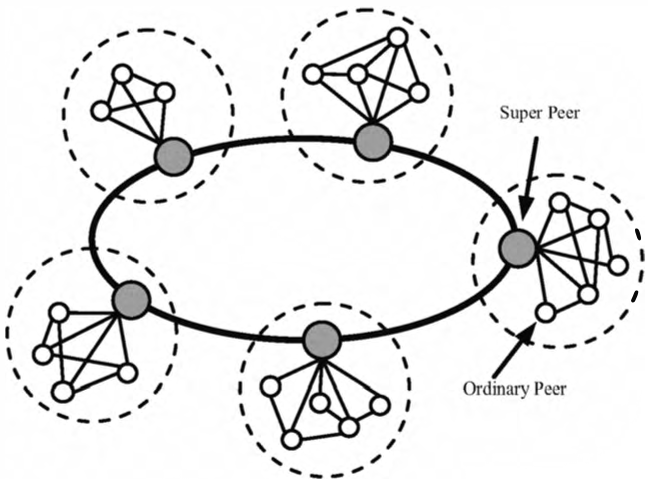 Figure 1: The dual-layer model showing semantic clusters connected via a structured Ring.
3. Global Inverted Index & Bloom Filters
To handle multi-keyword queries without massive data transfers, the authors use Bloom Filters. This allows a super-peer to quickly check if a community contains a set of keywords through a compressed bit array, preventing unnecessary routing hops.
Performance Benchmarks
The authors tested their system against the standard Chord protocol using a massive dataset of 1.12 million web pages across 6,000 peers.
Query Efficiency
Because semantically similar data is localized, the "hop count" (the number of nodes a query must visit) grows much slower than in standard Chord. The average latency was reduced to just 56.1% of Chord's.
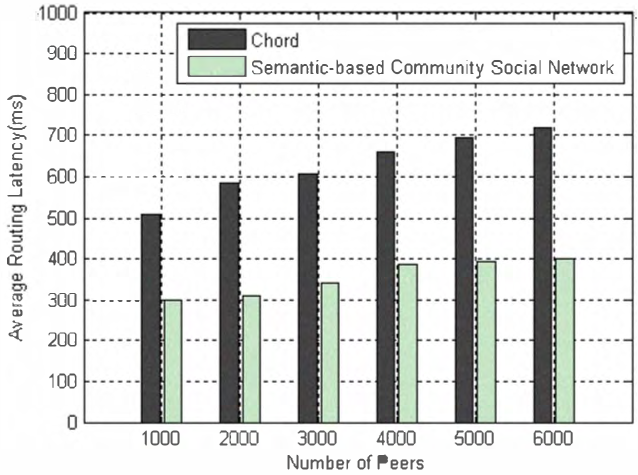 Figure 2: Performance comparison showing the drastic reduction in latency as the network scales.
Maintenance Cost
P2P networks are "churny"—nodes join and leave constantly. In a typical DHT, every "churn" event triggers multiple update messages. However, by grouping stable nodes as super-peers and managing most peer movements within the community, the maintenance traffic dropped by 70%.
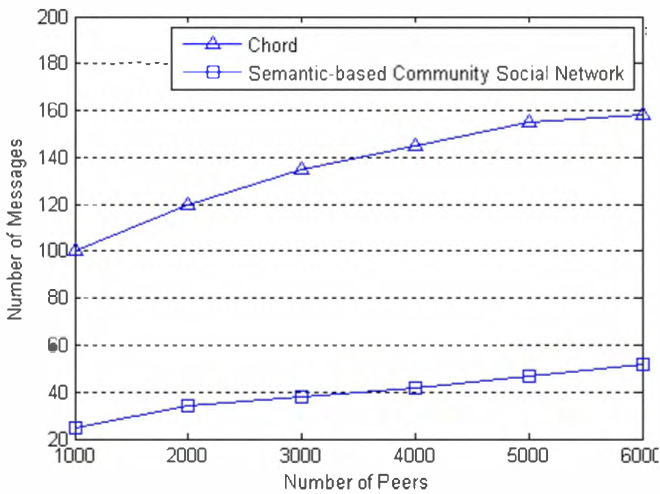 Figure 3: Message overhead comparison; notice the widening gap as the number of peers increases.
Critical Insight & Conclusion
This work highlights that Inductive Bias—the assumption that similar content is likely stored by similar users—is a powerful tool for network optimization. By embedding semantic intelligence into the routing layer, the paper effectively transforms a random graph into a "Small World" network where information is always just a few hops away.
Limitations: The model assumes that a peer's shared documents are semantically homogeneous. In reality, a user might share both "Physics papers" and "Cooking recipes," which could dilute the Peer Vector's accuracy. Future iterations might require "Multi-Interest" vectors to further refine routing.