
MS^2N: Bridging Semantics and Multimodality in Social Hypergraphs
A Semantic-Based Strategy to Model Multimedia Social Networks
The paper introduces the Multimedia Semantic Social Network () model, a high-level formal framework that integrates property graphs and hypergraph structures to represent the multidimensional nature of social interactions. It utilizes a semantic-based strategy to bridge the gap between low-level multimedia features and high-level conceptual meanings, implemented via GraphDB (Neo4j).
TL;DR
The explosion of Big Data in Online Social Networks (OSNs) has turned simple text-based interactions into complex, multimodal experiences. This paper proposes the Multimedia Semantic Social Network (), a formal model that treats social networks not just as simple graphs, but as weighted hypergraphs where users, multimedia objects, and abstract concepts are semantically intertwined. By bridging the gap between raw pixels and ontological meanings, the authors provide a scalable architecture for intelligent information retrieval in domains like cultural heritage.
Problem & Motivation: Beyond the Simple Link
Traditional Online Social Networks are typically modeled as simple graphs: nodes are users, and edges are "follows" or "friends." However, the modern digital landscape is dominated by the 5Vs of Big Data (Volume, Velocity, Variety, Veracity, and Value).
Existing approaches suffer from two major flaws:
- Application Silos: Most methodologies are application-oriented, dealing only with specific facets like privacy or user status, failing to provide a generalized data model.
- The Semantic Gap: There is a profound disconnect between "low-level" features (like the edge histograms of an image) and the "high-level" concepts they represent (e.g., a specific painting in a museum).
The authors' intuition was to move toward a hypergraph structure, allowing a single relationship (a hyperarc) to connect multiple entities, such as a user tagging another user and a specific concept within a photo simultaneously.
Methodology: The MS^2N Architecture
The core of the model lies in its tripartite node structure and categorized relationships.
1. The Hubs (Node Types)
- Users (U): Entities like people, institutions, or bots.
- Concepts (C): Abstract meanings (e.g., "Naples," "Impressionism").
- Multimedia (M): Physical signs like images, videos, or posts.
2. Weighted Semantic Hyperarcs
Instead of binary links, the model uses weighted edges to express the strength of a relationship. These are categorized into Social, Similarity, and Semantic-Linguistic layers. For instance, a "Concept-to-Concept" link might represent Hyponymy (a more specific term), while a "Multimedia-to-Multimedia" link represents Content Similarity.
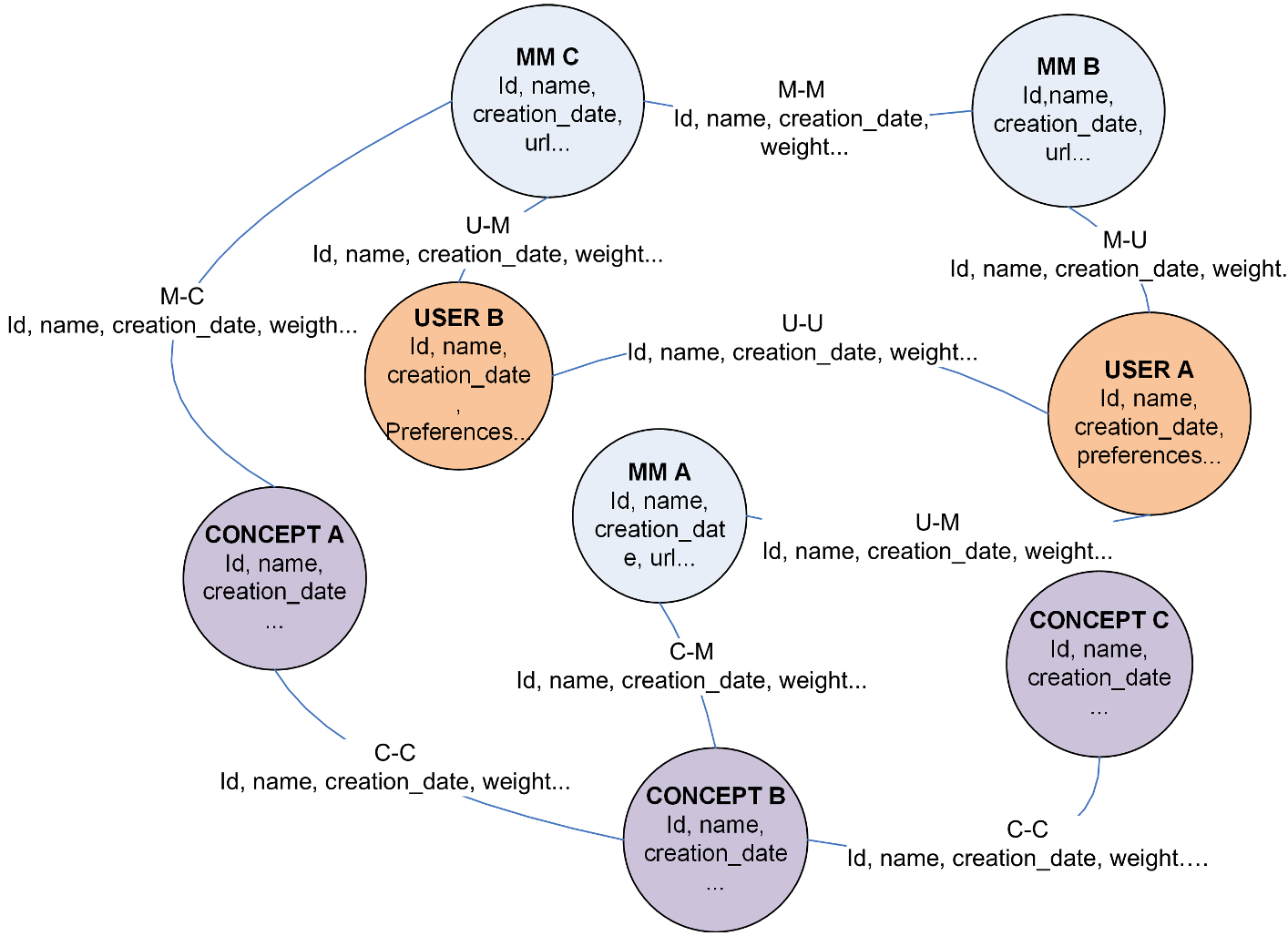 Fig 1: The MS^2N Model showing the interplay between Users, Concepts, and Multimedia objects.
3. Feature Integration
To make the "Multimedia" nodes functional, the authors store global descriptors directly within the graph:
- PHOG (Pyramid Histogram of Orientation Gradients): Captures local shape.
- JCD (Joint Composite Descriptor): Combines color and texture.
- Auto Color Correlogram: Maps spatial correlation of colors.
Experiments: Cultural Heritage Case Study
The authors implemented the model using Neo4j, a graph-based NoSQL database, and tested it on a cultural heritage dataset. By using the Cypher query language, they demonstrated how the model powers advanced functionalities:
- Trending Places: Identifying concepts (places) with the highest density of 'like' hyperarcs.
- Cross-Modal Recommendations: Recommending a new museum (Concept) to a user based on the visual similarity (Multimedia link) of paintings they previously posted.
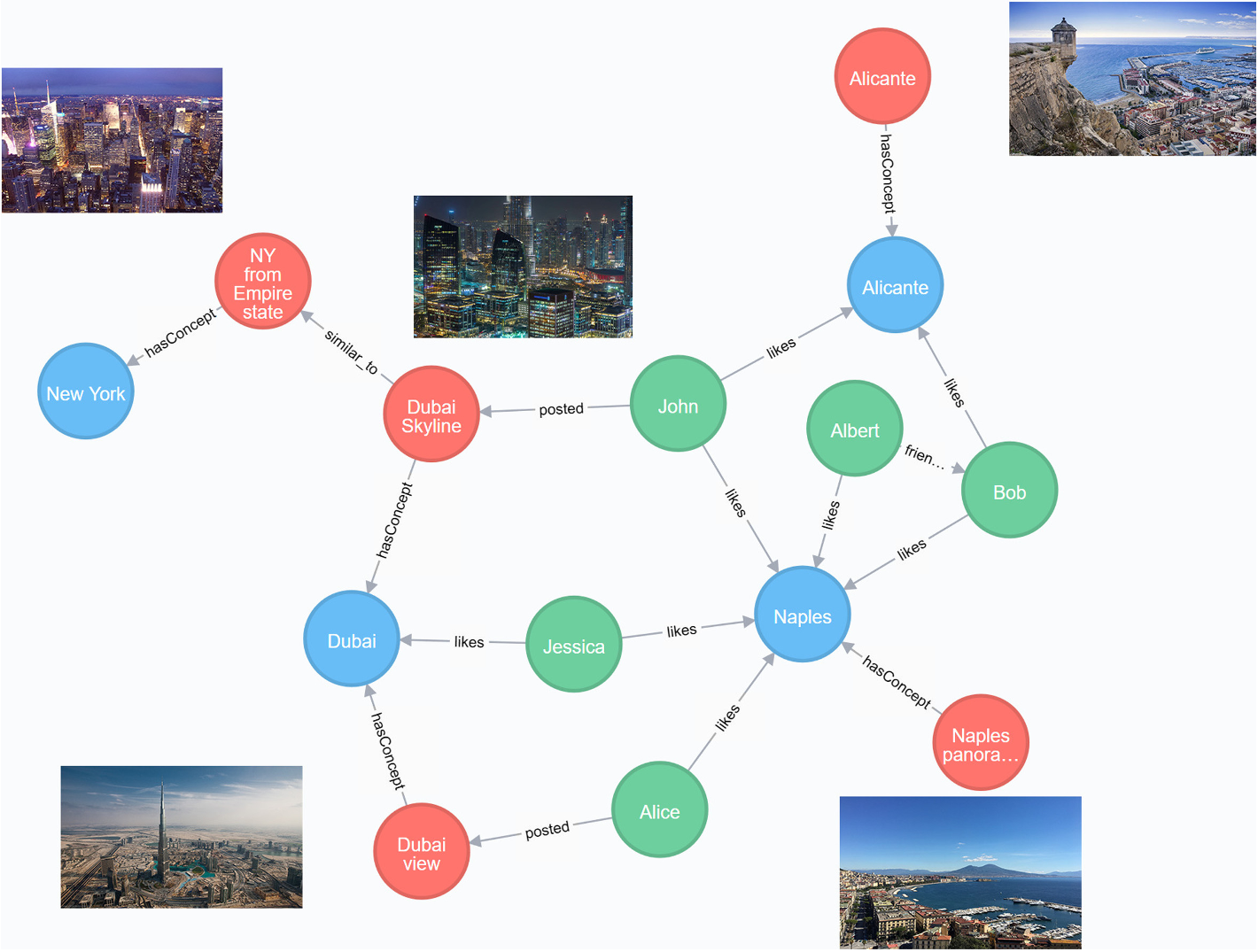 Fig 2: A slice of the Neo4j GraphDB showing "Albert" connected to "Naples" and similar imagery of "Dubai" and "New York".
Critical Analysis & Conclusion
The model succeeds in creating a highly abstract yet functionally rigorous framework. Its primary strength is extensibility; by anchoring social interactions to an upper ontology, it can adapt to any domain—from emergency signaling to product reviews.
Limitations: While the use of global descriptors (like JCD) is efficient for storage and speed, they are less robust than modern Deep Features (e.g., CLIP embeddings) regarding lighting conditions and scale. Future iterations of MS^2N would benefit from integrating latent vector representations from Foundation Models into the Hypergraph weights.
Takeaway: moves us closer to a "Sentient Social Network" where the system understands not just who is talking, but what they are sharing and why it matters in a broader semantic context.