
Beyond Word Frequency: Enhancing Category Recommendation via Folksonomy-Driven LDA
A Semantic Category Recommendation System Exploiting LDA Clustering Algorithm and Social Folksonomy
This paper introduces a semantic category recommendation system that combines LDA (Latent Dirichlet Allocation) clustering with social folksonomy to enhance automatic data categorization. The core contribution lies in a dual-phase approach: extreme dimensionality reduction during pre-processing and the use of external knowledge bases (like WordNet/Flickr) to map abstract clusters to human-readable semantic categories.
TL;DR
This study tackles the inefficiency of automatic category generation by introducing a workflow that slashes vector dimensions by 50% and uses external social folksonomies (like WordNet) to bridge the gap between "statistical clusters" and "human logic." The result is a faster, more intuitive recommendation system for large-scale SNS data.
Background & Motivation: The Gap in Sentiment and Statistics
In the era of Social Network Services (SNS), we are drowning in data but starving for organization. While clustering algorithms like Latent Dirichlet Allocation (LDA) are the industry standard for grouping similar documents, they face a critical "Interpretability Gap."
Most clustering outputs are just lists of keywords. If a cluster contains "Handball, Hockey, and Racing," a machine sees statistical proximity; however, a human sees the category "Sports." The authors argue that current systems fail because they don't have the contextual bridge to translate word frequencies into semantic hierarchies. Furthermore, the high dimensionality of text vectors makes these systems sluggish on large datasets.
Methodology: Pruning and Grounding
The authors propose a robust two-pillar approach to solve these bottlenecks.
1. Radical Dimensionality Reduction
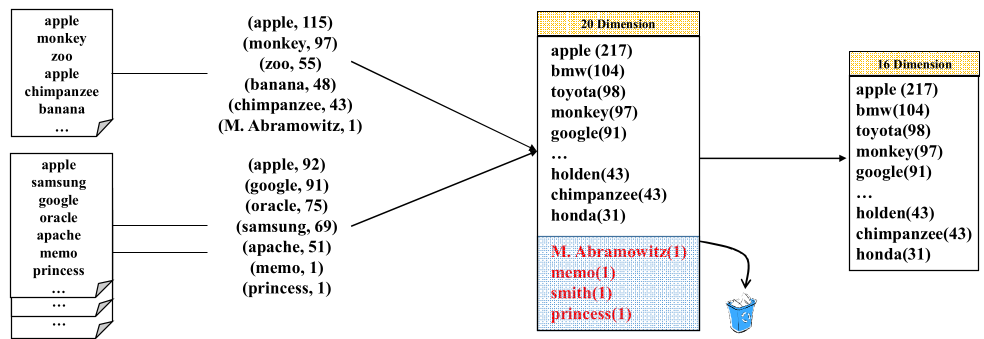
To combat computational complexity, the system implements a strict pre-processing filter. Beyond standard stop-word removal, the authors identify that words appearing in only one document or less than five times throughout the corpus often constitute over 50% of the vector space without contributing to thematic coherence. By pruning these, they achieve a massive reduction in the sparse matrix size.
2. Semantic Latent Topic Extraction
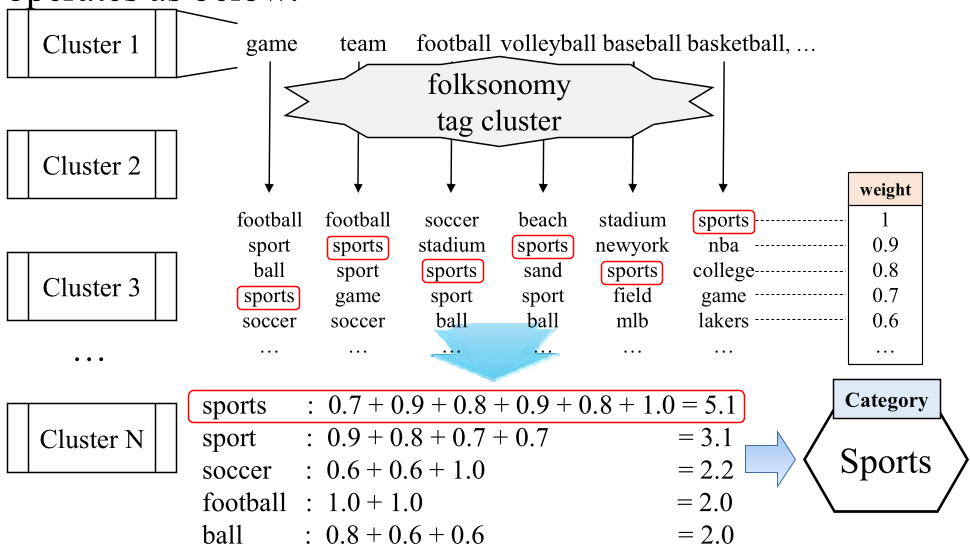
The most innovative part of the paper is the integration of Social Folksonomy. After LDA groups the documents, the system doesn't just pick the top word. Instead:
- It queries folksonomies (like WordNet or Flickr tags) to find hypernyms or related concepts for the cluster's top words.
- It applies a Reciprocal Weighting Scheme: Words are scored (1.0, 0.9, 0.8...) based on their position and semantic relevance.
- The word with the highest aggregate score is selected as the recommended category label.
Experimental Validation
Using a dataset of 50,000 newspaper articles, the authors used the MALLET toolkit to perform LDA with 5 topics and 200 iterations.
Performance Improvement
The contrast in processing time between the "Raw" approach and the "Pre-processed" approach was stark. By removing the low-frequency "noise," the LDA iteration speed increased, allowing for better scalability in big data environments.
Qualitative Accuracy
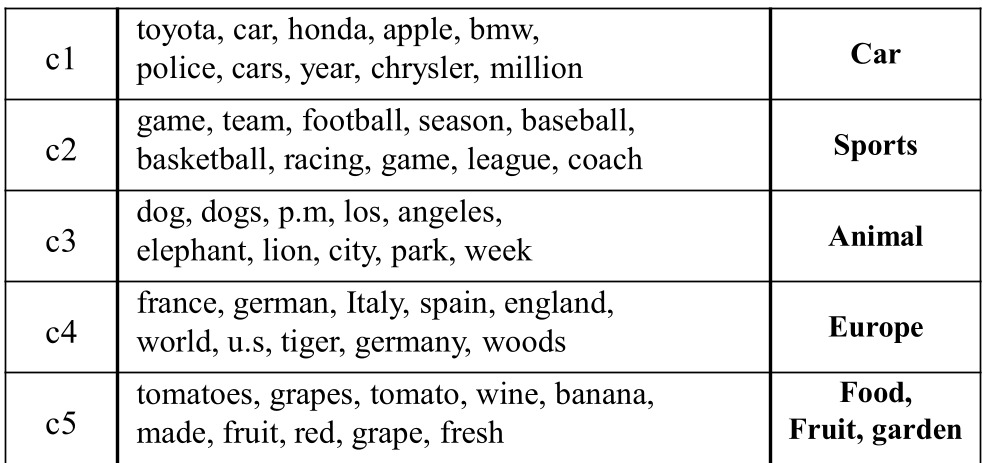
The table below showcases how the system successfully identified abstract categories that were not necessarily the most frequent single word but were the most semantically representative.
| Cluster Keywords | Extracted Category |
|---|---|
| toyota, car, honda, bmw, chrysler | Car |
| game, team, football, racing, league | Sports |
| france, spain, england, germany | Europe |
| tomatoes, wine, banana, grape, fruit | Food, Fruit |
Critical Insight & Future Outlook
The primary takeaway of this work is that unsupervised learning needs external anchors. A purely mathematical approach to text will always struggle with the nuance of human language. By tethering LDA to a folksonomy, the authors have provided a blueprint for more "human-centric" AI.
Limitations: The system's performance is strictly bounded by the quality of the external folksonomy used. If the knowledge base is outdated or lacks domain-specific jargon (e.g., specific tech terms or slang), the category recommendation may revert to generic or inaccurate labels. Future research should look into dynamic, self-updating knowledge graphs to keep pace with evolving language on social media.
Conclusion
This study effectively demonstrates that removing "the long tail" of infrequent words doesn't just save memory—it clears the path for clearer semantic labeling. By combining efficient pre-processing with social intelligence, we move one step closer to truly automated, intelligent information curation.