
Beyond Basic Sensing: Mastering Context Reasoning via Ontologies
Semantic Context Reasoning Using Ontology Based Models
This paper presents a Semantic Context Interpreter for pervasive computing, utilizing OWL-based ontologies and the Jena framework. It enables mobile applications to perform dynamic context reasoning and adaptation by inferring new knowledge from existing environmental data and user preferences.
TL;DR
In the world of pervasive computing, "gathering data" isn't enough—the system must "understand" the environment. This paper introduces an Ontology-Based Context Interpreter that uses formal logic to transform raw sensor data into meaningful actions. By leveraging OWL and the Jena framework, the authors provide a blueprint for mobile applications that adapt not just to where you are, but to what your surroundings mean.
The "Why": Why Simple Context Isn't Enough
Early context-aware systems relied on primitive structures like key-value pairs or simple object-oriented models. While these work for "If temperature > 30, turn on AC," they fail in complex, heterogeneous environments.
The Problem:
- Ambiguity: Different sensors might describe the same event in incompatible formats.
- Lack of Inference: Most models can't "connect the dots" (e.g., if a user is in a "Theater" and a "Movie" is playing, they are in a "Do Not Disturb" state).
- Rigidity: Changing a domain rule often requires rewriting the entire application logic.
The authors argue that Ontologies provide the necessary logic-based characterization to solve these issues, enabling shared knowledge and reusable reasoning across different platforms.
Methodology: The Architecture of Intelligence
The proposed Context Interpreter is a sophisticated engine composed of five core modules that interact with a domain ontology.
The Core Components
- Knowledge Database: Stores the "DNA" of the application logic—if-then rules and known facts.
- Inference Engine: The brain. It uses the Jena Semantic Web Framework to combine facts with rules to derive new knowledge.
- Query Engine: Uses RDQL (Resource Description Query Language) to let applications ask, "What is the current state of the world?"
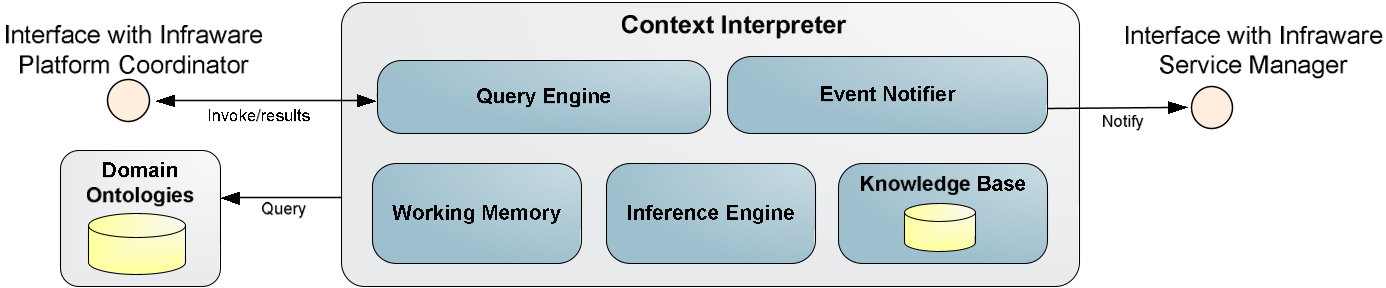 Figure 1: The conceptual architecture of the Context Interpreter, showing the flow from ontology definition to active inference.
The system uses Generic Rule Language (GRL). A rule doesn't just check a value; it evaluates a triple (Subject-Predicate-Object) to ensure semantic consistency.
Experimental Validation: The Tourism Use-Case
To prove the system's worth, the authors developed a tourism application. The challenge: helping a tourist in a new city while respecting their device's limitations and personal interests.
1. Intelligent Adaptation
If the system detects a user at a "Point of Interest," it checks their device type.
- Rule A: If
Device == MobilePhone, send a concise SMS. - Rule B: If
Device == SmartPhone, send a rich MMS.
2. Semantic Discovery
Using RDQL, the application can perform complex queries like finding activities that match the user’s "Nature" and "Sport" preferences without hard-coding every possibility.
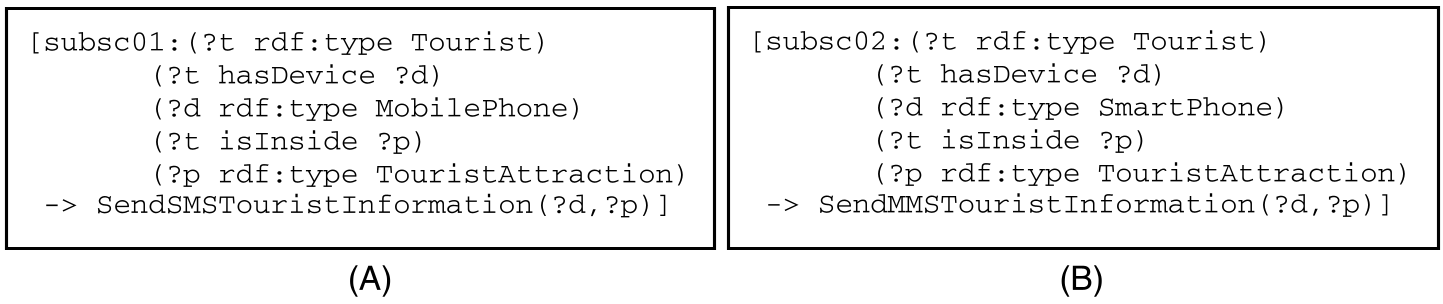 Figure 2: Example of different content delivery formats (SMS vs. MMS) inferred based on the device context.
Critical Insight & Conclusion
The true value of this work lies in separating policy from mechanism. By moving the logic into an ontology:
- Portability increases: The same reasoning engine can work for a Smart Home or a Smart City by simply swapping the OWL file.
- Extensibility is built-in: Adding a new "User Preference" doesn't break the existing notification service.
Future Outlook
While the paper successfully addresses semantic consistency, the authors acknowledge the next frontier: Quality of Context (QoC). In a world of unreliable sensors, the engine must not only reason about context but also about how "trustworthy" that context is. As we move toward 2026 and beyond, the integration of these symbolic reasoning systems with probabilistic AI (like LLMs) will likely be the key to truly "intelligent" pervasive environments.