
From Raw Sensors to Health Wisdom: The MyHealthAvatar Semantic Lifting Framework
Semantic lifting and reasoning on the personalised activity big data repository for healthcare research
The paper presents a comprehensive semantic architecture, developed within the EU-funded MyHealthAvatar project, to integrate and reason over heterogeneous health data from wearable sensors and mobile apps. It utilizes a hybrid NoSQL and RDF cloud-based repository to achieve scalable knowledge discovery and personalized lifestyle summarization.
TL;DR
The explosion of wearable tech has left us "data rich but knowledge poor." This paper introduces a sophisticated framework that takes messy data from devices like Fitbit and Withings, filters it through significant event mining, and "lifts" it into a semantic cloud. By using the MHA H-event Ontology, the system can automatically reason that a user’s 2-hour commute or lack of exercise poses a specific health risk, transforming raw numbers into actionable medical intelligence.
The "Data Silo" Problem in Digital Health
Self-monitoring is booming, but your heart rate data and your step counts often live in separate digital universes. Managing this "Big Data" is hard because:
- Heterogeneity: Every device exports data in different formats.
- Noise: Sensors record every minor movement, even when you're just shifting in your seat.
- Lack of Context: A "140/90 blood pressure" reading is just a pair of numbers until it's semantically linked to a "Hypertension" risk profile.
Methodology: The Engineering of Meaning
The authors solve this through a multi-layered approach that bridges the gap between raw storage and logical reasoning.
1. The Hybrid Storage Strategy
The system uses NoSQL (Column-family) for high-speed, scalable data ingestion and RDF (Triple Stores) for high-level knowledge representation. This balances the need for "Big Data" speed with "Smart Data" logic.
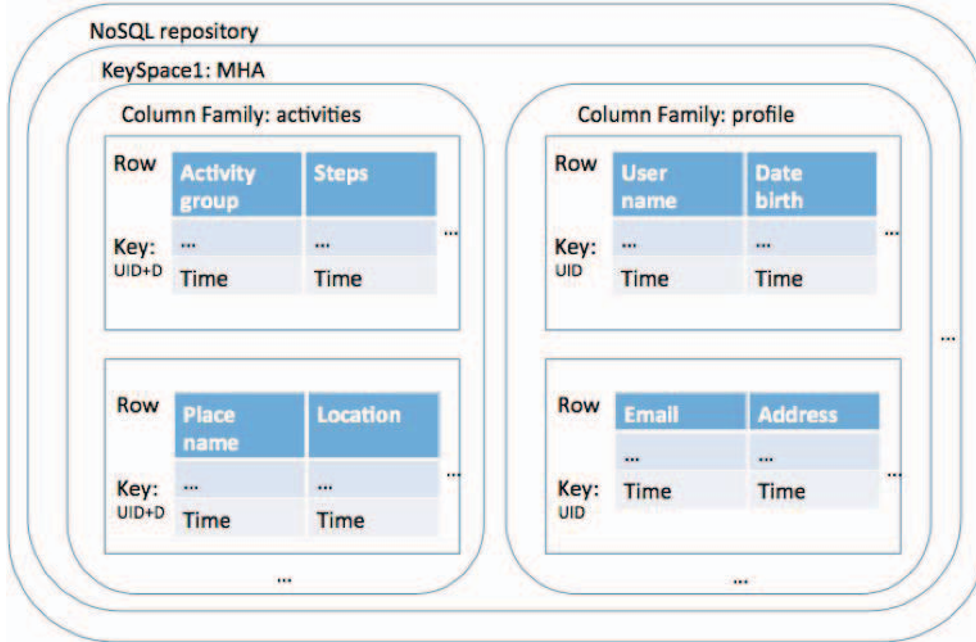 The NoSQL layer organizes heterogeneous data into specific column families like 'activities' and 'profiles'.
2. Significant Event Mining
Instead of uploading every single GPS coordinate, the system calculates a Significant Level of Activity (SLAi).
- Formula:
- The Logic: A 30-minute run at a gym is "lifted" as a significant event, while a 2-minute walk to the fridge is filtered out as noise.
3. Semantic Lifting and the H-Event Ontology
Once an event is deemed significant, it is mapped to the MHA H-event Ontology. This ontology acts as the "Rosetta Stone," connecting daily activities to established medical terminologies like SNOMED CT.
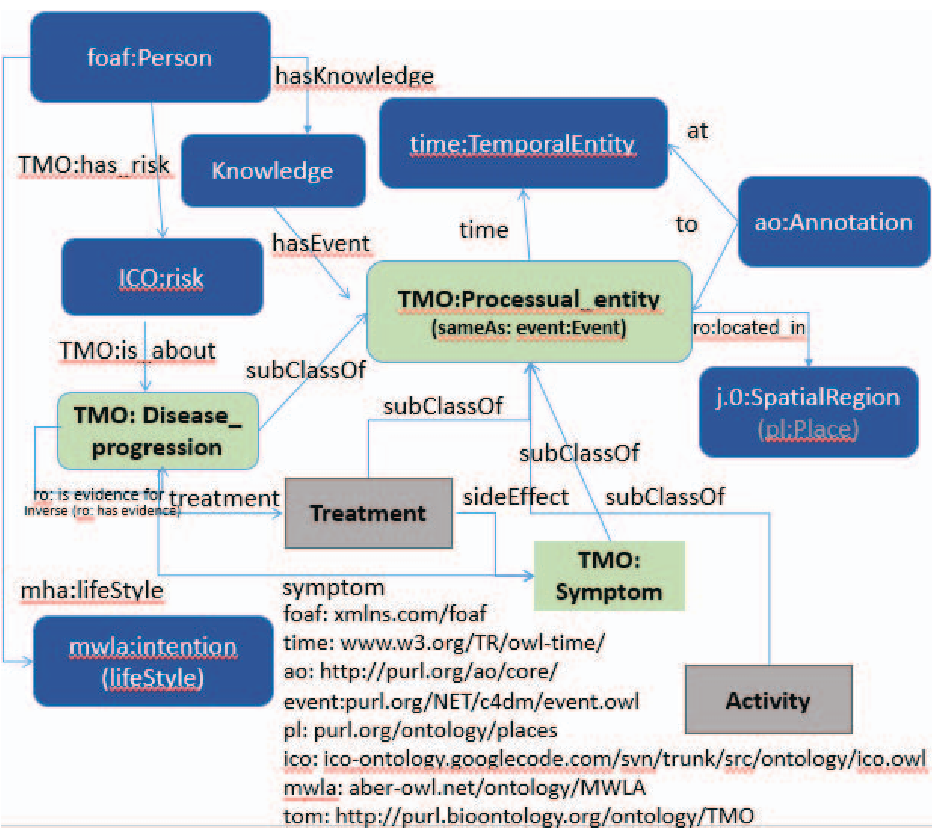 The core ontology centers on the 'Event' concept, linking Symptoms, Treatments, and Lifestyles.
Experiments: Reasoning the Future
The real power lies in Semantic Reasoning. Using Jena and SWRL (Semantic Web Rule Language), the system can run "if-then" logic across the entire data history.
Example Case:
- Input: User is over 60 years old + User has "No Activity" lifestyle detected in the last month.
- Reasoning: The system triggers a
High_Blood_Pressurerisk alarm.
By using SPARQL queries, the system can summarize a whole month of behavior into a single "Traveler" or "Sedentary" lifestyle tag, which is far more useful to a doctor than a spreadsheet of a million data points.
Critical Insight & Conclusion
The MyHealthAvatar framework moves beyond mere "lifelogging." Its true value is in Semantic Abstraction. By filtering noise at the NoSQL level and performing logic at the RDF level, it proves that semantic technologies are not just academic exercises—they are essential for making sense of the IoT-driven healthcare future.
Limitations: While the event mining is robust, the weights () are currently heuristic. Future iterations could use machine learning to personalize these weights based on a user's specific medical history.
Takeaway: This work demonstrates that the next frontier of health-tech isn't more sensors—it's better reasoning layers that understand what those sensors are trying to tell us.