
Harmonizing Digital Democracy: A Semantic Ontology for e-Participation
A semantic model for e-Participation - detailed conceptualization and ontology
This paper presents a comprehensive conceptualization and formal ontology for e-Participation, integrating government-led and citizen-led initiatives. It introduces an executable RDF-based semantic model that bridges fragmented existing frameworks to enhance interoperability and descriptive consistency in digital democracy.
TL;DR
Despite a decade of research, e-Participation remains a fragmented field with siloed models. This paper introduces the first comprehensive e-Participation Ontology, built on RDF/OWL, which unifies three critical perspectives: the Democratic Process, the Project, and the Sociotechnical Platform. It uniquely supports the "Duality of e-Participation"—acknowledging that modern democracy happens both in town halls and on Social Media.
The Problem: A Fragmented Democratic Space
Prior work in e-Participation has produced numerous frameworks (e.g., Macintosh’s Levels of Participation, the Behavior Chain Model), but these models often talk past each other. This lack of a shared "language" (ontology) makes it impossible to:
- Compare the effectiveness of different e-Participation initiatives.
- Integrate spontaneous citizen discussions on Social Media into formal policy-making.
- Automate the analysis of civic engagement data.
The authors argue that for digital democracy to be sustainable, it must bridge the gap between Government-led (formal, structured) and Citizen-led (spontaneous, social) participation.
Methodology: Structuration and Dynamic Capabilities
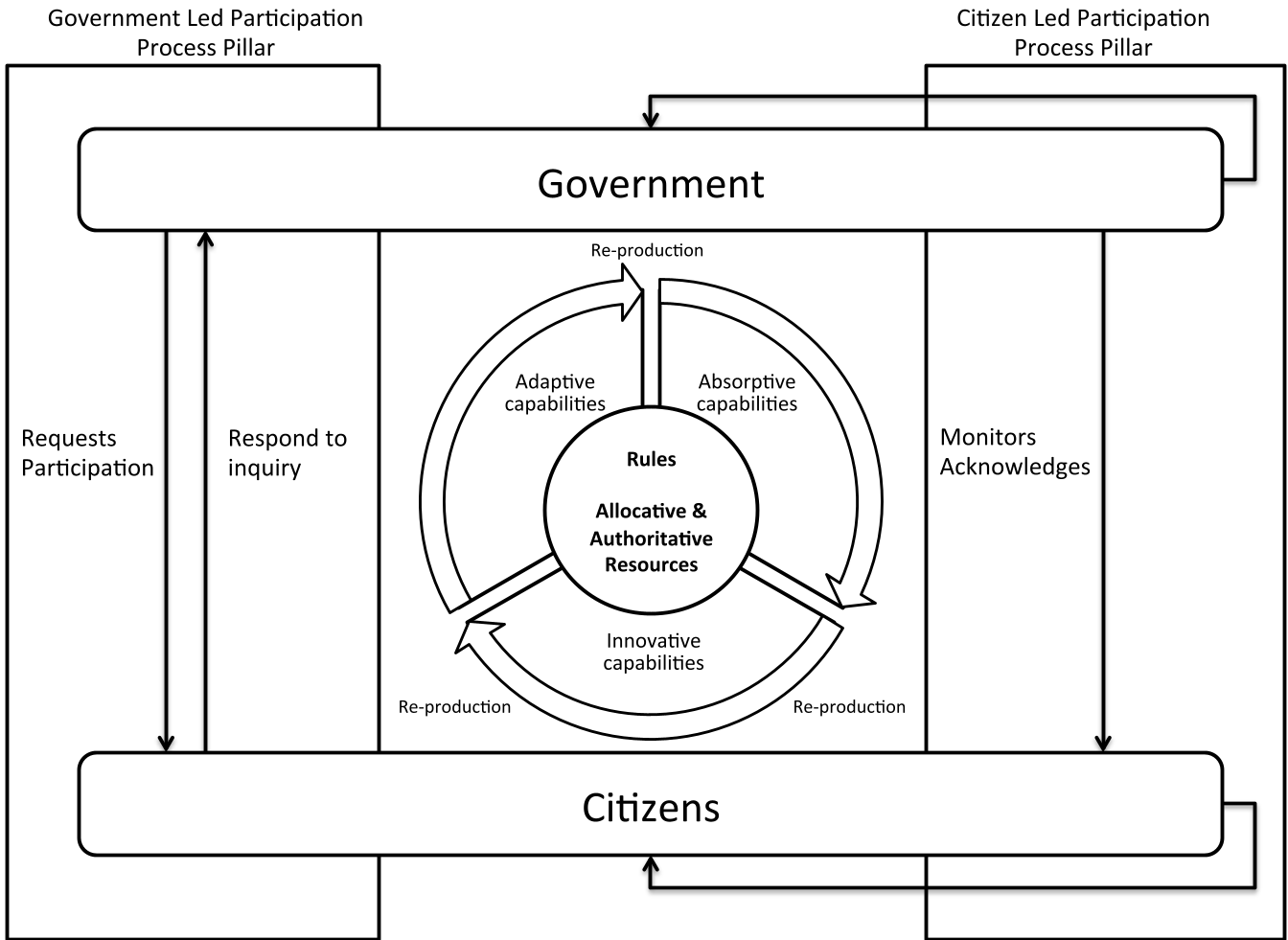
The authors don't just build a technical schema; they ground it in Structuration Theory, which looks at how social systems are reproduced via the interaction of "agency" (citizens) and "structures" (rules/policies).
By applying Pepper's World Hypotheses—Formism (entities), Mechanism (processes), Organicism (goals), and Contextualism (evaluation)—they derived "Competency Questions" to ensure the ontology covers every vital aspect of the domain.
The Core: The Integrated Model for e-Participation (IMeP)
The proposed IMeP architecture (shown below) distinguishes between adaptive, absorptive, and innovative capabilities. It treats the democratic process as a reflexive dialogue where Social Media monitoring is not just an "add-on" but a core part of the system's "absorptive capacity."
The resulting ontology translates these high-level concepts into RDF/OWL classes. For instance, a "Stakeholder" is linked to a "Project," which is linked to a "Democratic Process," which is facilitated by a "Platform" containing specific "Tools."
Experimental Results: Real-World Deployment
The authors validated the ontology by mapping two distinct initiatives:
- Galway Transportation Forum: A local initiative where the ontology helped categorize actors (e.g., the Mayor as a 'Decision Maker') and dissemination channels (Local Press, Radio).
- PuzzledByPolicy (EU Level): A multinational project on immigration policy where the ontology structured complex goals and domain-specific topics across different cultures.
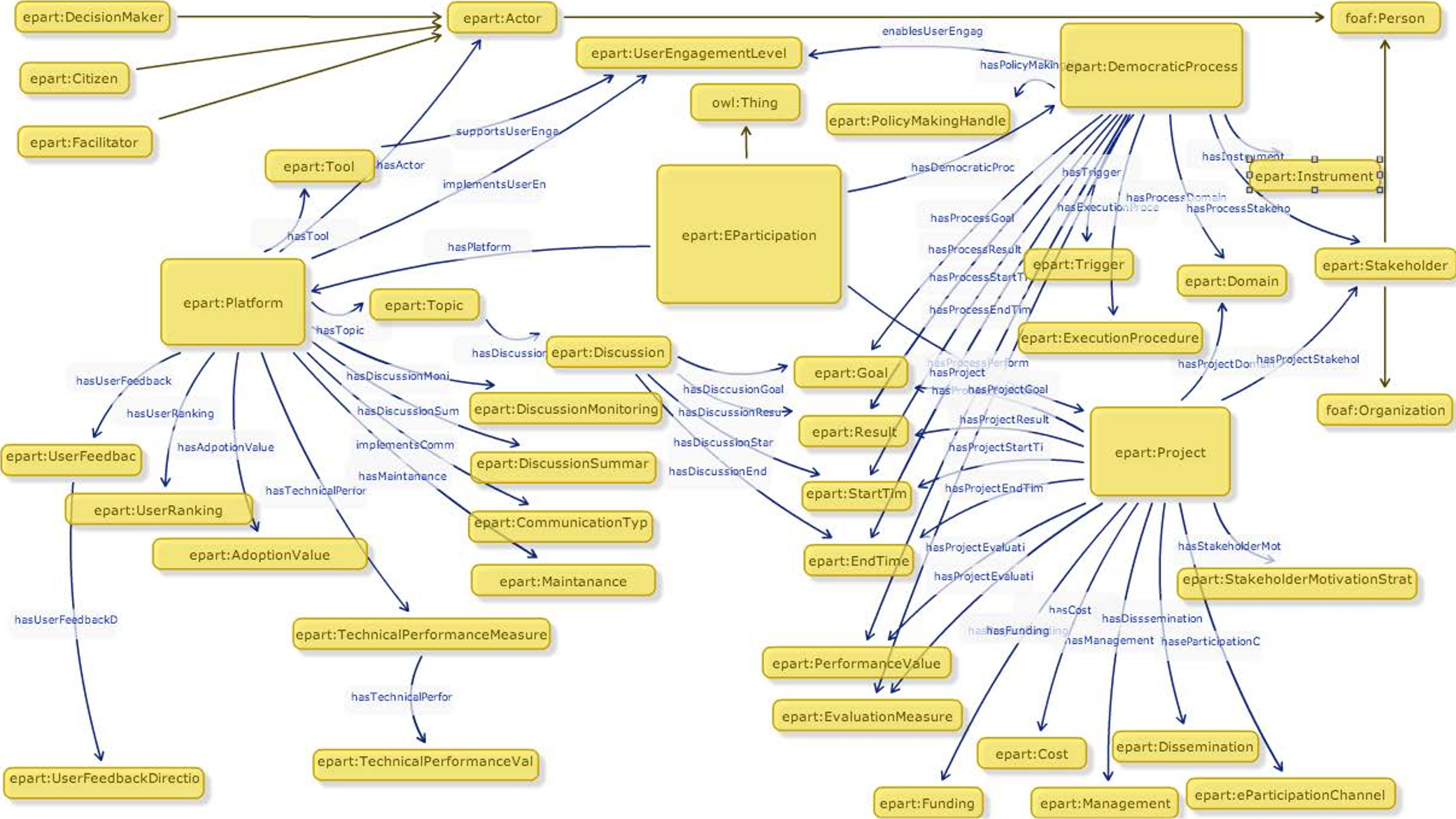
The use of Protégé and SPARQL endpoints allows this information to be exposed as "Open Data," enabling researchers to query the status of democratic projects across borders.
Critical Analysis & Conclusion
Takeaway
The shift from "models" to a "formal ontology" is the maturation of the e-Participation field. By making participation data machine-readable, we move closer to a world where public sentiment can be analyzed with the same rigor as financial or scientific data.
Limitations
While the ontology is comprehensive, the paper acknowledges that as a "core model," it requires case-specific extensions. It does not yet deeply address the nuances of deliberative quality (i.e., not just who spoke, but how meaningful the argument was).
Future Outlook
The authors envision a global e-Participation knowledge base. As AI and NLP continue to evolve, this ontology provides the necessary structured backbone for AI agents to participate in, summarize, and bridge human political discourse across the "Duality" of online life.