
Beyond Simple "Likes": Enhancing SNS Recommendations via Semantic Social Network Mining
Recommendation using analysis of semantic social network in social network services
The paper proposes a novel recommendation framework that integrates Semantic Social Networks with network mining. By leveraging ontologies and a description logic-based decision tree algorithm, it aims to uncover complex, multi-layered relationships between users and products in Social Network Services (SNS) to generate high-quality recommendation rules.
TL;DR
Modern recommendation systems are hitting a plateau by only looking at what you bought or who your direct friends are. This paper introduces a Semantic Social Network framework that uses ontologies and a specialized Description Logic-based Decision Tree to mine hidden patterns in social graphs, creating faster and more "intelligent" recommendation rules.
Problem & Motivation: The Limits of Similarity
Most recommendation engines today rely on Collaborative Filtering (CF)—the "people who bought this also bought that" logic. While effective, it has a glaring weakness: it doesn't understand why people are connected. Social Filtering (SF) tried to fix this by adding friend lists, but as the authors argue, "friendship" is just the tip of the iceberg.
In a Social Network Service (SNS), there are implicit layers of interaction: shared product interests, community clusters, and complex transitive relationships. The research intuition here is that if we can model these as a Semantic Graph, we can move beyond simple similarity scores to actual logical rules that define "neighborliness."
Methodology: Mining the Semantic Graph
The core innovation is a three-step process designed to turn raw SNS data into actionable recommendation rules.
1. Building the Semantic Ontology
Instead of a flat database, the system constructs an OWL (Web Ontology Language) based graph. This represents customers, products, and their myriad relationships as nodes and logical edges.
2. Network Mining via Description Logic
The researchers don't just use a standard Decision Tree. They've adapted the algorithm to work on a graph structure using Description Logic (DL).
- Refinements: Instead of simple value splits (e.g., Age > 20), the tree splits based on graph properties:
- Instance Type: What class does this user belong to?
- Instance Property: What is the specific relationship link between User A and Product B?
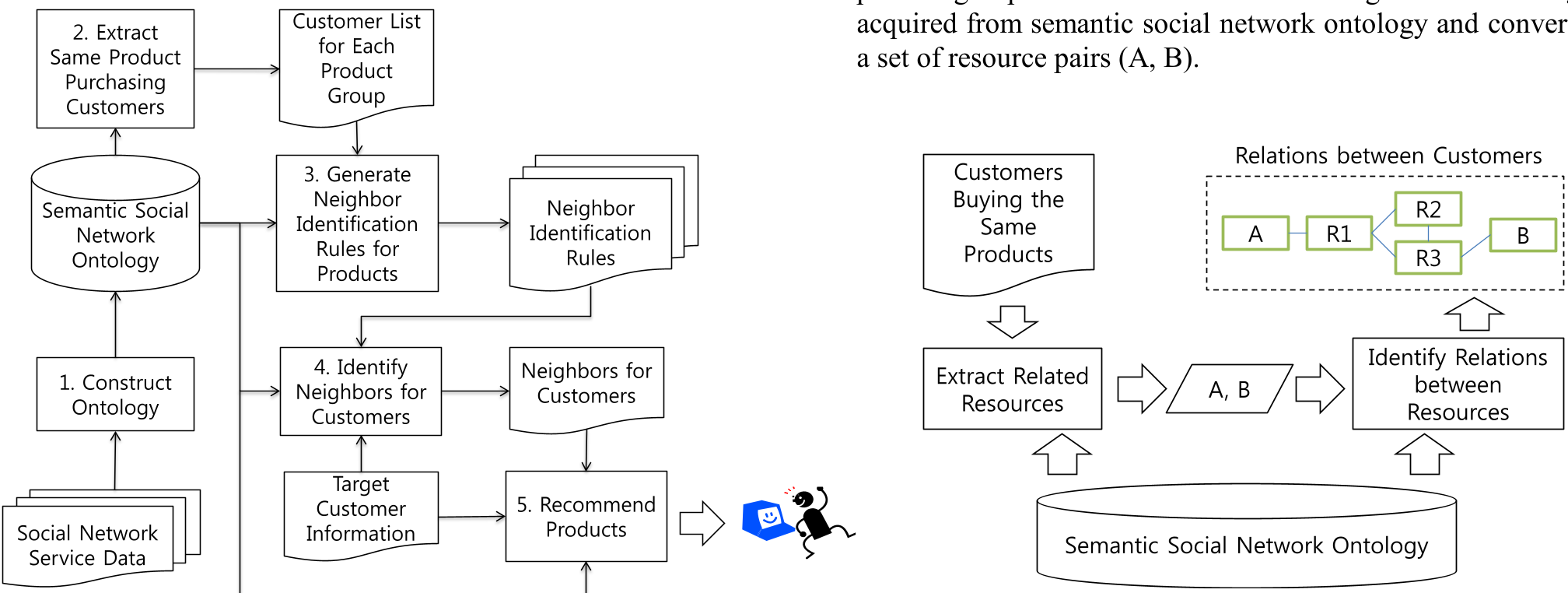
3. Rule-Based Neighbor Identification
Once the tree is trained, it generates logical rules. To find "neighbors" for a target user, the system simply runs an inference engine. This is significantly faster than calculating cosine similarities across a multi-million-dimensional matrix every time a recommendation is needed.
Experiments & Future Outlook
The framework suggests an architecture that addresses the "cold start" and "sparsity" problems by using semantic cues when transaction data is missing. By extracting neighbors who satisfy specific logical criteria (e.g., "Users who follow Tech Influencers and have purchased high-end cameras"), the system can pinpoint potential leads with higher precision.
Key Advantages:
- Speed: Pre-generated rules allow for near-instant neighbor identification.
- Explainability: Unlike black-box neural networks, these decision trees tell you exactly why a user is considered a neighbor.
- Multi-layered Insight: It captures the "multiplicative factors" of social influence that traditional CF ignores.
Critical Analysis & Conclusion
While the paper provides a robust theoretical framework for Semantic Social Filtering, its primary limitation is the lack of large-scale empirical validation on modern datasets (like the multi-billion edge graphs of today's SNS).
Takeaway: This work serves as a precursor to the modern "Knowledge Graph + Recommender System" trend. It proves that the future of recommendation lies not just in "big data," but in "smart data"—structured knowledge that understands the semantic fabric of human interaction.
Future Work: To truly compete with SOTA Large Language Model (LLM)-based recommenders, this methodology would need to be integrated with embedding-based methods to handle the inherent "fuzziness" of human social behavior.