
Bridging Silence: A Semantic Social Network for Saudi Breast Cancer Patients
A Semantic Social Network Service for Educating Saudi Breast Cancer Patients
The paper proposes a Semantic Social Network Service specifically designed for breast cancer patients in Saudi Arabia. By integrating Web 2.0 social features with Semantic Web technologies (RDF/FOAF), the system aims to automate information exchange and patient education while building a supportive local community.
TL;DR
This research introduces a specialized social platform tailored for breast cancer patients in Saudi Arabia. Unlike generic social media, it utilizes Semantic Web technologies (RDF/FOAF) to create intelligent profiles that automatically link patients with similar medical backgrounds, specialized physicians, and personalized educational resources to combat the isolation typically associated with the diagnosis.
Problem & Motivation: The Cultural and Technical Gap
Breast cancer is the most common form of cancer in Saudi Arabia, accounting for over 21% of cases and often appearing at more advanced stages in younger women. Beyond the physiological battle, there is a significant psychosocial barrier: patients often struggle to express feelings or share knowledge within their local context.
The authors identify a technical "blind spot" in existing social tools:
- Lack of Structure: Standard social profiles cannot effectively map medical relationships (e.g., "Patient treated via Radiotherapy at Specific Hospital").
- Inefficient Discovery: Finding peers with identical clinical challenges is difficult without a common semantic language.
- Educational Mismatch: Information retrieval is often generic rather than tailored to the patient’s specific diagnostic stage.
Methodology: Adding Semantics to Socializing
The core innovation lies in the transition from a traditional Web 2.0 social network to a Semantic Social Network.
1. The Semantic Profile Architecture
The system utilizes the FOAF (Friend of a Friend) ontology as its backbone. Every actor—whether a patient, survivor, doctor, or psychologist—has their profile data converted into an RDF/XML schema. This allows the machine to "understand" the relationships between nodes. For instance, a patient's profile doesn't just list text; it links to specific entities like Hospital Name, Type of Therapy (Chemotherapy/Radiotherapy), and Time of Diagnosis.
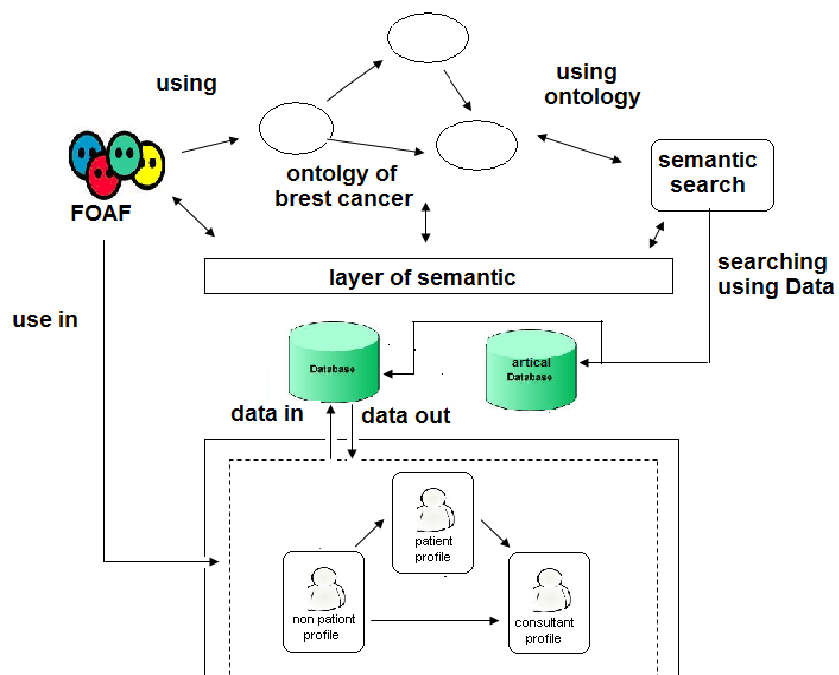 Figure 1: The proposed architecture showing the interplay between the Social Network layer and the Semantic Search/Profile layer.
2. Intelligent Search and Fusion
By adopting ontologies (such as those from the Protégé Ontology Library), the platform can perform Semantic Search. This moves beyond keyword matching to "fusion of information." When a user searches for symptoms or treatments, the system uses the underlying RDF data to disambiguate the query, increasing the relevancy of the educational articles and news displayed to the patient.
Experiments & Results
While the project is a "work in progress," the conceptual validation focuses on the interoperability provided by the FOAF layer.
- Enhanced Interoperability: By using standardized vocabularies, the network is designed to be easily merged with other international clinical networks in the future.
- Targeted Education: Preliminary logic shows that upon registration, patients instantly receive curated articles based on their specific cancer stage and treatment plan, a feat difficult to achieve with standard keyword-based systems.
Critical Analysis & Conclusion
Takeaway
The value of this research lies in its Human-Centric Design. It recognizes that medical recovery is as much a social process as a biological one. By embedding clinical data into a social graph (Semantic Profile), the system provides a specialized "safety net" that generic platforms like Facebook or Twitter cannot match.
Limitations & Future Work
One major challenge not deeply addressed is Privacy and Data Ethics. Dealing with sensitive medical information in an RDF/XML format requires robust encryption and anonymization protocols to prevent data leaks. Future iterations should explore how Differential Privacy or Federated Learning could be integrated to protect patient identities while maintaining the benefits of a semantic social graph.
Ultimately, this work serves as a blueprint for localized, disease-specific digital interventions that prioritize both data intelligence and emotional support.