
ADE: Bridging the "Practice of Mystery" in Dissertation Writing via Semantic Social Scaffolding
Semantic Social Scaffolding for Capturing and Sharing Dissertation Experience
This paper introduces the AWESOME Dissertation Environment (ADE), a collaborative learning platform that utilizes "semantic social scaffolding" to assist students in the complex process of dissertation writing. By tailoring a semantic wiki with a structured ontology, the system enables collective intelligence and experience sharing to support students in ill-defined academic domains.
TL;DR
Dissertation writing is notoriously difficult because it is an ill-defined, non-linear, and often lonely journey. The AWESOME Dissertation Environment (ADE) tackles this by transforming the solitary effort into a community-driven experience. Using a combination of Semantic Wikis and a specialized Writing Ontology, it scaffolds the learning process, allowing students to share "top tips," examples, and even their emotional states to create a collective intelligence repository.
The "Knowing-Doing" Gap in Academic Research
Most students approach their dissertation with a hand-book full of "how-to" guides, yet they feel completely lost when they start the actual work. This is the Knowing "About" vs. Knowing "How" problem. Tutors are often overwhelmed by repetitive questions, while students are too intimidated to ask "simple" questions during limited face-to-face sessions.
The authors identify a critical missed opportunity: Informal Social Support. By channelling the tacit knowledge of past and current students into a digital environment, the "practice of mystery" (as academic writing is often called) can be demystified.
Methodology: Engineering the Social Scaffold
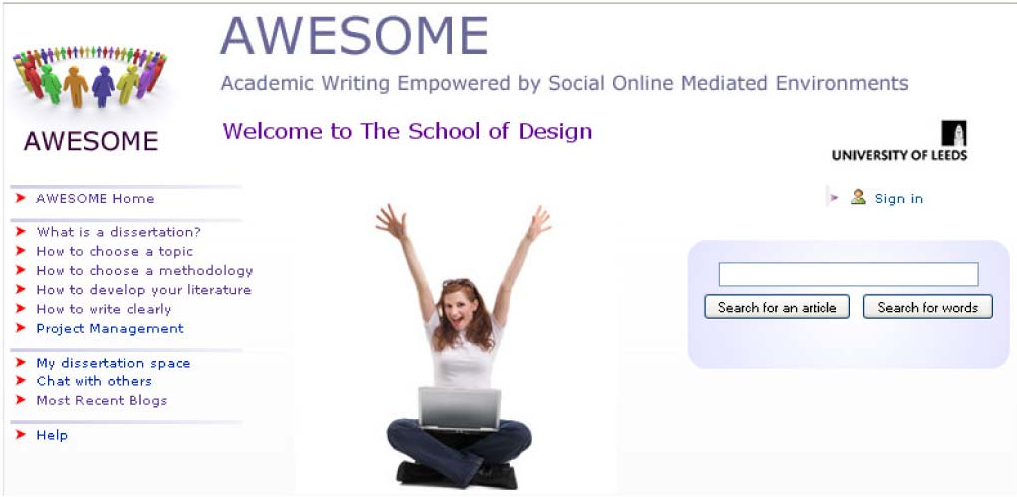
The core innovation of ADE is Semantic Social Scaffolding. Unlike a traditional wiki where information is just a flat list of pages, ADE uses an underlying ontology to "anchor" information.
1. The AWESOME Ontology
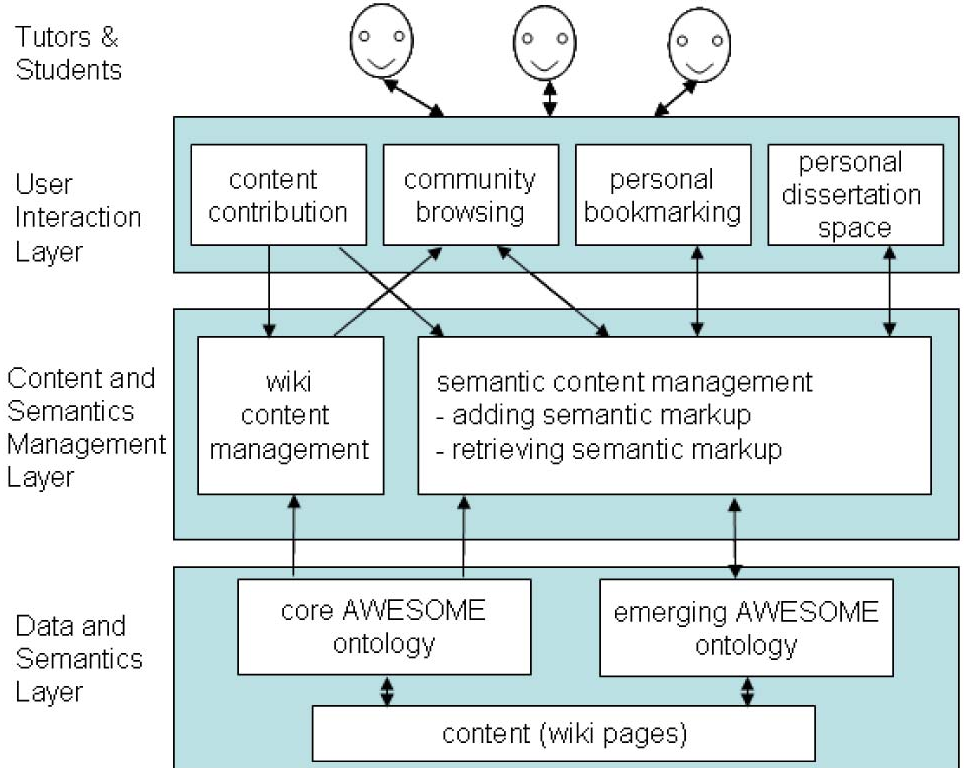
The system is built on three layers: Data/Semantics, Management, and Interaction. The ontology defines:
- Dissertation Process: Steps like "Topic Selection" or "Literature Review."
- Shared Components: Examples, Resources, FAQs, and Reflections.
- Personal Experience: Bookmarks and "Mood" indicators.
2. Semantic Forms and Queries
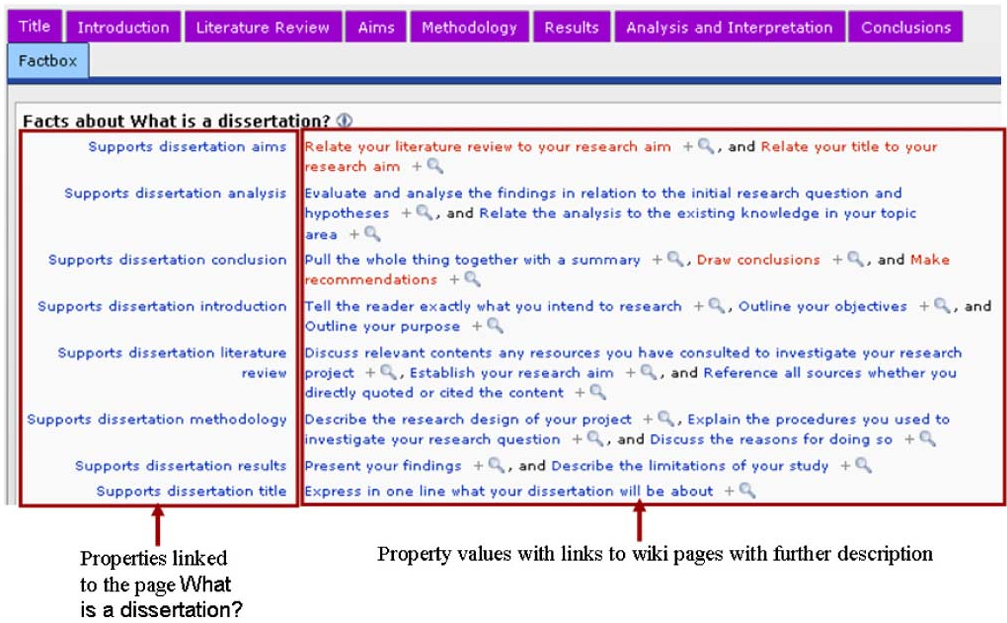
To lower the barrier for non-technical users (like Fashion Design students), the authors used Semantic Forms. Instead of writing complex code, users fill out a form that automatically attaches metadata (e.g., [[is top tip::...]]). This allows the system to run Semantic Queries that dynamically pull together "all tips regarding literature reviews" into a structured table on the homepage.
Experimental Insights: Fashion Design Trial
The project chose a "non-IT" domain—Fashion Design—to test the system's true usability.
Key Findings:
- The Power of Anonymity: The FAQ section was highly successful because students could ask "stupid" questions without fear of judgment from supervisors.
- Emotional Support: During summer breaks, the "Personal Space" served as a critical psychological anchor. Students shared moods like "nervous" or "stressed," realizing they weren't alone.
- Authority Traps: A hurdle emerged—students were reluctant to trust peer examples. They preferred "Tutor-Authorized" content, highlighting that in academic settings, a purely "flat" Web 2.0 model may not work; some hierarchy is needed to establish trust.
Critical Insight: Why Semantics Matter
The paper argues that simple "tagging" (like on social media) isn't enough for deep learning. Semantics provide the explanatory and metacognitive levels. When a student tags a page as a "Literature Review Success Case," they are internalizing the vocabulary and standards of their field. The "Emerging Ontology" captures the community's evolving understanding, making the environment "mature" as more students use it.
Conclusion & Future Outlook
The ADE project proves that technology-enhanced learning (TEL) is most effective when it is pedagogy-led. By moving the dissertation from an individualistic hurdle to a shared community asset, institutions can maximize their resources.
However, the "Cold Start" problem remains: a community tool is only useful if there is quality content. Future iterations aim to automate the "seeding" process by importing past high-quality dissertations and using AI to suggest initial semantic tags.
Takeaway for Educators: Don't just give students a wiki; give them a structural scaffold that reflects the real-world complexity of their tasks.