
Bridging the Expertise Gap: Transforming Competency Management via Semantic and Social Layers
Exploiting Semantic and Social Technologies for Competency Management
This paper introduces a multi-layered framework for enterprise competency management that integrates Semantic Web technologies with social networking. By harmonizing ontologies like FOAF, ResumeRDF, and SKOS, the system enables automated competency updates and agile profile sharing across organizational silos.
TL;DR
This research addresses the "awareness gap" in corporate environments—where specific organizational needs go unmet simply because internal experts are invisible to the system. By combining Semantic Web ontologies (FOAF, ResumeRDF, SKOS) with an Enterprise Social Network, the authors create a self-updating ecosystem that automates competency acquisition and fosters agile knowledge sharing.
Background: The Failure of Static HR Systems
In most modern enterprises, Human Resource Information Systems (HRIS) act as passive graveyards for data. Competency records are often manually entered from CVs and rarely updated after the initial hire. This leads to several critical pain points:
- Stale Profiles: Manual updates cannot keep pace with real-world skill acquisition.
- Syntactic Barriers: Standards like HR-XML allow data exchange but lack the "meaning" required for automated reasoning.
- Hierarchical Silos: Information flows vertically, preventing horizontal collaboration where a developer in Team A might need a specific skill hidden in Team B.
Methodology: The Three-Pillar Architecture
The core of the paper is the definition of a Semantic Layer that acts as the "glue" between disparate enterprise systems.
1. The Semantic Layer (The "Brain")
The authors didn't reinvent the wheel; instead, they harmonized existing "Upper Ontologies":
- FOAF (Friend-of-a-Friend): Manages personal identity and social links.
- ResumeRDF: Models professional summaries and work history.
- SK (Schmidt & Kunzmann) Ontology: Specifically handles the nuances of competencies, proficiencies, and learning goals.
- SKOS (Simple Knowledge Organisation System): Bridges these with domain-specific taxonomies (e.g., specific programming languages or management techniques).
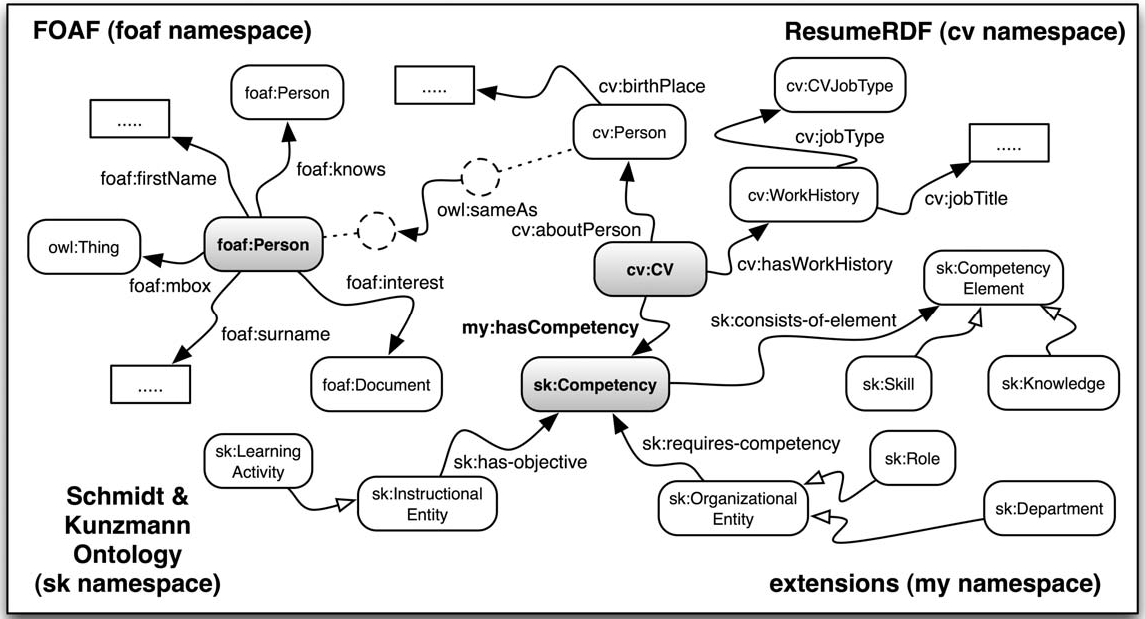 Fig 1: The Upper Ontologies sub-layer showing the harmonization of FOAF, ResumeRDF, and SK models.
2. The Learning Loop (IWT Integration)
The system integrates with the Intelligent Web Teacher (IWT). When a "Gap Analysis" identifies a missing skill for a specific role, IWT automatically:
- Maps target competencies to learning objects.
- Delivers a personalized learning path.
- Assesses the employee and, upon success, automatically updates the Semantic Layer.
3. The Social Layer (The "Nervous System")
By exposing the Semantic Layer to an Enterprise Social Network, new skills are no longer buried in a database. Using SPARQL queries converted to RSS feeds, the system notifies "followers" or relevant teams whenever a colleague acquires a new competency.
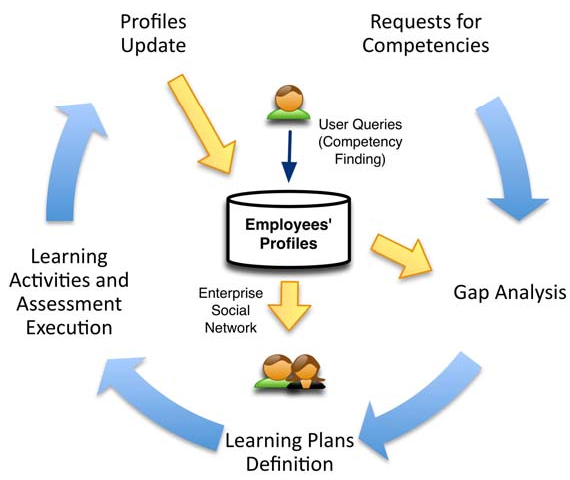 Fig 2: The lifecycle of competency maturing, from identification to finding through social networks.
Key Results and Collaborative Intelligence
The integration facilitates what the authors call "Collective Intelligence." Rather than asking "who knows X?" in a mass email, employees can use semantic search (User Queries) to find experts based on real-time, validated competency data.
| IWT Component | Semantic Layer Equivalent |
|---|---|
| Concept Maps | SKOS Graphs |
| Target Concepts | Target Competencies |
| Learners' Profiles | FOAF + ResumeRDF + SK |
| Learning Activities | sk:LearningActivity |
Critical Insight & Future Outlook
The brilliance of this approach lies in its Semantic Interoperability. By moving away from unstructured text (as found in IMS RDCEO) toward a graph-based RDF approach, the enterprise becomes a "programmable" entity where talent can be automatically routed to tasks.
Limitations: While the framework is robust, its success depends heavily on the initial quality of the domain ontologies. Additionally, the transition from legacy HRIS systems to a "Linked Data" model remains a significant integration challenge for non-digital-native firms.
Final Takeaway: True Enterprise 2.0 isn't just about putting "Facebook for Work" in place; it’s about ensuring that the social network is powered by an underlying semantic truth that evolves as employees learn.