
Detecting Social Media Hijacking: A Semantic Incoherence Approach
Semantic Text Analysis for Detection of Compromised Accounts on Social Networks
This paper proposes a novel framework for detecting compromised social media accounts by analyzing semantic incoherence in message streams. The core method utilizes KL-divergence between smoothed uni-gram language models of regular users and potential adversaries, achieving a significant Accuracy of 0.80 and Precision of 0.90 in a balanced Twitter dataset.
TL;DR
Researchers from UIUC have developed a framework to catch "compromised" social media accounts—legitimate accounts stolen by hackers—by measuring how much the "language" of the account suddenly changes. By comparing the statistical distribution of words before and after a potential hack using KL-divergence, their system achieves 90% precision in identifying malicious takeovers.
Background: The Trust Exploitation Trap
When an account is compromised, the damage isn't just to the digital asset; it's an exploitation of the trust network. Unlike bots, which are often "born" malicious, compromised accounts have a history of legitimate interactions. Traditional security looks for IP changes or weird login times, but hackers have become adept at hiding these "signals." The ultimate indicator, however, is the content. A person’s "semantic fingerprint" is unique, and an adversary—no matter how clever—will eventually deviate from the original user's linguistic patterns.
The Core Insight: Why Language Models?
The authors argue that a user’s textual output is drawn from a specific probabilistic distribution (). When an attacker takes over, they draw from a different distribution ().
The challenge? We don't know when the attack started or ended. The solution? Random Sampling. By randomly picking start and end points () and calculating the divergence between the "inner" and "outer" text blocks, the authors found that compromised accounts consistently show higher "incoherence" scores across all samples.
Methodology: Measuring Incoherence
The framework uses a Uni-gram Language Model instantiation:
- Split the Stream: The timeline is divided into a "User" set and an "Attack" set based on sampled time-points.
- Smoothing: Since users and attackers use different vocabularies, Laplace smoothing is applied to ensure the distributions can be mathematically compared.
- KL-Divergence: The model calculates the Kullback-Leibler divergence—a measure of how one probability distribution differs from a second.
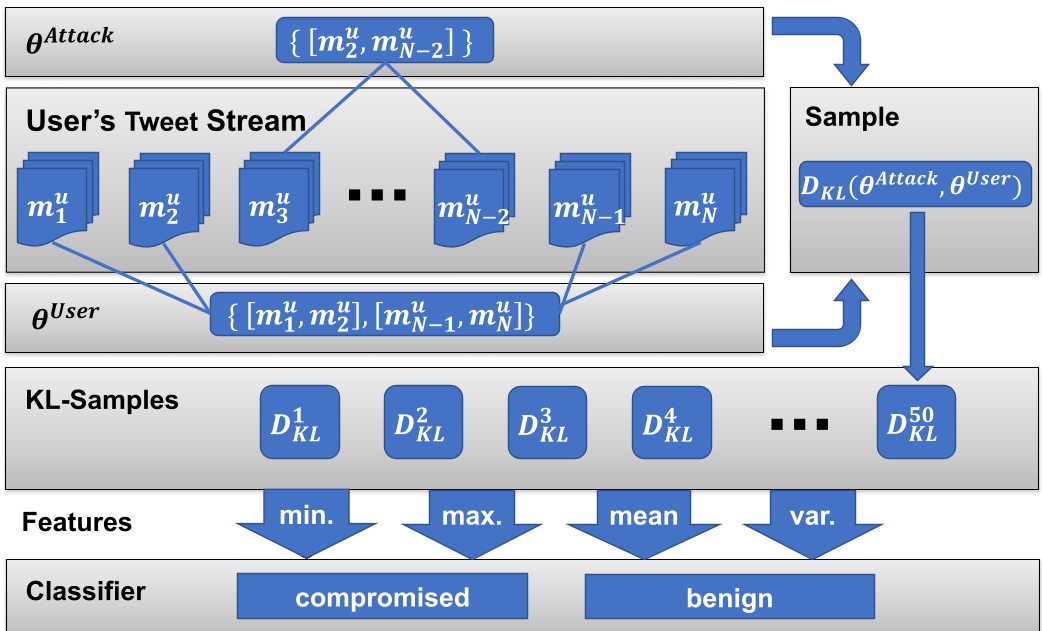 Fig 1: The model samples random intervals to calculate KL-divergence between the suspected "attack" window and the "benign" history.
The Heatmap Evidence
The effectiveness of this approach is most visible in the "Heatmaps" generated by the authors. In benign accounts, the KL-divergence remains low (blue) regardless of the time-window selected. In compromised accounts, the "takeover" period glows deep red, indicating a massive semantic shift.
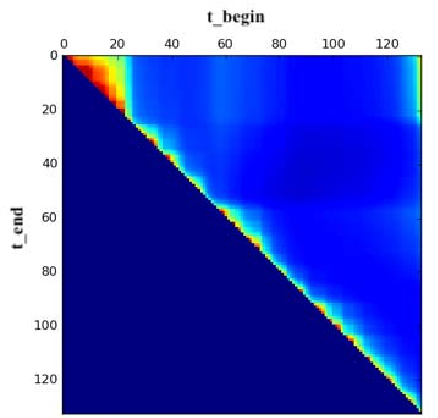 Fig 2: Heatmaps comparing Benign (a, b) vs. Compromised (c, d) accounts. Red indicates high semantic incoherence.
Experimental Performance
The researchers tested their framework against traditional text classifiers (TF-IDF, Doc2Vec) and industry baselines like COMPA.
- Stand-alone Power: The Language Model (LM) features alone provided a 19.4% improvement in accuracy over COMPA.
- The Hybrid Advantage: When combined with embedding methods (Doc2Vec) and behavioral signals, the system reached its peak performance, suggesting that semantic incoherence captures a "signal" that neural embeddings and metadata miss.
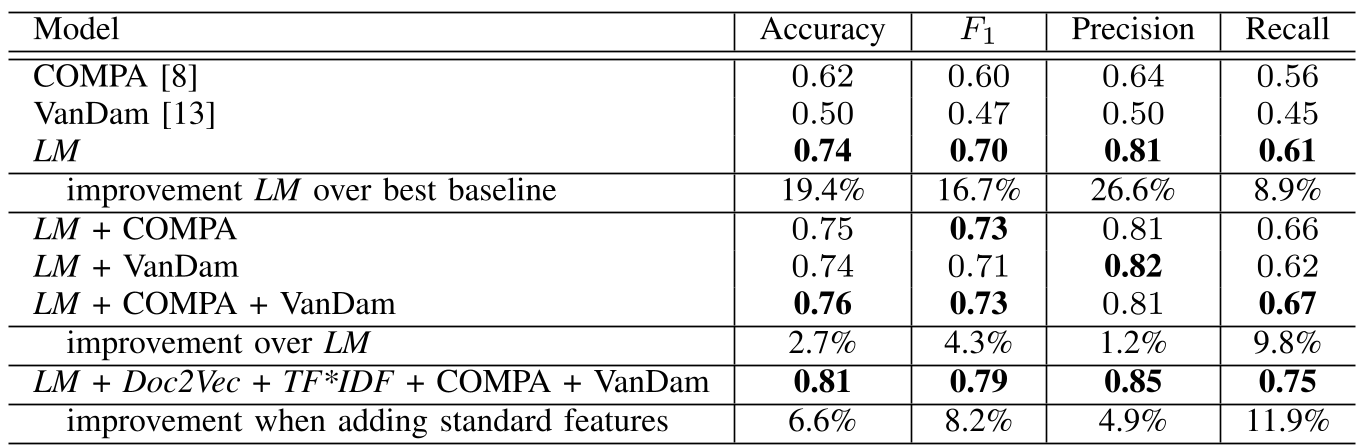 Table 1: Comparison of LM features against existing SOTA detection methods.
Real-World Application & Limitations
In a qualitative test on real Twitter data, the system successfully identified a "Lead Generation" scheme where a hijacked account was blasting links to specific followers.
Limitations:
- Training Data: The model was primarily trained on simulated data (swapping users). While it worked on real data, "real-world" labels would likely sharpen its accuracy.
- Short Takeovers: Very brief attacks (single-tweet injections) remain a challenge because the sample size is too small to build a robust "Attacker" language model.
Conclusion
This research moves beyond "what" is being said (keywords) and looks at "how" it's being said (distribution). By treating account security as a language modeling problem, social platforms can build a defense that is significantly harder for human adversaries to spoof. As AI-generated spam becomes more sophisticated, these types of differential semantic analyses will become critical in maintaining the integrity of our digital social fabric.