
Uncovering the Social Fabric: Real-World Relationship Discovery via WiFi Semantic Trajectories
Semantic trajectories-based social relationships discovery using WiFi monitors
This paper introduces a method for discovering social relationships using WiFi probes and semantic trajectories. By deploying WiFi monitors across a university campus, the researchers developed the LCSS_ΔT similarity measurement and the Resident Population Classification (RPC) algorithm to achieve high-accuracy relationship inference and community detection.
TL;DR
Researchers have successfully moved beyond simple "location pings" to map complex human relationships. By transforming raw WiFi probes from smartphones into Semantic Trajectories, this study can identify whether two people are classmates, friends, or lovers with up to 87% accuracy, simply by observing how they move through a university campus.
Context: The Invisible Signal
Every smartphone constantly broadcasts WiFi "probe requests" to find known networks. These signals contain unique MAC addresses and timestamps. While previous research used this data to track foot traffic, they often missed the "why" and "who." This paper argues that your movement pattern between places (e.g., Canteen -> Lab -> Dorm) is a unique "semantic fingerprint" that reveals your social identity.
The Problem: Beyond "Where" to "How"
Traditional trajectory analysis treats locations as isolated points. However, two people might visit the same library but never meet, or they might arrive at a canteen at different times for different reasons. Existing methods like Dynamic Time Warping (DTW) or Edit Distance (ED) struggle with the "semantic" nature of these movements—they don't understand that a 5-minute gap in a dorm is different from a 5-minute gap in a lecture hall.
Methodology: The LCSS_ΔT Breakthrough
The core innovation lies in the LCSS_ΔT (Longest Common Subsequence with Time Threshold) algorithm.
1. Semantic Enrichment
Instead of raw GPS or signal coordinates, the authors tag locations with functional labels (Teaching Building, Canteen, Laboratory). This transforms a data point from a coordinate into a "Life Event."
2. The Flexible Similarity Metric
The authors define the similarity as:

The genius of this approach is the variable DT (Time Threshold):
- Large DT: Matches users who follow similar daily routines (e.g., both are "Lab Rats"), even if they don't move together.
- Small DT (< 3 mins): Matches "Encounter points," identifying people who are actually walking or eating together.
3. Architecture Overview
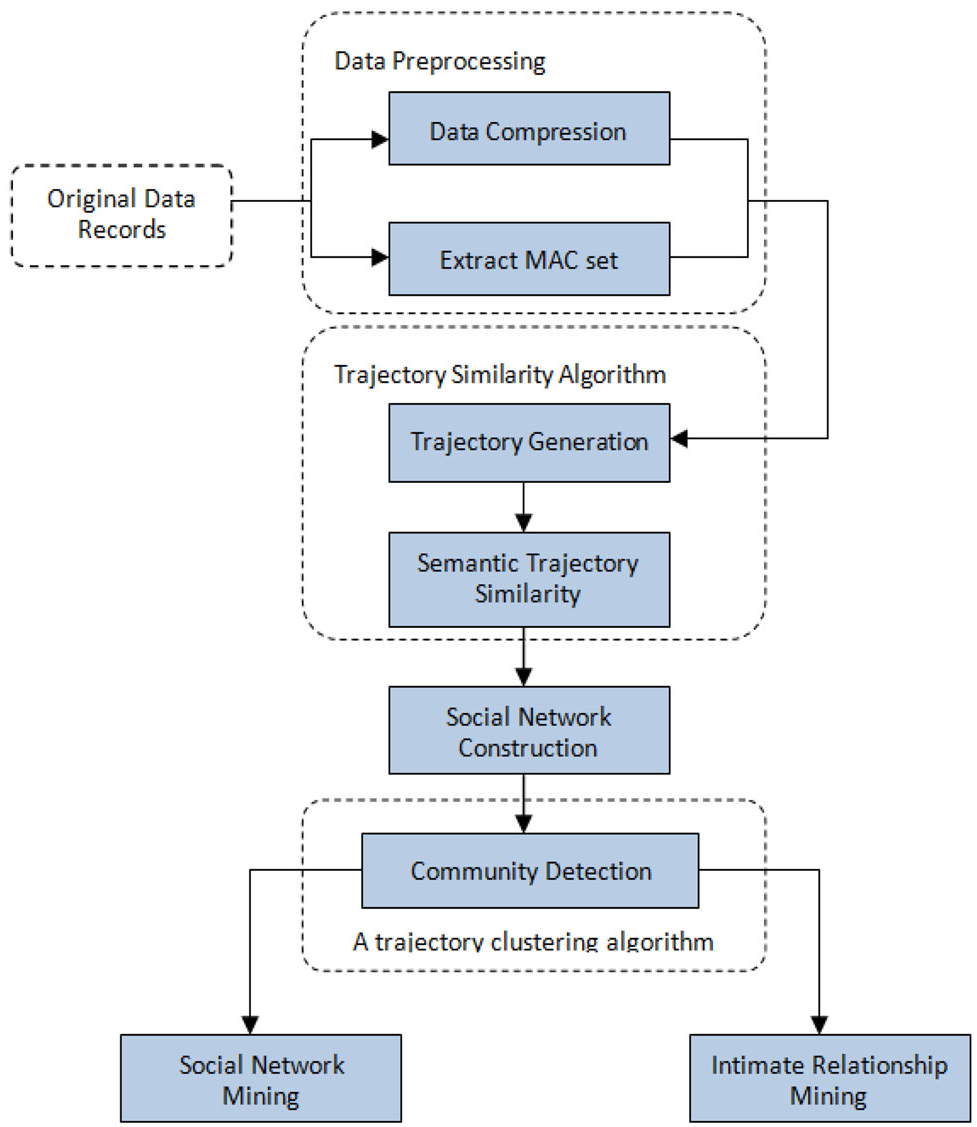
The system follows a pipeline from raw data collection to community detection:
Experiments: Campus Case Study
The researchers deployed 19 monitors for 6 months, collecting 20GB of data.
The RPC Algorithm
To filter out "noise" (like a delivery driver passing through), they used Resident Population Classification (RPC) based on K-means clustering of arrival times. This ensures the social graph only includes the actual campus community.
Social Network Architectures
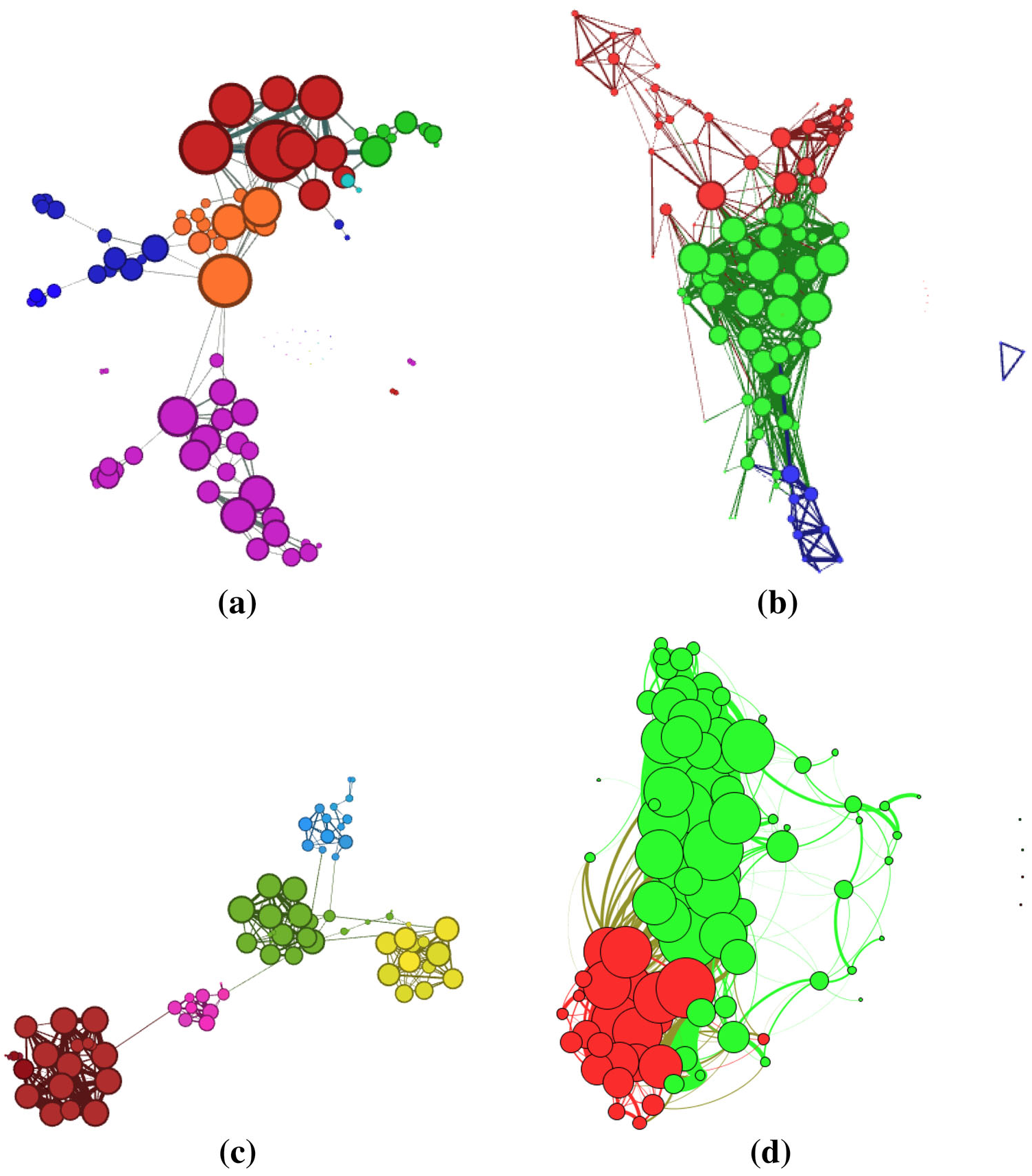
The study found that different building types produce different social structures:
- Laboratories: High connectivity. Most inhabitants (grad students) share identical "Lab-to-Dorm" loops.
- Canteens: Diverse, modular communities representing different departments and social strata.
Inferring Intimacy
By analyzing "Encounter Features" (Location + Time), the model could differentiate ties:
- Friends/Classmates: High encounter rates in teaching buildings and canteens during working hours.
- Lovers: High encounter rates at dormitory buildings during "off-hours" and weekends.
Critical Insight & Conclusion
This work outperforms standard sequence matching (DTW/ED) because it respects the temporal-spatial constraints of human behavior.
Takeaway: Semantic trajectories turn raw mobility data into a social sensor. While highly effective for urban planning and organizational sociology, it also raises significant privacy questions: if a passive WiFi monitor can tell who you are dating, we need to rethink the "anonymity" of our broadcasted MAC addresses.