
Unmasking Social Ties: Discovering Relationships through WiFi Semantic Trajectories
Semantic trajectories-based social relationships discovery using WiFi monitors
The paper introduces a framework for discovering social relationships using WiFi probe data by modeling user movements as semantic trajectories. It proposes a novel similarity measurement based on a revised Longest Common Subsequence (LCSS) algorithm and identifies distinct social network structures within a university campus.
TL;DR
Researchers from Beijing University of Posts and Telecommunications have developed a system to map social networks using the "WiFi probes" constantly emitted by our smartphones. By treating these signals as Semantic Trajectories—sequences of meaningful locations like "Canteens" or "Labs"—the team can identify social groups and relationship types with high precision. Their study proves that your movement patterns (where you go and in what order) are a digital fingerprint of your social life.
Background: Beyond Simple "Co-location"
In the world of social computing, knowing two people were at the same Starbucks at 10:00 AM is informative, but it's "noisy" data. They could be best friends, or just two strangers in a queue.
The core Motivation of this paper is that transfer patterns matter. If two users follow the same sequence of locations—moving from a dormitory to a specific teaching building, then to a specific canteen—they are much more likely to have a legitimate social tie. Previous SOTA methods focused on shared SSIDs (WiFi names) or static location overlaps, missing the rich context of human routines.
Methodology: The Core Engine
The researchers processed over 8.9 billion records collected over six months across a university campus. The methodology follows three critical stages:
1. Resident Population Classification (RPC)
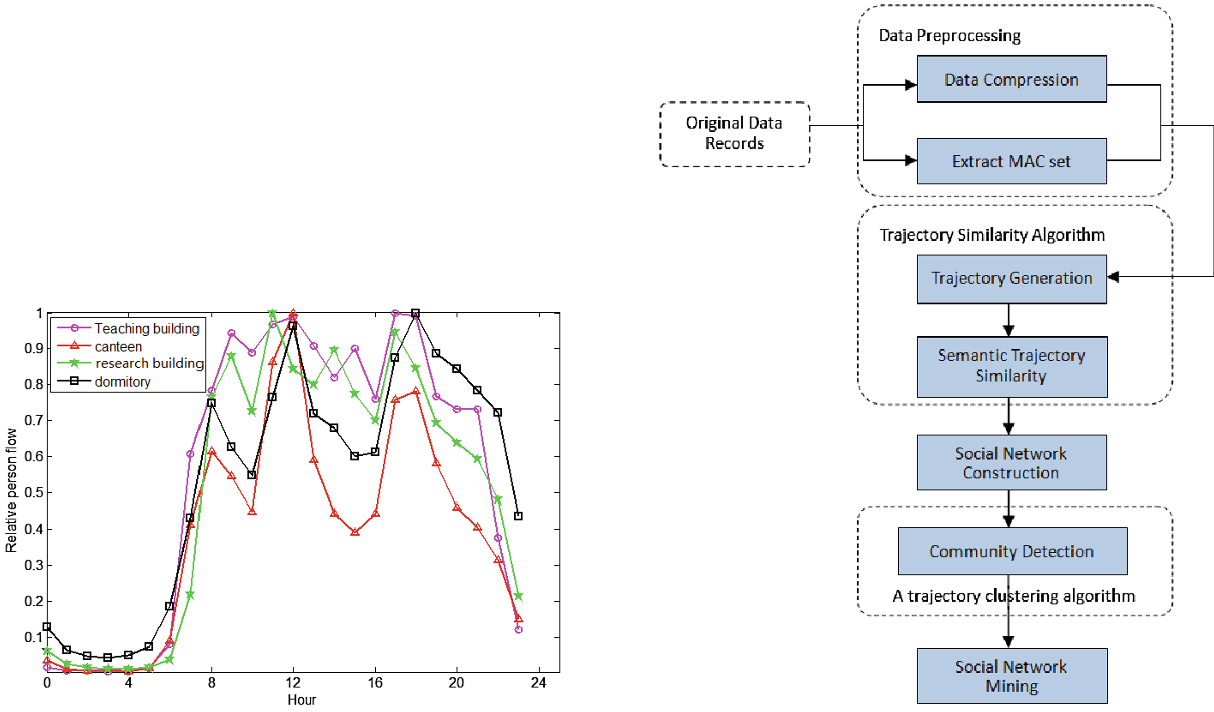
To filter out "noise" (like a delivery driver passing by a building), the authors proposed the RPC algorithm. It uses K-means clustering on timestamps to match a device’s presence against the "rush hour" patterns of specific buildings. If your device appears in a lab during standard research hours consistently, you are classified as a resident of that building.
2. Semantic Trajectory Similarity
This is the technical heart of the paper. Instead of raw GPS coordinates, the system uses Semantic Stops. The similarity between two users, and , is calculated using a revised Longest Common Subsequence (LCSS):

The inclusion of (time difference threshold) allows the model to be flexible. Setting a small (e.g., 3 mins) detects people physically walking together, while a large detects people with similar lifestyles but different schedules.
Experiments: Campus Social Topologies
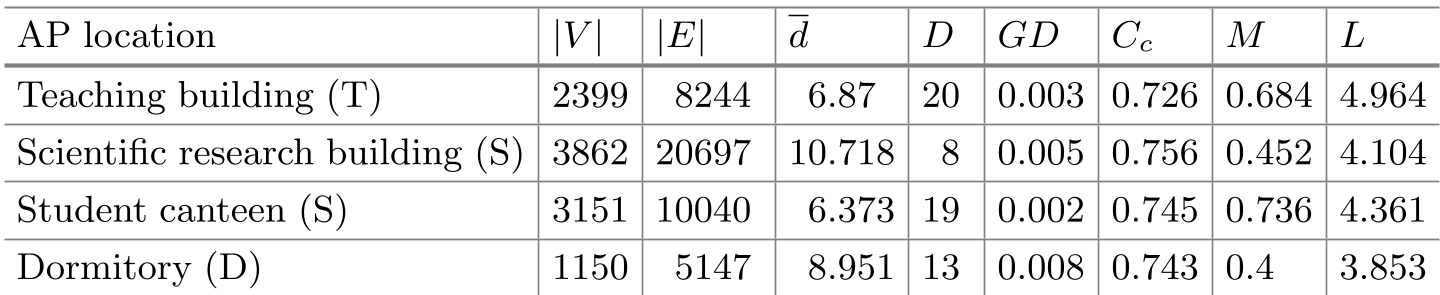
The study analyzed four distinct social networks based on building types. The results, visualized via Gephi, show striking differences:
- Scientific Research Buildings: Characterized by a "large community" structure. Graduate students have poor mobility, staying in labs for long periods, leading to high node degrees and dense clusters.
- Canteens: Exhibit high Modularity (0.736). This reflects the canteen as a "hub" where distinct social "islands" (undergrads, PhDs, staff) meet but remain in their own semantic groups.
- Dormitories: Show the highest connectivity, as roommates and floor-mates naturally share the most complex semantic sequences.
Critical Insight & Future Outlook
This work demonstrates that WiFi monitors act as a passive "social sensor." By moving from "where" to "in what order," the authors bridge the gap between raw signal processing and behavioral sociology.
Limitations: The primary challenge remains privacy. While MAC addresses were used as unique IDs, the ability to reconstruct a person's life (dormitory to lab to canteen) raises significant ethical questions. Future work likely needs to integrate Differential Privacy or On-device processing to leverage these insights without compromising individual anonymity.
Takeaway: Your smartphone’s WiFi probes are not just searching for the internet; they are broadcasting your social identity.