
Deciphering the Law: How Machine Learning Explains Its Own Decisions in German Statutes
Semantic types of legal norms in German laws: classification and analysis using local linear explanations
This paper presents a framework for the automated classification of German legal norms into a nine-type functional taxonomy (e.g., Duties, Permissions, Prohibitions). The authors evaluate a rule-based approach using UIMA Ruta and various supervised machine learning models, achieving a peak F1-score of 0.83 with a Linear Support Vector Classifier (SVC) and 0.78 with engineered rules.
Executive Summary
TL;DR: This research tackles the automated classification of German legal norms. Using a specialized taxonomy of nine functional types—ranging from Duties to References—the authors demonstrate that while Support Vector Machines (SVM) achieve a state-of-the-art F1-score of 0.83, the real breakthrough lies in Explainable AI (XAI). By using LIME (Local Interpretable Model-agnostic Explanations), the authors prove that the ML model isn't just "guessing" but is picking up on the same modal verbs and linguistic structures that human lawyers use to interpret the law.
Context: This work segments the German Civil Code (BGB) into its smallest functional atoms, positioning itself as a foundational study for the next generation of eDiscovery and automated legal review.
The Problem: The Complexity of the "Black Box"
Legal language, especially in civil law jurisdictions like Germany, is notoriously dense. Unlike common language, legal statements are "orders of validity" rather than simple facts. Traditionally, research has been split into two camps:
- Rule-Based Systems: Highly transparent but brittle and difficult to scale.
- Machine Learning: Highly accurate but opaque "black boxes" that legal professionals are hesitant to trust.
The authors argue that for AI to be adopted in law, we don't just need a "correct" prediction; we need to know why the model reached that conclusion.
Methodology: Rules vs. Neurons
The study utilizes the tenancy law portion of the German Civil Code (), comprising 601 manually labeled sentences.
1. The Taxonomy
The authors propose a 9-category functional taxonomy based on Deontic logic:
- Obligations: Duty, Prohibition.
- Rights: Permission, Indemnity.
- Structural: Definition, Reference, Continuation, Objection, Consequence.
2. Modeling & Architecture
The paper compares a Knowledge Engineering approach (using UIMA Ruta for rule-based extraction) against Supervised Machine Learning.
 Figure 1: The KDD (Knowledge Discovery in Databases) process applied to legal norm classification.
The rule-based system went through four iterations, while the ML pipeline tested 15 different configurations including Multinomial Naive Bayes, Random Forests, and SVMs.
Experiments and Results
The Linear Support Vector Classifier (SVC) emerged as the clear winner. Interestingly, the researchers found that removing stopwords or using TF-IDF weighting actually decreased performance. This suggests that in the legal domain, "small" words (like articles and pronouns) carry significant structural weight.
| Classifier Type | Best F1-Score |
|---|---|
| Rule-Based (Iteration 4) | 0.78 |
| Linear SVC (Raw Text) | 0.83 |
| Logistic Regression | 0.81 |
The X-Factor: LIME Analysis
The most compelling part of the study is the use of LIME to peel back the curtain of the SVC's decision-making process.
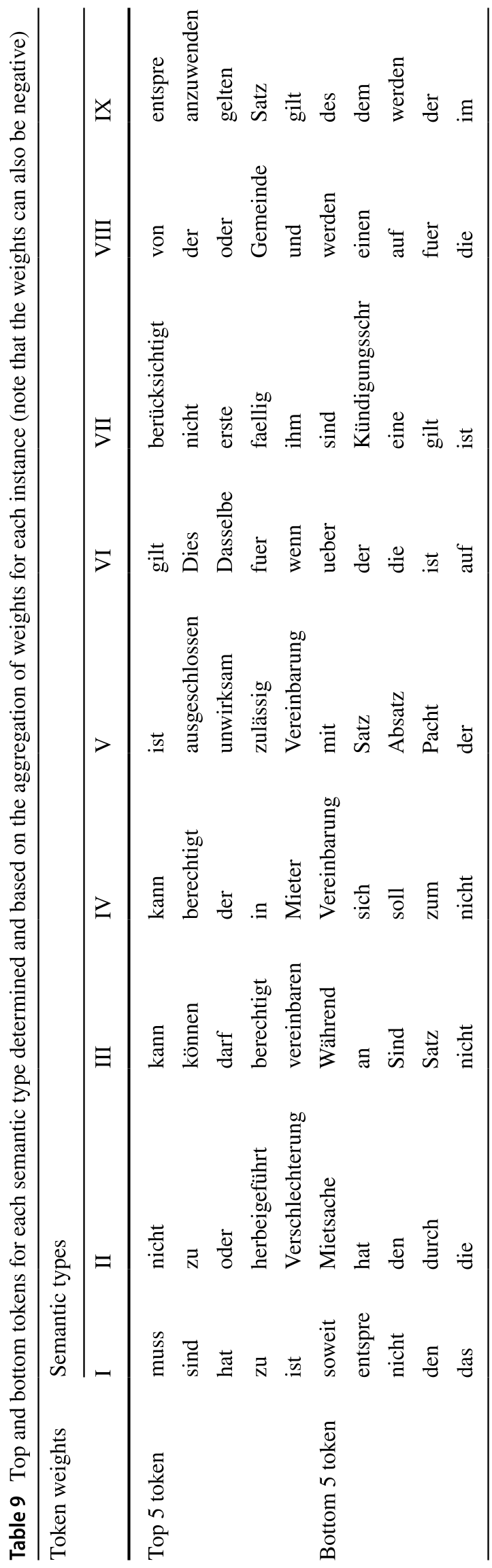 Table 9: Statistical overlap between ML weights and human rules.
As seen in the analysis, when the model classifies a sentence as a "Duty," it puts heavy positive weight on tokens like "hat", "zu", and "muss". These are exactly the modal auxiliaries that define obligations in German legal theory. This alignment validates that the model has internalized the "Grammatical Interpretation" method used by legal scholars.
Deep Insights: Bridging the Gap
The study concludes that the "functional semantic type" of a norm depends heavily on modal verbs.
- Duty is signaled by "must" and "shall".
- Permission is signaled by "can" and "may".
- Reference is identified by terms like "applies" and specific section indicators.
Limitations & Future Work
The dataset (n=601) is relatively small. The authors note that while rules were better at handling "corner cases" with very few samples (like Prohibitions), the ML models would likely scale better with more data. Future research should focus on domain portability—testing if a classifier trained on Tenancy Law can accurately parse Tax Law or Criminal Law.
Conclusion
This paper is a vital roadmap for Explainable Legal Tech. It proves that we don't have to choose between the transparency of human-written rules and the raw power of machine learning. By using local linear approximations, we can demystify the "black box," providing legal professionals with a tool that is both highly accurate and verifiable.