
The State of Semantic Web in Austrian Tourism: Beyond the SEO Surface
Usage of Semantic Web in Austrian Regional Tourism Organizations
This paper investigates the adoption of Semantic Web technologies within all 133 Austrian Regional Tourism Organizations (RTOs). The study reveals that 59% of RTOs utilize semantic markup, primarily leveraging Schema.org and Microdata to improve search engine visibility and machine readability.
TL;DR
Austrian Regional Tourism Organizations (RTOs) are increasingly using Semantic Web technologies to fight back against the dominance of Online Travel Agencies (OTAs). This study of 133 RTOs finds that while nearly 60% have adopted semantic markup, the implementation is heavily skewed towards basic SEO (like addresses and navigation) rather than the deep, domain-specific data needed for next-generation AI travel assistants.
Contextual Positioning
In the hierarchy of the digital tourism ecosystem, Austrian RTOs sit between individual businesses and national boards. They are the frontline for regional promotion. This paper serves as a vital "health check" on the industry's digital maturity, shifting the focus from if they use the Semantic Web to how effectively they use it.
The "Why": Motivation & Pain Points
The Austrian tourism sector contributes roughly 16% to the national GDP. However, its digital presence is threatened by OTAs (like Booking.com), which excel at data interoperability.
- The Problem: RTO websites often lag behind in technical innovation, making their content less "visible" to intelligent agents, voice search, and specialized search engines.
- The Insight: Semantic markup (Microdata, JSON-LD) acts as a bridge, making web content machine-readable. If RTOs provide better data than OTAs, they can reclaim direct traffic.
Methodology: Mapping the Austrian Digital Landscape
The authors leveraged the Web Data Commons dataset, a massive crawl of the public web, to extract "RDF quads" (data statements) belonging to 133 specific RTO domains.

The methodology was rigorous, filtering over 1.2 million RDF quads and grouping them into twelve functional topics. This categorization is crucial because it distinguishes between "junk" metadata and "value-added" tourism data.
Key Findings: The Pareto Principle at Work
The results reveal a significant "digital divide":
- The 80/20 Rule: Just 20% of RTOs produce 82% of the semantic data. Regions like Vienna (
wien.info) are power users, while 41% of RTOs have no semantic footprint at all. - Ontology Choice:
Schema.orgis the undisputed king (63.7%), followed by its predecessorData Vocabulary. - Format Dominance: Despite the rise of JSON-LD, Microdata remains the workhorse in this sector, accounting for nearly 94% of usages.
The "Touristic Tip" Gap
The most striking result is found in the analysis of what is being marked up. As shown in the table below, while Navigational Information and Addresses are widespread, critical industry-specific data like Product Data (accommodations) and Local Tourism Businesses are neglected.
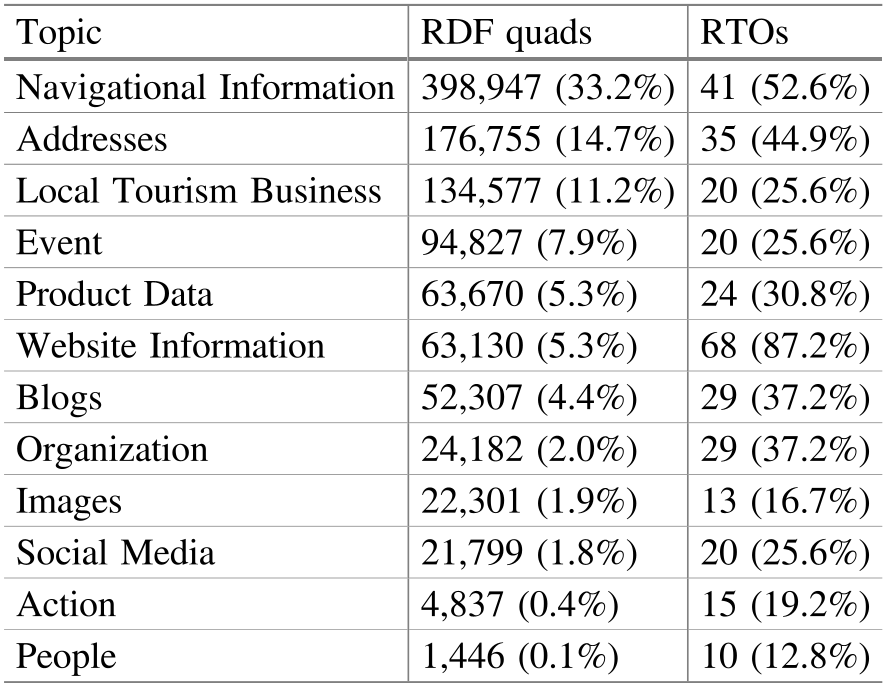
- The Missed Opportunity: Almost no RTOs annotated ski resorts, food establishments, or specific amenities (e.g., "pets allowed"). Without this, a voice assistant cannot answer a specific query like "Find a pet-friendly hotel near a ski lift in Tyrol."
Critical Insight: Realizing the "Web 3.0" Vision
The paper concludes that Austrian RTOs are "doing the homework but skipping the extra credit." They have implemented the basics required by Google to show breadcrumbs in search results, but they are failing to utilize the Domain-Specific potential of the Semantic Web.
Limitations and Future Outlook
The study highlights that many semantic implementations are flawed (syntax errors, missing attributes), which effectively renders the data useless for automated agents. Furthermore, the reliance on older datasets (2017) suggests that while the situation may have improved, the fundamental challenge remains: Interoperability.
Final Takeaway
To survive the next wave of AI-driven travel search, RTOs must stop viewing semantic markup as a "technical SEO checkbox" and start seeing it as a strategic data asset. The goal isn't just to be "on the web" but to be "in the knowledge graph."