
Beyond the Bibliography: Mapping the Social Brain of Academia via Web Citations
11702_Semantic Web Link Analysis to Discover Social Relationships in Academic Communities.
Summary
Problem
Method
Results
Takeaways
This paper introduces a Semantic Web-based framework for "Web Citation Analysis," a novel application of bibliometric techniques to the Web. It develops a core ontology for classifying social relationships (Socio-cognitive links) and knowledge references (Intellectual links), achieving state-of-the-art granularity in identifying research communities and academic "gatekeepers" through link metadata.
## TL;DR
While traditional citations tell us what papers are important, they miss the "hidden" social fabric of science—mentorships, project collaborations, and informal communities. This paper pioneers **Web Citation Analysis**, utilizing Semantic Web ontologies to transform raw hyperlinks into a nuanced map of academic influence, identifying "gatekeeper" scientists who bridge different intellectual islands.
## The Problem: The "Flat" Web vs. The "Deep" Academy
For decades, we have relied on *Bibliographical Author Co-citation Analysis (ACA)*. While effective, it views the academic world through a narrow straw: only formal papers count. However, the Web is where modern research lives. The problem? To a standard algorithm, a link from a professor to their PhD student looks the same as a link to a software tool. This "semantic vacuum" prevents us from seeing the real-world social structures that drive innovation.
## Methodology: Teaching Machines to Understand "Why" We Link
The authors moved beyond simple link counting by introducing two critical layers:
### 1. The Intellectual Macro-View (PCA)
By collecting data from over 5,000 researchers and 273,000 web pages, the authors applied **Principal Component Analysis (PCA)** to co-citation matrices. This allowed them to see how researchers cluster together based on who links to whom.
### 2. The Semantic Micro-View (The Ontology)
This is the core innovation. The authors developed a social ontology comprising 35 distinct classes. They categorized links into two major "kingdoms":
* **Intellectual (Referential) Links**: Links to work, societies, or tools (roughly 80% of data).
* **Socio-cognitive (Social) Links**: Deep ties like *Co-author*, *Supervisor*, or *Academic Committee member*.
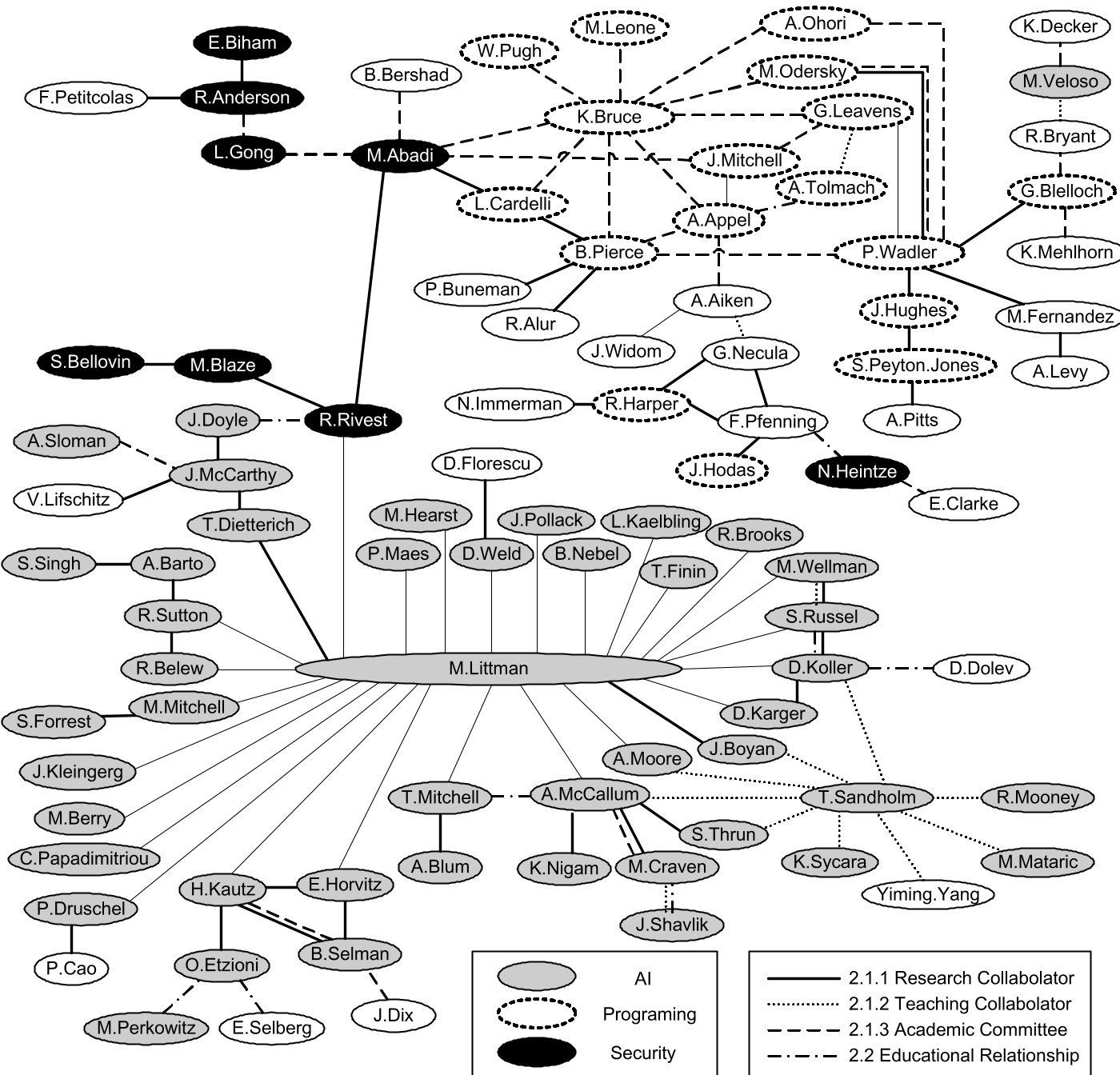
*Figure: The conceptual framework for classifying academic social ties via link metadata.*
## Empirical Results: Finding the Gatekeepers
The experiment yielded fascinating results when comparing Web clusters to traditional Bibliographic clusters.
* **The Superset Effect**: Web clusters are broader. For example, while professional bibliographies might only show a small "Machine Learning" clique, Web citations reveal a massive "AI" community where ML is just a subset.
* **Detecting "Gatekeepers"**: Using a metric called **Betweenness**, the researchers identified individuals who act as bridges between disparate fields.
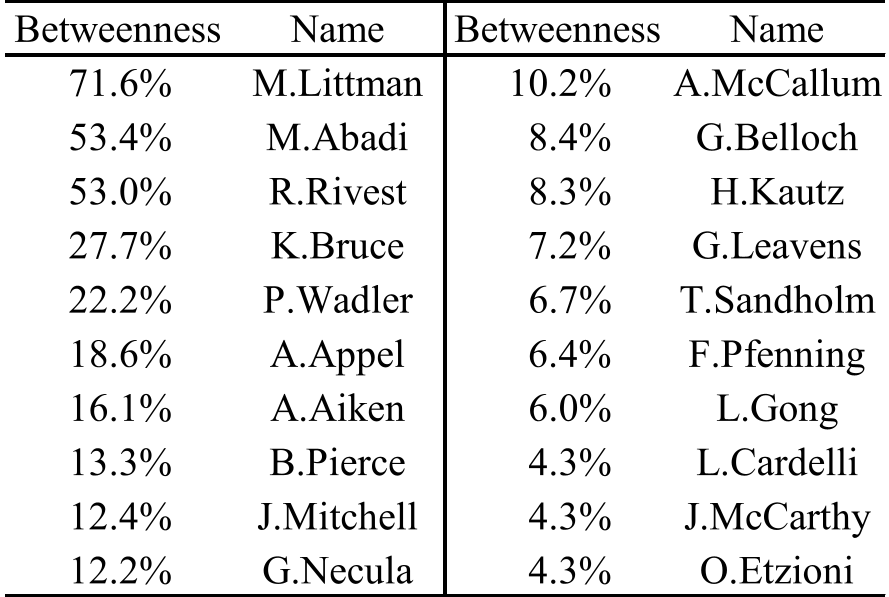
*Table: Researchers like M. Littman (71.6%) and M. Abadi (53.4%) demonstrate high "Betweenness," proving they are the structural glue connecting different academic silos.*
## Deep Insight: The Value of Semantic Metadata
The most striking takeaway is that **Intellectual Ties** (knowledge-sharing) often act as a precursor to **Socio-cognitive Ties** (social collaboration). By analyzing the *anchor text* and surrounding context of links, the researchers could predict the strength of an academic relationship more accurately than by looking at a co-authorship list alone.
## Conclusion & Future Outlook
This work laid the foundation for what we now recognize as the **Semantic Web**. It suggests that the value of an academic is not just in their h-index, but in their "Social Betweenness"—their ability to facilitate the flow of ideas between communities.
**Limitations**: The study relied on manual annotation for the ontology, which is non-scalable in the era of LLMs. Future research would benefit from using NLP to automatically classify these 35 link types across the entire open Web.
---
**Keywords**: *Author Co-citation Analysis (ACA), Semantic Web, Social Network Analysis (SNA), Ontology, Bibliometrics.*