
Sem-CNN: Bridging Lexical Shallows and Semantic Depths in Crisis Informatics
Semantic Wide and Deep Learning for Detecting Crisis-Information Categories on Social Media
The paper introduces Sem-CNN, a wide and deep Convolutional Neural Network (CNN) architecture designed to classify crisis-related social media posts into fine-grained information categories (e.g., help requests, infrastructure damage). By integrating named-entity semantics from DBpedia into a wide linear component alongside a deep CNN for text, it achieves SOTA performance on the CrisisLexT26 dataset.
TL;DR
In the chaos of a natural disaster, social media becomes a lifeline, but the sheer volume of "noise" makes manual filtering impossible. This paper presents Sem-CNN, a hybrid architecture that combines the feature-extraction power of Convolutional Neural Networks (CNN) with the contextual richness of DBpedia semantics. By treating named entities as specialized "Wide" features, the model significantly outperforms traditional machine learning in identifying critical categories like help requests and infrastructure reports.
Problem & Motivation: The Context Scarcity of Crisis Tweets
During events like the 2011 Japan earthquake, millions of tweets are generated daily. While identifying if a tweet is crisis-related is relatively solved, identifying what kind of information it contains—fine-grained classification—remains a major bottleneck.
The authors identify a core limitation: Lexical Scarcity. A tweet like "Colorado fire displaces hundreds" and "If you are evacuating please dont wait" are both crisis-related, but they require different humanitarian responses. Standard word embeddings (Word2Vec/GloVe) often fail to capture this distinction because they rely on local context within short, 280-character messages that are often riddled with slang and typos.
Methodology: The Wide & Deep Insight
The core innovation lies in the Wide & Deep architecture (initially popularized by Google for recommendation systems). The authors adapt this to text classification:
- The Deep Component (CNN): Handles the raw text. It uses three convolutional filter sizes (3, 4, 5) to capture local n-gram patterns, effectively learning the "style" and "vocabulary" of crisis talk.
- The Wide Component (Linear): This is the "Semantic" engine. It takes extracted entities (e.g., "Red Cross", "Oklahoma") and maps them to DBpedia concepts (e.g., "Non-Profit", "Location").
- Semantic Abstracts: Beyond just labels, the authors experimented with using the first sentence of a DBpedia abstract to provide even more descriptive features for the linear model to weigh.
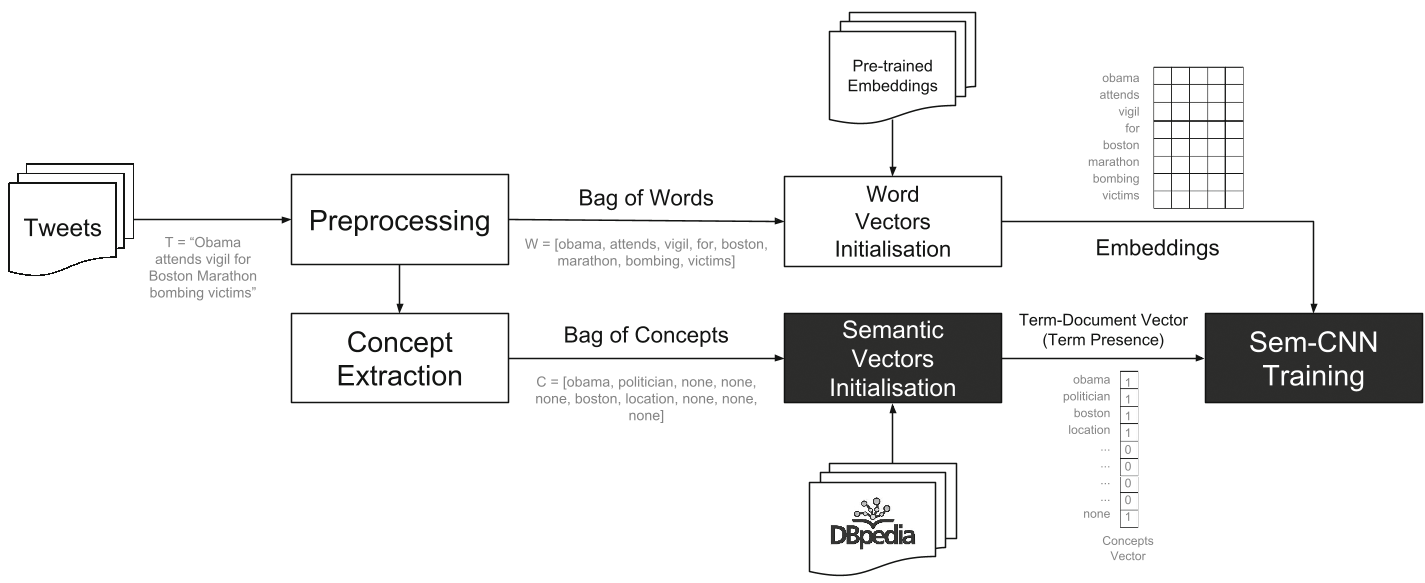 Figure 1: The Sem-CNN Pipeline involving text processing, concept extraction, and dual-vector initialization.
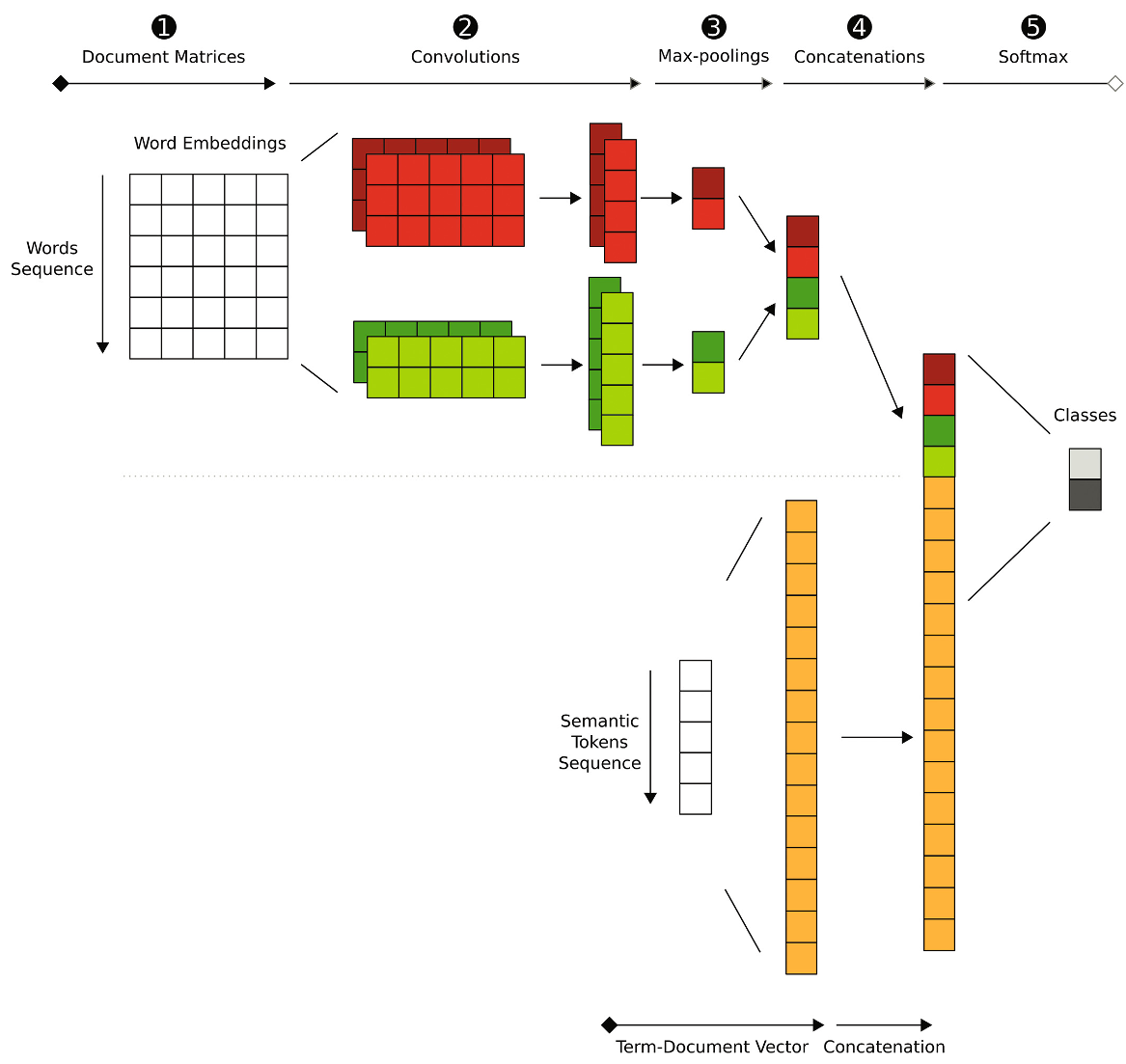 Figure 2: The Sem-CNN Architecture, joining the Deep CNN (left) with the Wide Semantic Layer (right).
Experiments & Results: Semantics Matter
The model was tested against SVM (TF-IDF) and SVM (Word2Vec) baselines. The results were telling:
- Baseline Struggles: Traditional SVMs plateaued between 50-60% F1-measure.
- The Sem-CNN Jump: When semantic richness was high (tweets with at least 2 entities), Sem-CNN reached 64% F1, whereas SVMs plummeted to 49-54%.
- Significance: The improvement wasn't just marginal; the model showed a +22.6% improvement in specific F1 metrics, proving that the wide linear layer effectively "rescued" the CNN from making errors when lexical context was missing.
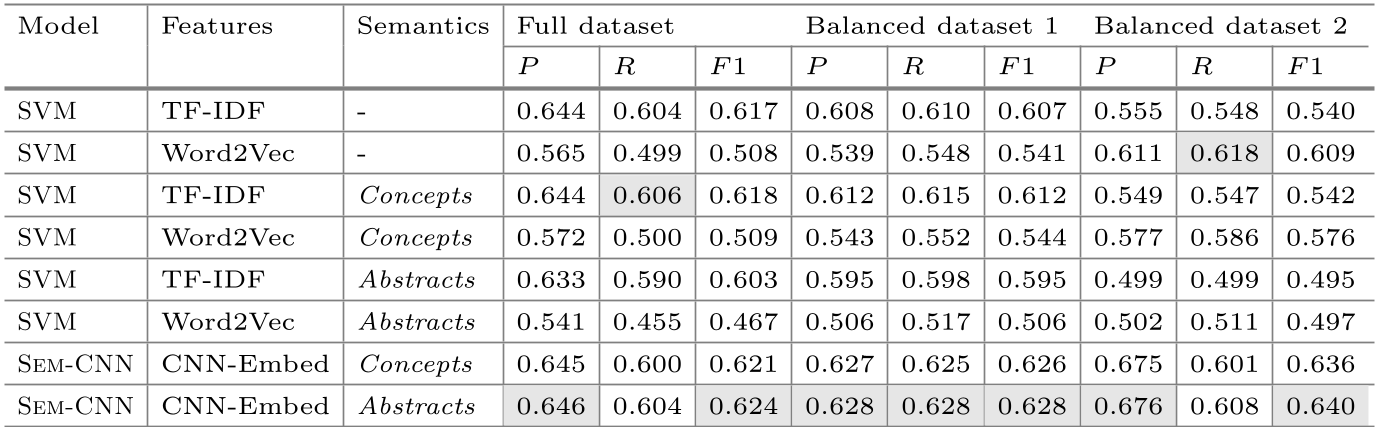 Table 3: Comparative Analysis showing Sem-CNN outperforming all baseline variations across balanced and unbalanced datasets.
Critical Analysis & Conclusion
Takeaway: Sem-CNN demonstrates that for high-stakes, short-text classification, Knowledge Graphs (KG) are the perfect "inductive bias" to help neural networks understand the real world.
Limitations:
- Entity Coverage: The model relies on Entity Extraction tools (TextRazor). If the tool fails to recognize a new, emerging crisis location or organization, the "Wide" component loses its power.
- No Sequential Semantics: The current model uses a "Bag-of-Concepts" approach, ignoring the order of semantic entities.
Future Work: The authors suggest moving toward Semantic Relations (e.g., Location X HAS Crisis Y) or using Hierarchical Attention Networks (HAN) to let the model decide which specific words or entities are most critical for a given classification.
In the evolving landscape of AI for Social Good, Sem-CNN provides a robust blueprint for how we can synthesize "deep learning" with "human knowledge" to save lives during global emergencies.