
Semantically Enhanced Software Traceability: Beyond the Bag-of-Words
Semantically Enhanced Software Traceability Using Deep Learning Techniques
This paper introduces a "Tracing Network" based on Deep Learning for automated software traceability. By utilizing Word Embeddings and Recurrent Neural Networks (RNN), specifically Bidirectional Gated Recurrent Units (BI-GRU), the method achieves significant improvements in generating trace links between high-level requirements and design artifacts in safety-critical domains.
TL;DR
Researchers from the University of Notre Dame have developed a deep learning-based Tracing Network that utilizes BI-GRU (Bidirectional Gated Recurrent Units) and specialized word embeddings to automate the creation of trace links. Unlike traditional methods that get lost in keyword mismatches, this approach learns the "internal language" of software requirements and design, outperforming industry-standard baselines (VSM/LSI) by over 40% in precision and recall.
Background: The Traceability Crisis in Safety-Critical Systems
In domains like aviation (DO-178C) or rail control, traceability isn't just a "nice-to-have"—it's a regulatory mandate. Engineers must prove that every hazard is addressed by a requirement, every requirement is represented in design, and every design element is tested.
However, manual tracing is a nightmare: it's time-consuming, expensive, and prone to human error. Automated Information Retrieval (IR) tools were supposed to help, but they suffer from the "Term Mismatch Problem." If a requirement mentions a "BOS Administrative Toolset" and the design describes an "Operational Data Panel," a standard keyword search will fail to see the link, even though they represent the same concept in context.
The Intuition: Semantics and Sequential Memory
The authors argue that software artifacts are more than a collection of words; they have structure and contextual semantics. To solve the mismatch, the system needs two things:
- Domain Knowledge: Understanding that "locomotive" and "on-board unit" are related.
- Sentence Semantics: Understanding how the order of words changes meaning.
Methodology: The Tracing Network
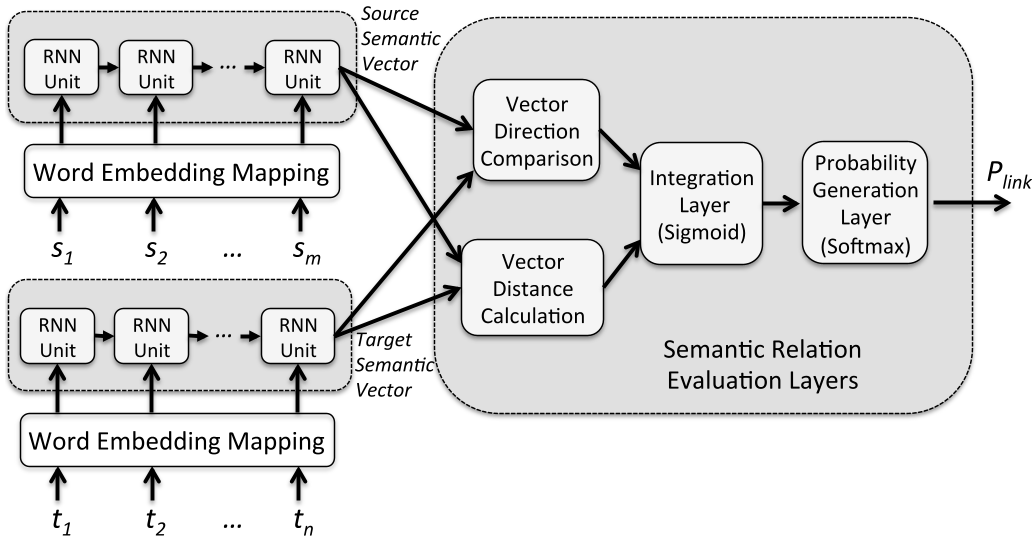
The architecture is a sophisticated pipeline designed to transform raw text into a high-dimensional "semantic space."
1. Domain-Specific Word Embeddings
Before building the network, the authors used Word2vec (Skip-gram) to train vectors on a 52.7MB corpus of Positive Train Control (PTC) documents. This ensures that the model understands domain-specific jargon before it even looks at a requirement.
2. The Recurrent Engine (RNN)
The core of the system is the RNN layer. The authors tested several variants:
- LSTM: Uses a memory cell to capture long-term dependencies.
- GRU: A more efficient version of LSTM with fewer parameters.
- Bidirectional (BI): Processes the sentence both forwards and backwards to capture full context.
3. Semantic Relation Evaluation
Instead of a simple cosine similarity, the network uses a specialized layer to compare two semantic vectors ( and ). It calculates:
- Similarity: Point-wise multiplication ().
- Difference: Absolute subtraction (). These are fed into a Softmax layer to output the final probability of a link.
Experimental Battle: Deep Learning vs. IR Baselines
The authors benchmarked their BI-GRU model against the classic Vector Space Model (VSM) and Latent Semantic Indexing (LSI) on a massive industrial dataset of 1,651 requirements and 466 design artifacts.
Key Findings:
- Superior Accuracy: The BI-GRU achieved a Mean Average Precision (MAP) of 0.598, significantly higher than VSM (0.423).
- The Power of Memory: Standard RNNs outperformed "bag-of-words" baselines, proving that word order matters in software engineering documentation.
- Gains with Scale: When the training data was bumped to 80% (simulating a project evolving over time), the MAP soared to 0.834.
Deep Insight: How the GRU "Thinks"
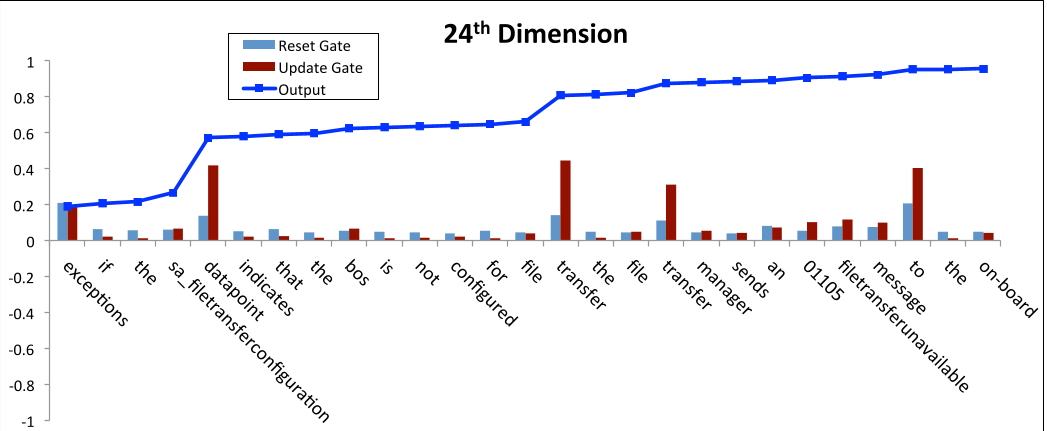
One of the most fascinating parts of the study is the visualization of Gate Behavior. By looking at the "Reset" and "Update" gates of the GRU, the authors showed how the model "attends" to specific keywords like transfer or message while filtering out noise. Some dimensions in the vector focus on global keywords, while others track local context shifts (e.g., changing from a discussion about "datapoints" to "system users").
Critical Analysis & Conclusion
While the Tracing Network represents a massive leap forward, it isn't perfect. The authors noted a "glass ceiling" in precision caused by its inability to rule out certain false positives that share many semantic associations but serve different functional roles.
Limitations:
- Cold Start: The model requires an initial set of manual links to "learn" the domain, making it difficult to use in a completely brand-new project with zero history.
- Negative Sampling: The performance is highly sensitive to how "non-links" are sampled during training.
The Future:
This work sets the stage for shifting software engineering from syntactic matching to semantic reasoning. The next frontier? Applying these models to cross-modal tasks, such as tracing natural language requirements directly to Source Code or System Logs, potentially revolutionizing how we maintain safety-critical software throughout its lifecycle.