
GRIS-SIM: Bridging Structural Connectivity and User Semantics in Influence Maximization
Semantics-aware influence maximization in social networks
This paper introduces the Semantics-aware Influence Maximization (SIM) problem, which incorporates user-specific semantic values into the traditional structural influence maximization task. The authors propose the GRIS-SIM framework, utilizing a Generalized Reverse Influence Set (GRIS) technique that achieves a state-of-the-art -approximation guarantee while significantly improving efficiency through an optimal sampling strategy.
Executive Summary
In the world of viral marketing, not all "nodes" are created equal. Influencing 1,000 random users is rarely as valuable as influencing 100 high-value target customers. Traditional Influence Maximization (IM) has long focused on the topology of social graphs—finding the structural "kings" of the network—while remaining blind to the semantics of the individuals.
This paper presents GRIS-SIM, a semantics-aware framework that redefines the IM objective. By integrating semantic values directly into a generalized Reverse Influence Set (RIS) framework, the authors achieve a theoretical approximation guarantee while boosting expected influence by up to 58% and improving computational efficiency by an order of magnitude.
The Problem: The "Blind" Spots of Traditional IM
Standard IM algorithms aim to maximize the number of activated nodes. However, in scenarios like promoting professional medical equipment, a "share" from a medical student is far more valuable than one from a general trader.
The authors identify three fatal flaws in previous works:
- Semantic Ignorance: Treating a high-value target and a low-value user as identical 1s in an objective function.
- Structural Disruption: Earlier "semantic" methods often partitioned networks into sub-graphs, which destroys the natural diffusion properties of the social network.
- Lacking Generality: Most solutions were bespoke for specific attributes (like location) and could not generalize to arbitrary user tags or weights.
Methodology: The Power of Weighted Sampling
The core innovation lies in the Generalized RIS (GRIS) technique. Traditional RIS-based methods sample nodes uniformly to build Reverse Reachable (RR) sets. GRIS, however, introduces a flexible Sampling Strategy .
1. The Strategy Framework
Instead of uniform sampling, GRIS uses two vectors:
- Vector : Defines the probability of choosing a specific node as a root for an RR set.
- Vector : Assigns a weight to the resulting RR set based on the root node's semantic value.
2. The Optimal Sampling Strategy ()
The researchers mathematically prove that the optimal way to minimize the number of samples—and thus the runtime—is to sample nodes with a probability proportional to their semantic value.
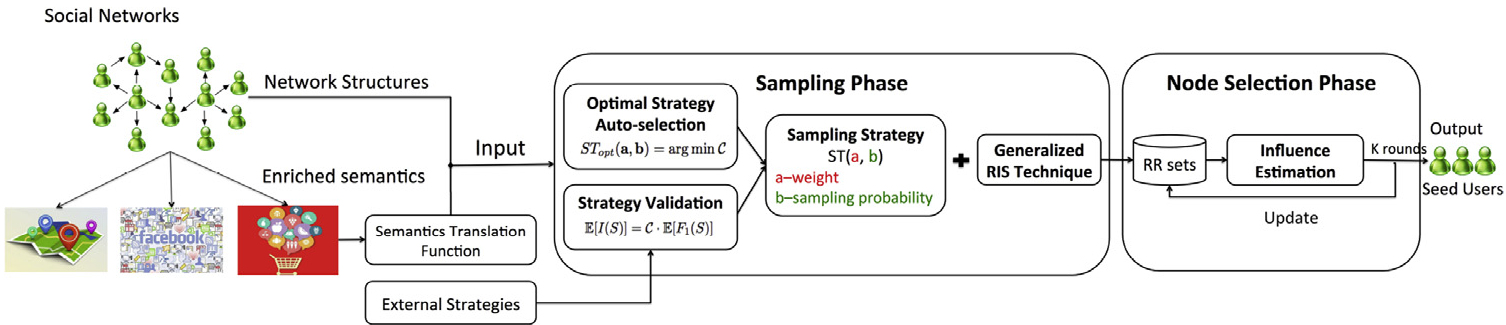 Figure 1: The GRIS-SIM framework bridging various semantics (locations, shopping history, etc.) with social structures.
Experimental Validation
The authors tested GRIS-SIM against competitors like BWR and LDD across datasets ranging from Hamsterster to YouTube (1.1M nodes).
SOTA Performance
Under both Independent Cascade (IC) and Linear Threshold (LT) models, GRIS-SIM consistently outperformed heuristic methods. Because GRIS-SIM uses a theoretically grounded unbiased estimator, it finds seeds that are strategically placed to reach high-value semantic clusters.
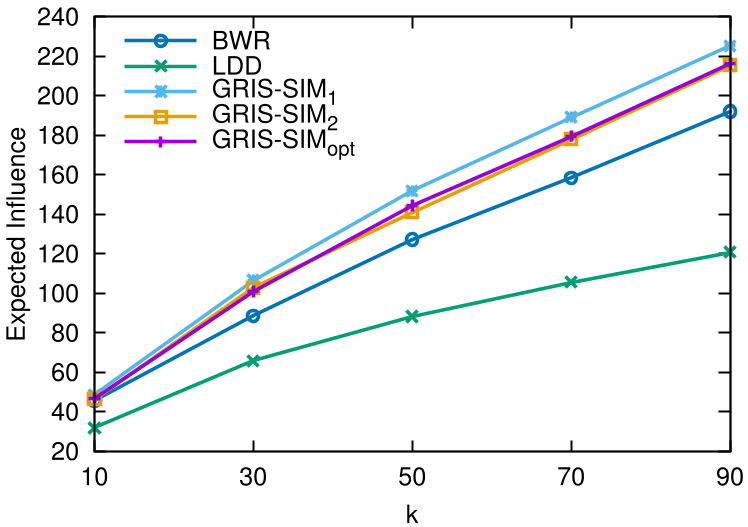 Figure 2: Expected influence comparison across different datasets. GRIS-SIM variants (blue/green/red) sit significantly higher than heuristic baselines.
Computational Efficiency
One of the most striking results is the efficiency of . By avoiding the generation of RR sets for "worthless" or low-semantic nodes, maintains the same accuracy while requiring significantly fewer total samples.
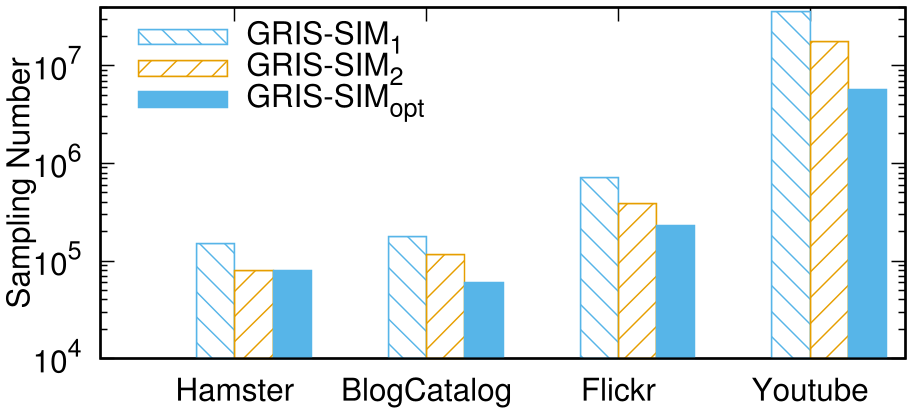 Figure 3: Comparison of required sampling sizes (). The optimal strategy () requires the fewest samples to reach the target error bound.
Critical Insight: Why it Works
The "magic" of GRIS-SIM isn't just that it "prefers" high-value nodes; it’s that it uses the Martingale Central Limit Theorem to bound the estimation error. By intelligently selecting which areas of the graph to sample deeply, the algorithm spends its "computational budget" where the semantic payoff is highest.
Conclusion & Future Outlook
GRIS-SIM successfully moves Influence Maximization from a purely topological problem to an application-aware problem. While the current work focuses on static networks, the authors point toward dynamic networks and competitive IM (multiple agents vying for influence) as the next frontier. For practitioners in viral marketing and social analytics, this paper provides a robust blueprint for targeting influence where it truly generates value.