
GRIS-SIM: Bridging the Gap Between Network Structure and User Semantics in Influence Maximization
Semantics-aware influence maximization in social networks
This paper introduces the Semantics-aware Influence Maximization (SIM) problem, which incorporates user-specific semantic values into the traditional influence spread objective. The authors propose the GRIS-SIM framework, a generalized Reverse Influence Set approach that achieves a state-of-the-art (1 - 1/e - ε) approximation guarantee while significantly optimizing efficiency.
TL;DR
The classic Influence Maximization (IM) problem asks: "Who are the most influential people?" But for a brand, the real question is: "Who are the people who will influence the most valuable customers?" This paper introduces Semantics-aware Influence Maximization (SIM) and the GRIS-SIM framework, which integrates user value (semantics) into the mathematical core of influence spread, achieving SOTA accuracy with significantly higher efficiency.
Problem & Motivation: The Identity Crisis in Social Graphs
Traditional IM algorithms are "identity-blind." They focus purely on the topology of the graph—the number of hops and the probability of activation. In reality, a bookseller doesn't just want to reach anyone; they want to reach students.
The authors identify three fatal flaws in previous works:
- Ignoring Semantics: Treating a "high-value" node the same as a "low-value" node during the optimization process.
- Breaking Structural Constraints: Partitioning the network into semantic sub-graphs (e.g., a "student graph"), which ignores cross-community influence.
- Lacking Generalization: Most existing solutions are hyper-specialized (e.g., only for location data) and lack a robust theoretical approximation guarantee.
Methodology: The Power of Generalized RIS (GRIS)
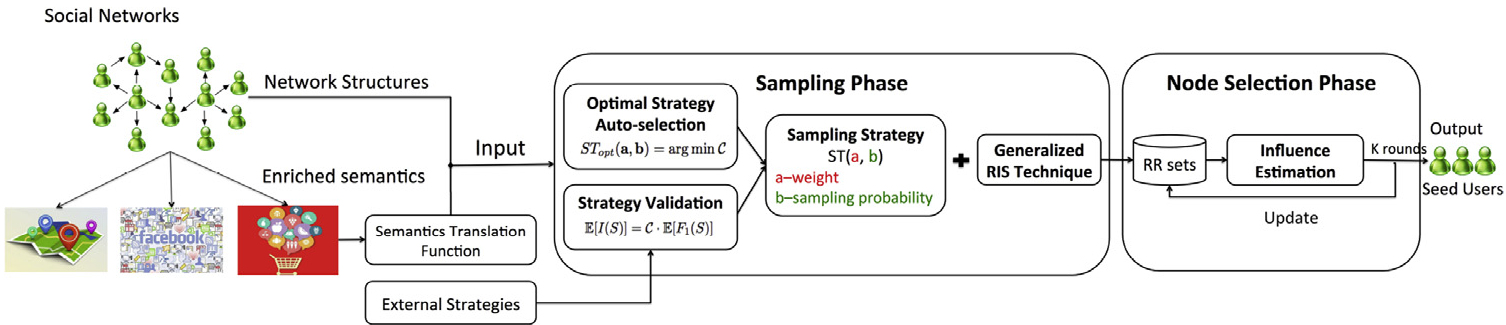
The core innovation is the GRIS (Generalized Reverse Influence Set) technique. To understand this, we must look at how standard RIS works: it samples "nodes" to see who can reach them. GRIS-SIM evolves this by introducing a Sampling Strategy ST(a, b).
- Vector (Weighting): Assigns a weight to each Reverse Reachable (RR) set based on the root node's semantic value.
- Vector (Probability): Determines the probability of a node being chosen as the root of an RR set.
Architecture Overview
The framework operates in two distinct phases: The Sampling Phase and the Node Selection Phase. By intelligently picking seeds based on a weighted coverage function, the algorithm ensures that the selected "influencers" are those most likely to trigger cascades toward high-value semantic targets.
The Optimal Strategy
The authors prove that the absolute most efficient way to sample is the STopt strategy, where nodes are sampled in direct proportion to their semantic value . This allows the algorithm to ignore "zero-value" nodes in the network entirely, drastically reducing the computational overhead.
Experiments & Results: Efficiency Meets Effectiveness
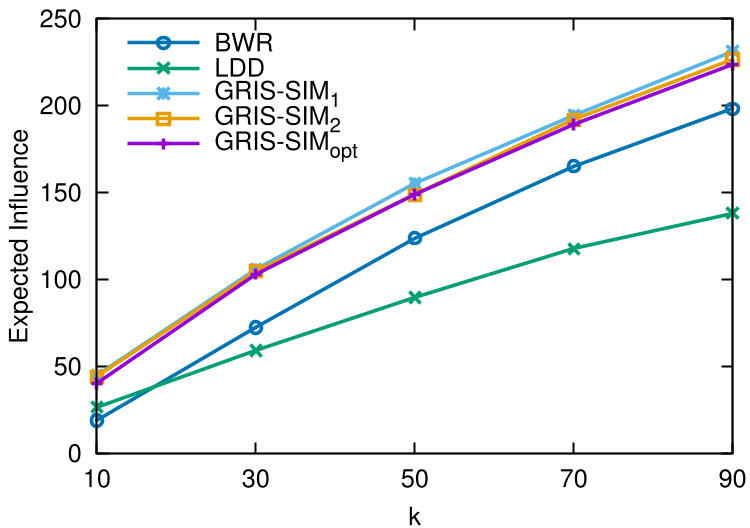
The authors tested GRIS-SIM against heuristic baselines (BWR, LDD) and other SOTA methods across datasets like Flickr, YouTube, and Gowalla.
1. Superior Influence Spread
GRIS-SIM consistently outperformed competitors by identifying seeds that reach high-value clusters. In datasets with skewed semantic values, the improvement reached up to 58%.
2. Efficiency Gains
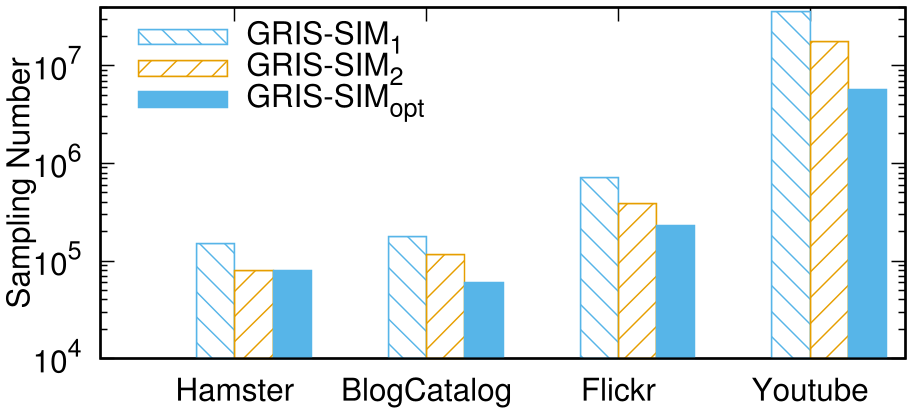
By using the STopt strategy, the framework achieved "near-linear" time complexity. Compared to GRIS-SIM1 (uniform sampling), the optimized version is orders of magnitude faster because it doesn't waste time simulating cascades for nodes that the user doesn't care about.
Critical Analysis & Conclusion
The brilliance of this work lies in its theoretical rigor. Many "semantic" algorithms rely on heuristics; this paper uses Martingale theory to prove a approximation ratio.
Takeaway: If you are building a viral marketing engine or a recommendation system, the message is clear: stop treating your graph as just nodes and edges. By embedding user semantics directly into the sampling probability, you can achieve better results with less compute.
Limitations: The current model assumes a static network. In real-world scenarios, semantics (interests) and structures (friendships) are fluid. Future work extending GRIS-SIM to dynamic, time-evolving graphs will be the next frontier in social network analysis.