
Semantic Selection: A New Frontier in Job Shop Scheduling Efficiency
A semantics-based dispatching rule selection approach for job shop scheduling
This paper introduces a novel semantics-based approach for selecting dispatching rules in job shop scheduling. By utilizing an extended Sustainable Manufacturing Ontology and a tree-matching algorithm to calculate semantic similarity between production objectives and rules, the system achieves high-performance scheduling (SOTA results in multi-objective scenarios) without the heavy data requirements of machine learning or extensive simulations.
TL;DR
In the high-stakes world of industrial manufacturing, choosing the right "Dispatching Rule" (DR) is the difference between a streamlined floor and a bottlenecked disaster. While most systems rely on rigid rules for single goals, this paper introduces a Semantics-based Selection System. By treating scheduling goals and rules as "concepts" with measurable linguistic similarity, the system can automatically engineer perfect rule combinations for complex, multi-objective scenarios in real-time.
The Motivation: The "Static Rule" Bottleneck
Historically, a job shop might use Shortest Processing Time (SPT) to maximize throughput. But what if a customer suddenly demands high priority for a specific late order? Traditional rules struggle to balance these conflicting goals without manual intervention or exhaustive simulation.
The authors identified that current state-of-the-art (SOTA) methods—mostly Machine Learning (ML) or Simulation-based—suffer from a major flaw: Brittleness. If you change the objective, you have to retrain the model or rerun thousands of simulations. This paper asks: What if the model understood "what" the rule and the objective actually meant?
Methodology: Mining Meaning from Math
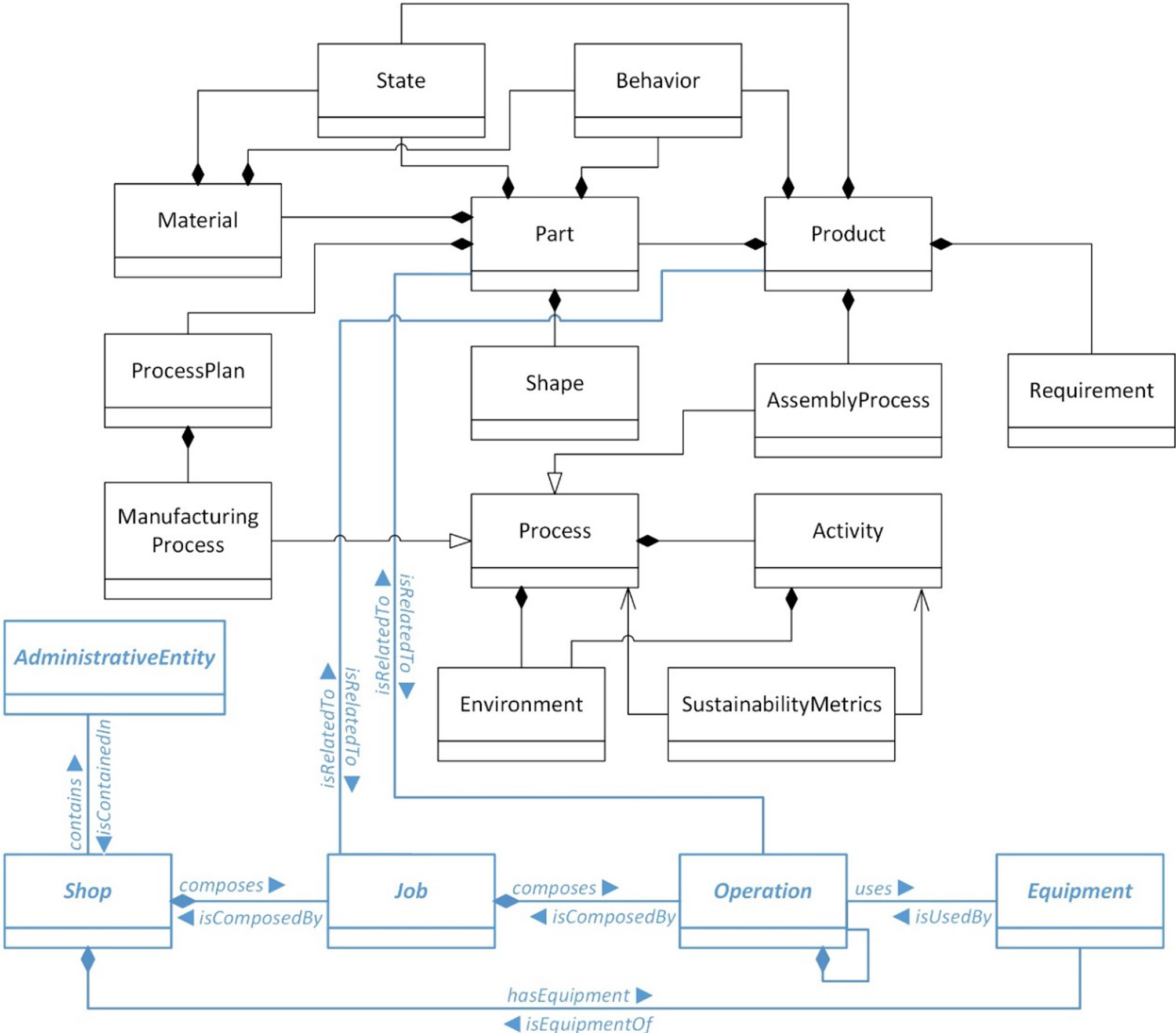
The core innovation lies in the Sustainable Manufacturing Ontology. The authors extended existing models to include specific scheduling parameters like JobDueDate, ProcessingTime, and TardinessPenalty.
1. Semantic Expression
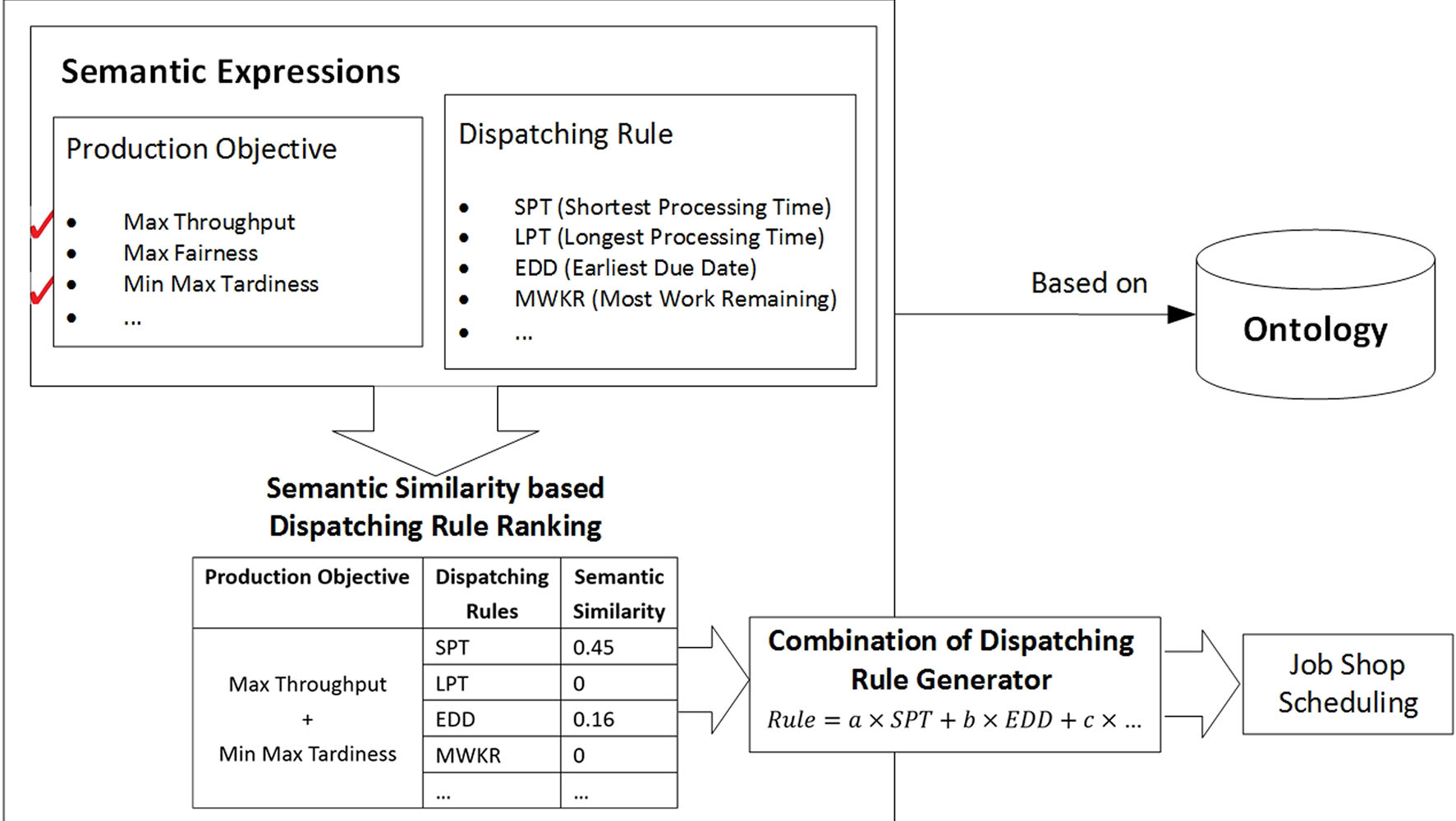
Every rule and objective is translated into a tree structure. For example, "Minimize Tardiness" is no longer just a variable; it is a semantic branch consisting of JobDueDate (Early) and OperationDueDate (Early).
2. The Tree-Matching Algorithm
To compare a rule (the tool) against an objective (the goal), the authors developed a tree-matching algorithm.
- Depth Weighting: Higher-level concepts (General) carry more weight than leaf nodes (Specific attributes).
- Logic Gates: The algorithm handles "AND" and "OR" relationships within the rules, ensuring that the similarity score reflects logical intent.
Experiments: Proving the Intuition
The team tested their approach against a simulated environment of 8 machines and 50 jobs. They evaluated 16 dispatching rules against 10 distinct production objectives.
Key Findings:
- Zero-Shot Adaptation: The system could select effective rules for "randomly selected combinations of objectives" without needing previous data for those specific pairs.
- Composite Superiority: When objectives were combined (e.g., Fairness + Makespan), the system generated weighted composite rules that outperformed any single, stand-alone rule.
Deep Insight: Why This Matters
The industry is moving toward Industry 4.0, where "agility" is the buzzword. Most AI solutions focus on Data, but this work focuses on Knowledge.
By using an ontology, the system possesses an Inductive Bias that understands the physics of manufacturing. It knows that "Tardiness" is fundamentally related to "Due Dates" because they share semantic roots. This allows the system to make "common sense" decisions that a pure black-box neural network might take thousands of trials to learn.
Conclusion & Limitations
This semantics-based approach offers a significant shortcut for manufacturers who cannot afford the time for simulation or the data for deep learning.
Future Outlook: While powerful, the method currently relies on a manually curated ontology. The next evolution of this work likely involves using Large Language Models (LLMs) to automatically extract these semantic relationships from technical manuals, potentially automating the entire system setup.
Academic Reference: Zhang, H., Roy, U. A semantics-based dispatching rule selection approach for job shop scheduling. J Intell Manuf (2018).