
SMSN: Bridging the Semantic Gap in Large-Scale Mobile Ad Hoc Social Networking
A Semantics-based Approach to Large-Scale Mobile Social Networking
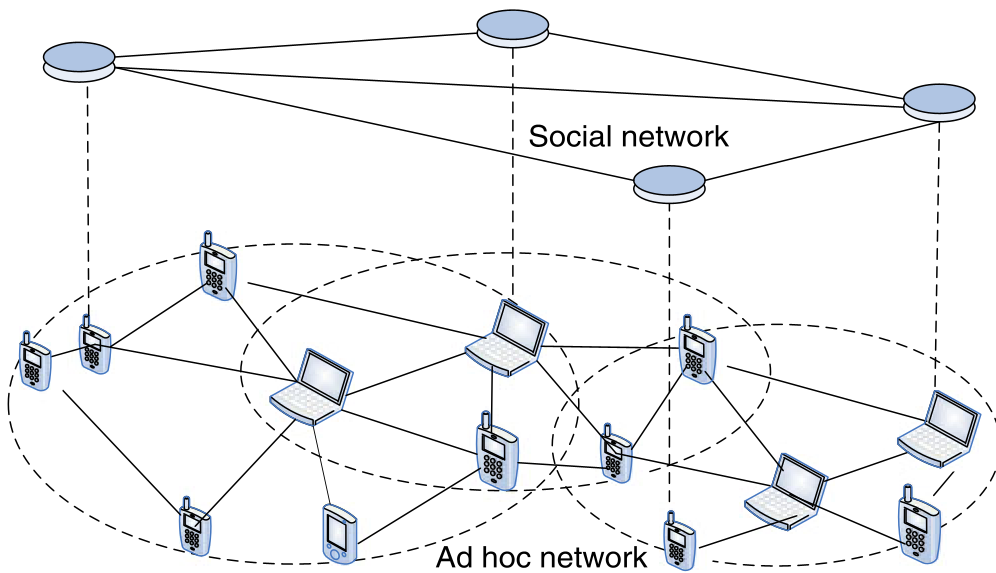
The paper introduces SMSN (Semantics-based Mobile Social Network), a novel framework for establishing spontaneous multi-hop social networks using mobile ad hoc networks (MANET). It leverages OWL-based ontologies and a Semantic Distance-Vector (SDV) routing protocol to enable intelligent friend discovery and privacy-preserving profile matching without relying on centralized infrastructure.
Executive Summary
TL;DR: SMSN is a pioneering framework that turns a collection of mobile devices into a smart, self-configuring social network. By shifting from simple keyword matching to ontological reasoning, it allows users to find "friends" based on the meaning of their interests (e.g., matching "mobile networks" with "ad hoc systems") while using a specialized Semantic Distance-Vector (SDV) protocol to keep network overhead low.
Background: Published at a time when mobile social networking was transitioning from centralized apps (like early Facebook Mobile) to spontaneous interactions, this paper sits at the intersection of Semantic Web and MANET (Mobile Ad Hoc Network) research. It moves beyond "proximity alerts" to true decentralized community building.
Problem & Motivation: The "Keyword" Trap
Before SMSN, spontaneous social networks—tools used at conferences or stadiums—fell into two traps:
- Semantic Ambiguity: If I list "Distributed Systems" and you list "P2P Computing," a keyword-based system sees zero overlap. This "vocabulary problem" hinders the discovery of meaningful social patterns.
- The Flooding Curse: In a multi-hop ad hoc network, finding a person five hops away usually requires "flooding" (broadcasting to everyone), which kills mobile battery life and clogs narrow bandwidth.
The authors' insight was to use Ontologies to provide a common language and Cross-layer Routing to "guide" queries toward semantically similar nodes rather than shouting in the dark.
Methodology: Intelligence at the Edge
The SMSN architecture is built on four pillars:
1. Ontological Profile Generation
Instead of a flat list of tags, users have an OWL-DL profile. To save memory on phones, the system separates the T-Box (general hierarchy of concepts) from the A-Box (your specific instances).
2. Semantic Similarity Measurement
The core innovation is the Weighted-Distance Measure. It doesn't just count hops in an ontology tree; it considers:
- Node Depth: Concepts deeper in the tree (more specific) are more similar than broad concepts at the top.
- Link Type: "Equivalent-to" links have a shorter semantic distance than "has-a" links.
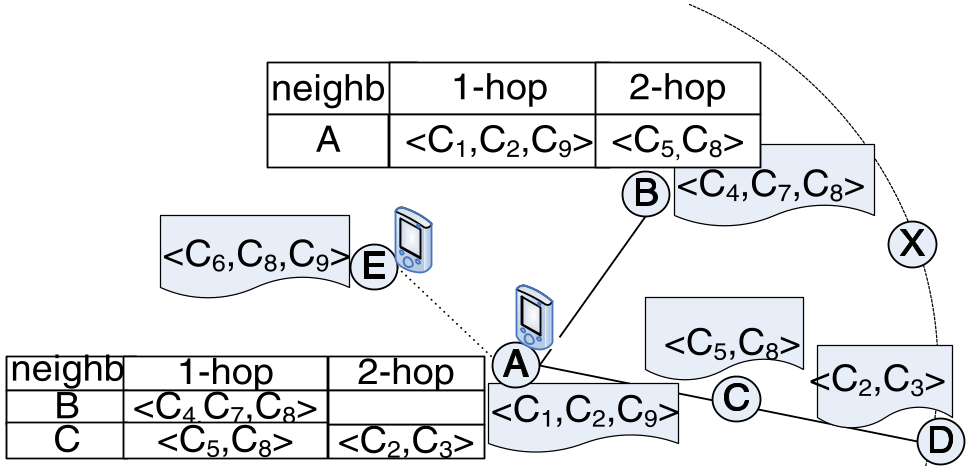
3. SDV Routing (Semantic Distance Vector)
Imagine a routing table that doesn't just store "IP addresses" but "Interest Vectors." Effectively, node A tells node B: "I have access to people interested in [Databases] within 2 hops." This allows queries to "leap" across the network toward the right semantic neighborhood.
Experiments & Results: Precision Meets Efficiency
The authors benchmarked SMSN against standard exact-match and flooding techniques:
- Discovery Success: Ontology-based matching (O1/O2) identified significantly more friends than keyword matching (E1/E2). Even with a strict similarity threshold (t=0.8), the semantic approach found relations the keyword approach missed.
- Scalability: Surprisingly, as profiles became more complex (more properties), the latency on J2ME-powered phones remained nearly constant, proving the efficiency of the "Instance Projection" method.
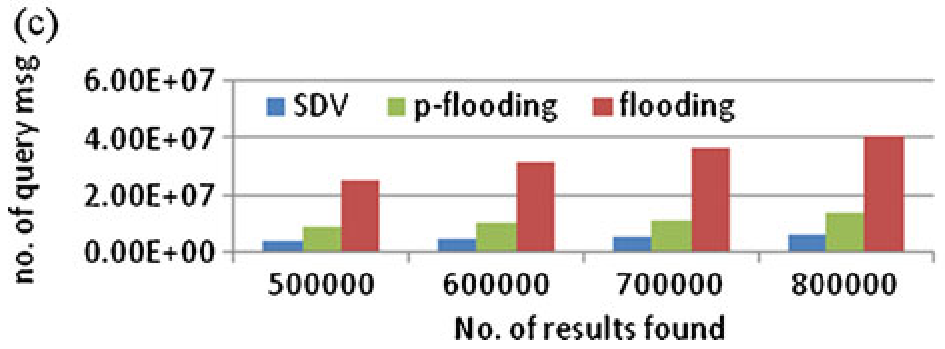
- Mobility Resilience: Even at speeds of 20 m/s, the SDV protocol maintained its lead over p-flooding, demonstrating that semantic "hints" in routing tables are robust against changing topologies.
Critical Analysis & Conclusion
Takeaway
SMSN successfully proved that the Semantic Web isn't just for servers; it's a powerful tool for the edge. By integrating semantic indices into the routing layer, the authors solved the dual problem of "who to connect with" and "how to find them" without a central server.
Limitations & Future Work
- The Shared Ontology Assumption: The system assumes every node uses the same T-Box. In a real-world heterogeneous environment, "Ontology Alignment" (mapping two different trees) would be necessary.
- Privacy Overhead: While the homomorphic encryption for exact matching is secure, it is computationally expensive for 2011-era phones. Modern implementations might look toward Trusted Execution Environments (TEEs) or Zero-Knowledge Proofs (ZKPs).
Overall, SMSN remains a foundational reference for anyone designing decentralized social protocols or intelligent IoT mesh networks.