
SemCaDo: Harmonizing Causality and Serendipity for Intelligent Ontology Evolution
SemCaDo: A serendipitous strategy for causal discovery and ontology evolution
SemCaDo is a novel active learning framework for Causal Bayesian Networks (CBNs) that integrates semantic background knowledge from domain ontologies. It utilizes a "serendipitous" strategy to guide experimental interventions and automates ontology evolution by feeding discovered causal relationships back into the knowledge base.
Executive Summary
TL;DR: SemCaDo is an active learning framework that bridges the gap between Causal Bayesian Networks (CBNs) and Domain Ontologies. By using a "serendipitous" discovery strategy, it identifies the most informative experiments to resolve causal ambiguities and then re-integrates these findings to evolve the underlying ontology.
Background Positioning: This work represents a significant leap in Statistical Relational Learning. While most SOTA methods treat data and knowledge as separate entities, SemCaDo treats them as a closed-loop system, where knowledge guides data collection and data validates knowledge evolution.
Problem & Motivation: The "Blind" Search for Causality
The "holy grail" of data science is moving from mere correlation to causality. However, standard Bayesian Networks suffer from Markov Equivalence—different causal structures can explain the same observational data perfectly.
To find the "true" structure, researchers perform interventions (experiments). But experiments are:
- Expensive: Testing gene knockouts or clinical trials costs millions.
- Infinite: Without guidance, the number of possible experiments is overwhelming.
The Insight: Human experts don't experiment randomly; they use their semantic understanding of the world. SemCaDo replicates this by using ontologies—structured representations of a domain—to prioritize "surprising" discoveries that provide the most value to our global knowledge base.
Methodology: The Serendipitous Strategy
The core of SemCaDo is its Utility Function, which moves beyond simple connectivity-based metrics.
1. Semantic-Driven Utility
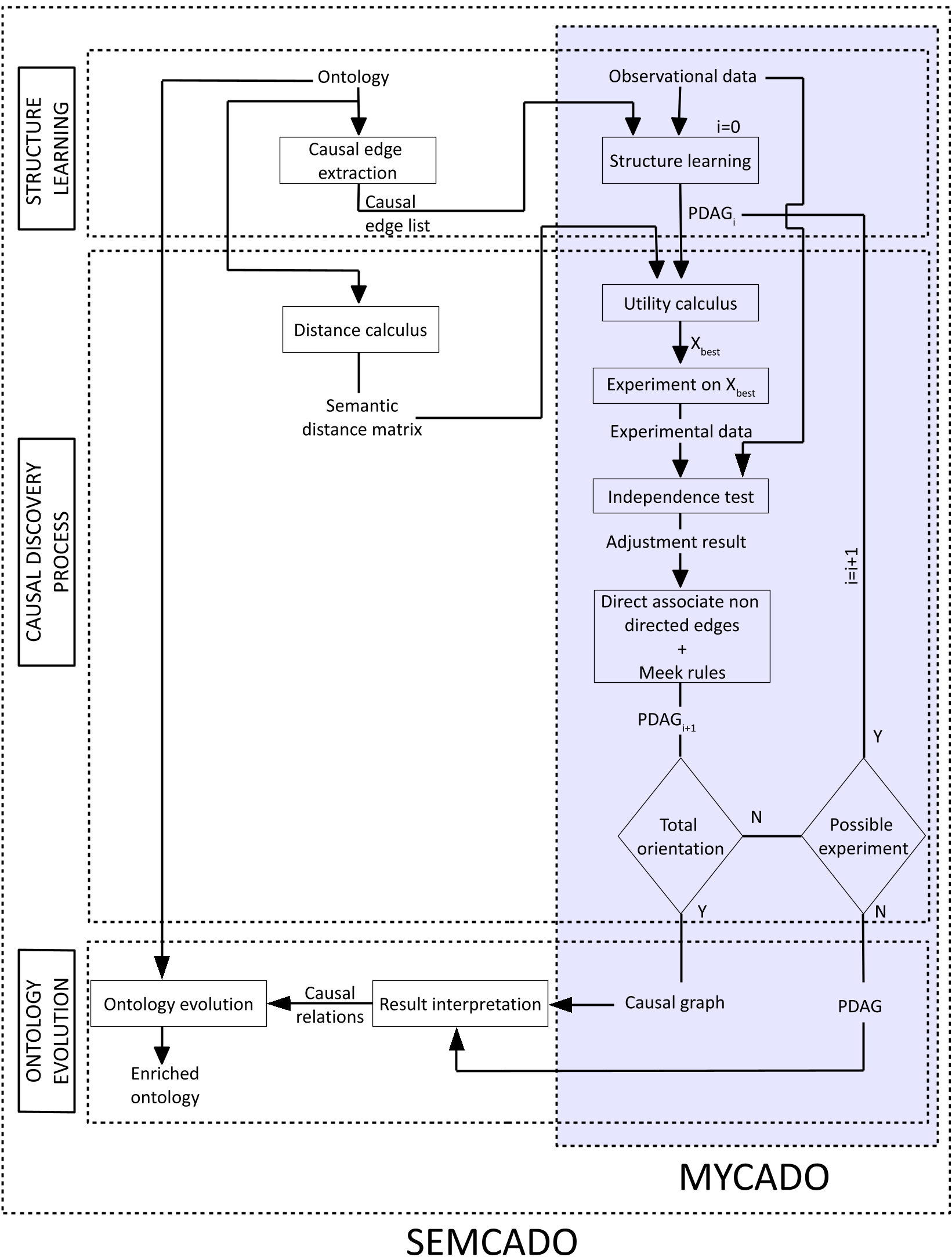
Unlike previous algorithms like MyCaDo that only look at how many edges an experiment might orient, SemCaDo introduces Semantic Inertia (). This metric measures the "semantic distance" between variables in the ontology hierarchy.
2. The Feedback Loop
The workflow follows a rigorous three-step cycle:
- Initialization: Extract existence constraints (e.g., ) from the ontology to prune the DAG search space.
- Active Discovery: Select the next experiment that maximizes , effectively searching for "unexplored" biological or physical pathways.
- Evolution: Validated discoveries are fed into an Ontology Evolution Cycle (Capture Represent Validate), moving the ontology from one consistent state to a more enriched one.
Experiments: Genetic Discovery in Yeast Cells
The authors validated SemCaDo using Saccharomyces cerevisiae (Yeast) genomic data. This is a classic "Big Data, High Uncertainty" problem where thousands of genes interact.
Key Performance Metrics:
- Saved Experiments: When the ontology provided clear discriminative information, SemCaDo saved up to 57% of unnecessary experiments compared to standard active learning.
- Cumulative Gain: The algorithm reaches a "semantic maxima" much faster than baselines, meaning it finds the most important causal links early in the process.
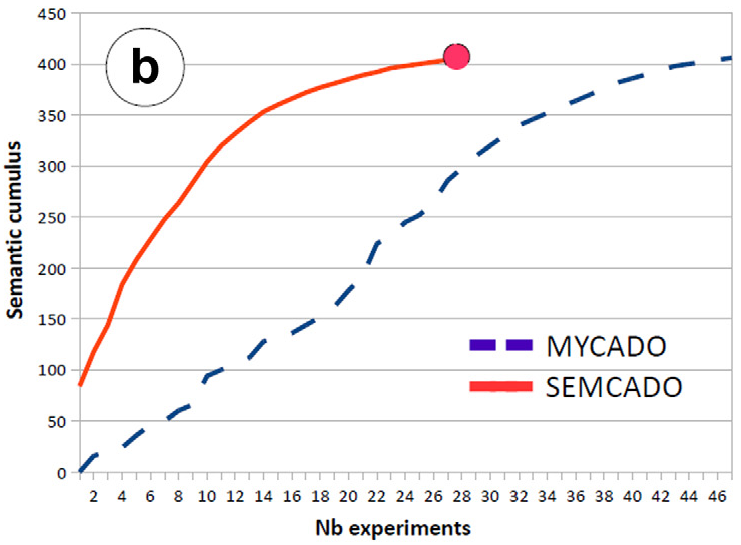
The study also highlighted a critical factor: Multiple Annotations. In complex ontologies like GO (Gene Ontology), genes often have multiple roles. The authors found that using "single annotations" (simplifying the model) actually made SemCaDo’s serendipity more effective, as it could more clearly identify "unexpected" relations between distant semantic concepts.
Critical Analysis & Conclusion
Takeaway
SemCaDo successfully transforms the learning of Causal Bayesian Networks from a pure statistical task into a knowledge-aware process. Its ability to "reuse" existing knowledge to save on experimentation costs is a major win for fields like drug discovery and traffic management.
Limitations
- Causal Sufficiency: The model assumes no hidden (latent) variables, which is rarely true in real biology.
- Complexity: Calculating semantic distances iteratively for massive ontologies can be computationally expensive (though caching can mitigate this).
Future Outlook
The next frontier for SemCaDo is moving toward Semi-Markovian models to account for hidden confounders. Furthermore, with the rise of Large Language Models, we can imagine a version of SemCaDo that dynamically updates its ontology by reading real-time scientific literature, creating a truly autonomous "AI Scientist."
Reference: Ben Messaoud, M., Leray, P., & Ben Amor, N. (2014). SemCaDo: A serendipitous strategy for causal discovery and ontology evolution. Expert Systems with Applications.