
SOAM: Bridging the Gap Between Relational Databases and the Semantic Web
A Semi-automatic Ontology Acquisition Method for the Semantic Web
The paper introduces the Semi-automatic Ontology Acquisition Method (SOAM), a framework designed to transform relational database schemas and data directly into OWL (Web Ontology Language). By bridging the gap between relational models and semantic ontologies through mapping rules and lexical refinement, it significantly accelerates Semantic Web development.
TL;DR
The success of the Semantic Web hinges on the availability of high-quality ontologies. However, building them manually is a nightmare. SOAM (Semi-automatic Ontology Acquisition Method) addresses this by leveraging the massive amounts of data already stored in relational databases. It extracts OWL ontologies using a rigorous set of transformation rules and refines them using authoritative lexical knowledge (like WordNet) to ensure the resulting knowledge graph is both accurate and useful.
Background & Motivation: Why Databases?
If the Semantic Web is the "future" of information, Relational Databases (RDBs) are the "present." Most of the world's structured data lives in SQL tables. Authors Man Li et al. argue that we shouldn't start from scratch; we should transform the rich metadata (schemas) and content (tuples) of existing databases into the Semantic Web's language: OWL.
The challenge isn't just moving data—it’s preserving meaning. Relational models focus on storage efficiency (Normalization), whereas Ontologies focus on logical relationships and hierarchy.
Methodology: The SOAM Framework
SOAM breaks down the "RDB-to-Ontology" problem into four logical steps:
- Schema Capture: Extracting tables, attributes, primary keys, and foreign keys.
- Structural Mapping: Converting the schema into OWL Classes and Properties using a set of 11 rules.
- Refinement: Using external dictionaries to validate and polish the "coarse" machine-generated structure.
- Instance Acquisition: Migrating the actual data tuples into the ontology as individuals.
1. The Core Mapping Logic
The researchers developed 11 specific rules to handle the transition. For example:
- Rule 2: Maps 3NF relations (tables) to Ontological Classes.
- Rule 4 & 5: Transform foreign key relationships into "has-part" or "object properties."
- Rule 9-11: Convert database constraints (NOT NULL, UNIQUE) into OWL Cardinality restrictions.
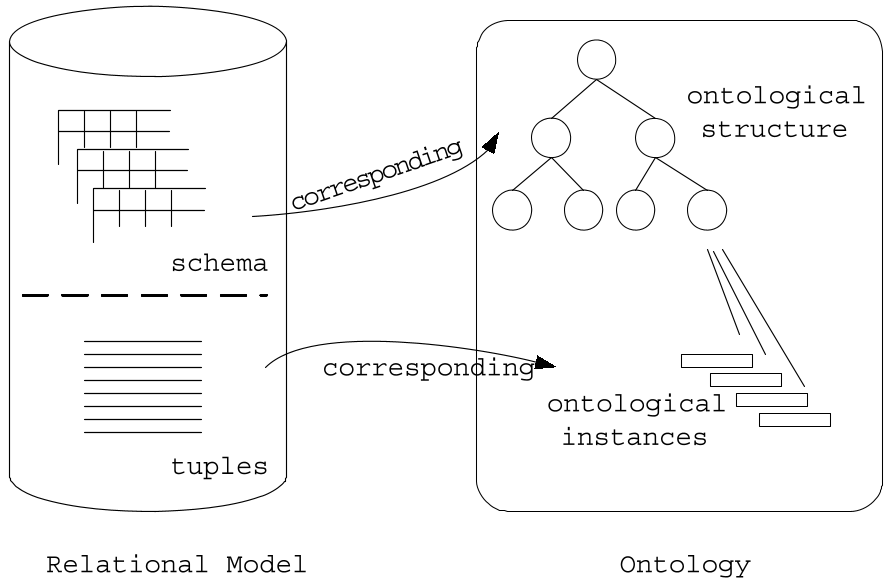 Fig 1: The general correspondence between Relational Databases and Ontological Models.
2. The Refinement Algorithm (The Secret Sauce)
The standout feature of SOAM is the Conceptual Similarity Measure. Instead of just looking at the name of a class (Lexical Similarity), it looks at the neighborhood: This formula ensures that when the system suggests a refinement from WordNet, it considers if the Super-concepts and Sub-concepts also match. This "structural awareness" prevents the system from misidentifying concepts with similar names but different meanings.
Experiments and Case Study
To prove SOAM works, the team applied it to the Digital Library of Renmin University. They targeted the economics domain using the Classified Chinese Library Thesaurus as their gold-standard reference.
Key Results:
- Scale: Created an ontology with 900 classes, 1,100 properties, and 30,000 instances.
- Efficiency: The process bypassed the need for a "middle model," a common overhead in previous academic approaches.
- Tooling: The authors implemented this via CODE, a custom development environment for managing the semi-automatic workflow.
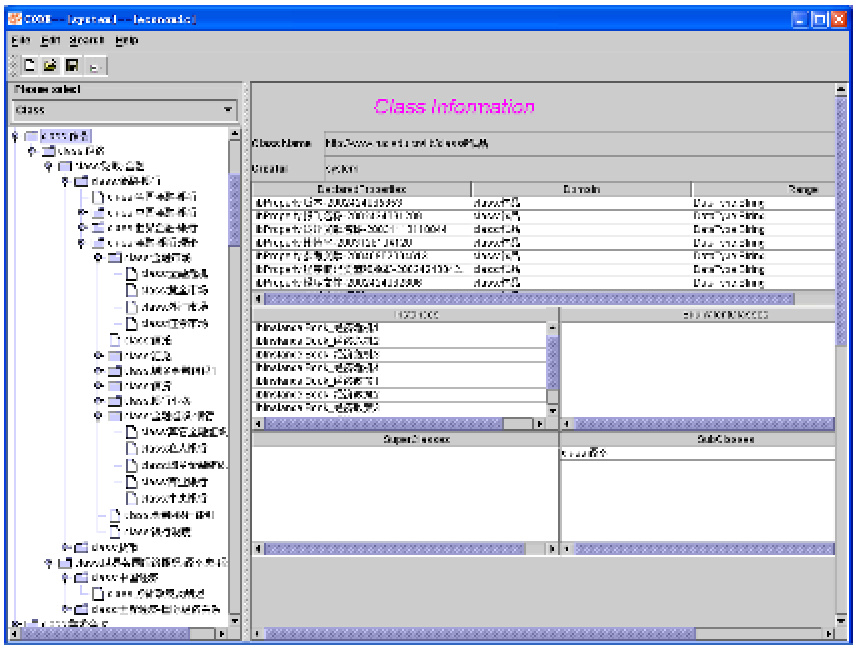 Fig 2: Screen snapshot of the acquired Economic Ontology in the CODE tool.
Critical Insight & Conclusion
SOAM’s primary contribution is its pragmatism. While many papers focus on purely automated mapping, this work acknowledges that database schemas are often "coarse" or optimized for performance rather than semantics. By inserting a human-in-the-loop refinement step powered by lexical similarity algorithms before populating instances, it prevents the propagation of errors.
Limitations: The method assumes a 3rd Normal Form (3NF) database. While common, legacy systems or "data lakes" with messy, unnormalized data might require significant preprocessing before SOAM can be effective.
Takeaway for Practitioners: When migrating legacy data to a Semantic Graph, don't just map tables to classes. Use the "neighborhood" (super-concepts) to validate the mapping, and always refine your schema before you start the heavy lift of data ingestion.