
Graph Anomalies Unveiled: A Fuzzy Approach to Social Network Outliers
6087_A semi-supervised graph-based algorithm for detecting outliers in online-social-networks.
This paper introduces a semi-supervised graph-based algorithm for detecting anomalous nodes in Online Social Networks (OSNs). By combining structural egonet analysis, Gaussian Mixture Model (GMM) clustering, and a Fuzzy Inference Engine, the method achieves significant improvements in detection accuracy, reaching up to 100% F-score on specific datasets.
TL;DR
Detecting "odd" behavior in massive social networks is akin to finding a needle in a haystack of connections. This paper presents a novel semi-supervised framework that combines Egonet structural features, Gaussian Mixture Models (GMM), and Fuzzy Inference Engines. By moving from rigid thresholds to a "degree of abnormality," the method achieves near-perfect F-scores (up to 100%) on large-scale datasets like Facebook and Orkut.
Background: Beyond Simple Statistics
In the context of the early 2010s social media explosion, identifying malicious accounts or structural anomalies became critical for platform security. While traditional methods focused on simple degree distributions or clustering coefficients, they lacked the nuance to distinguish between a "highly active user" and a "structural outlier." The researchers identified that abnormality is not binary; it exists on a spectrum that requires a more sophisticated mathematical handler—Fuzzy Logic.
Methodology: The Three-Pillar Architecture
The proposed algorithm operates in three distinct phases designed to refine raw graph data into actionable intelligence.
1. Structural Feature Extraction
The authors focus on the Egonet—the sub-network centered around a specific node. They calculate two primary anomaly scores ( and ):
- : Measures the density of connections within the egonet.
- : Normalizes these connections against the maximum possible density to identify structural deviations.
2. Unsupervised Clustering via GMM
Rather than setting human-defined thresholds, the paper employs a Gaussian Mixture Model (GMM). By maximizing the Log-Likelihood, the system automatically groups nodes into clusters based on their statistical similarity.
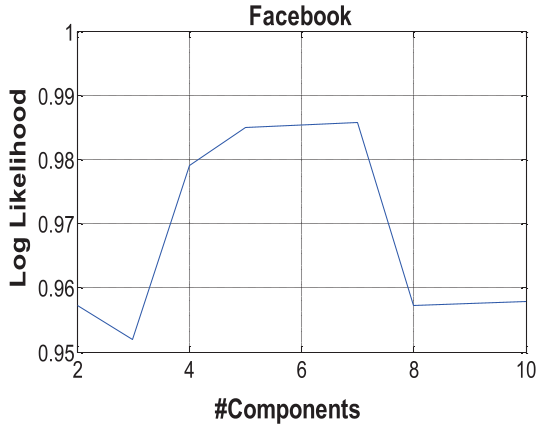 Figure: The optimization process for GMM components across Facebook, Flickr, and Orkut datasets.
3. The Fuzzy Inference Engine
The core innovation lies in the Fuzzy Inference System. It takes the GMM outputs and maps them to membership functions ( to ), converting crisp numbers into linguistic variables like "Low Anomaly" or "High Anomaly." This allows the model to handle the inherent uncertainty of social data.
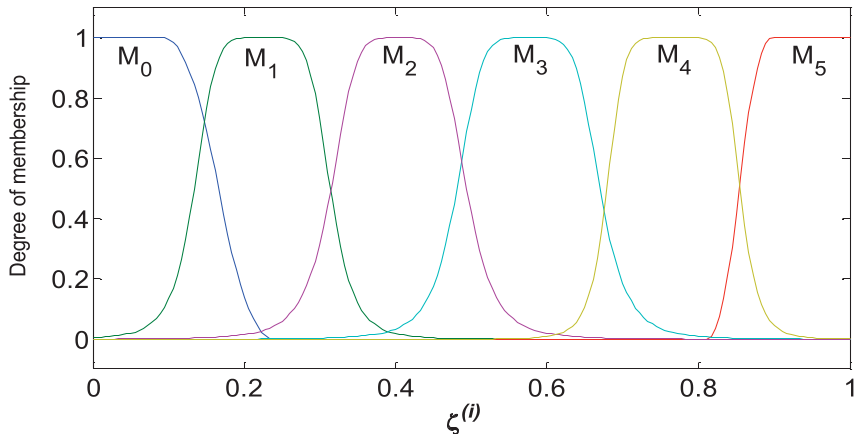 Figure: The input membership functions used to determine the degree of node abnormality.
Experiments: Crushing the Baselines
The researchers tested their approach against OddBall, the SOTA at the time. The results were decisive:
| Dataset | Method | Recall | Precision | F-Score |
|---|---|---|---|---|
| Proposed | 100.00% | 97.06% | 98.51% | |
| OddBall | 59.04% | 98.00% | 73.68% | |
| Orkut | Proposed | 100.00% | 100.00% | 100.00% |
| OddBall | 100.00% | 89.19% | 94.29% |
The "Proposed Method" consistently captured a higher percentage of true outliers (Recall) while maintaining high accuracy (Precision), even in the noisy Flickr environment.
Critical Insight: Why Does It Work?
The success of this method stems from its Hybrid Nature. Purely unsupervised methods often confuse variance with anomalies. By introducing a "semi-supervised" flavor—where the membership functions are derived from the statistical properties of the specific dataset ()—the model adapts its "intuition" of what an outlier looks like based on the network's unique topography.
Future Outlook and Limitations
While highly effective for static graphs, the method:
- Computational Complexity: Calculating egonets for every node in a billion-user graph remains a challenge.
- Temporal Dynamics: The current model doesn't account for how "abnormality" evolves over time.
Overall, this work laid the groundwork for modern anomaly detection by proving that structural context plus probabilistic modeling is the winning formula for graph analysis.