
BWV: Conquering the Long Tail of Emotions in the Twitterverse
Semi-Supervised Method for Multi-category Emotion Recognition in Tweets
The paper introduces a semi-supervised framework for multi-category emotion recognition in tweets, specifically proposing the Balanced Weighted Voting (BWV) algorithm. It leverages small amounts of initial domain knowledge and large-scale unlabeled data to build fine-grained classifiers for 20 emotion categories, achieving significant SOTA improvements in domain-specific contexts like sports.
TL;DR
Recognizing 20 distinct emotions in 140 characters is an uphill battle against data scarcity and class imbalance. This paper presents a semi-supervised framework that uses pseudo-labeling and a novel Balanced Weighted Voting (BWV) algorithm to turn massive unlabeled tweet datasets into high-performance, domain-specific emotion classifiers. By rebalancing the "louder" emotions (like Joy) against "quieter" ones (like Relief), the authors achieved up to a 105% improvement in F1-score.
The Problem: The "Pride" Bias and the Cost of Annotation
Why is emotion recognition so hard? Two reasons: Domain Sensitivity and Data Imbalance. A classifier trained on movie reviews won't understand the specific emotional slang of a "Sports" fan. Furthermore, in any given event, some emotions dominate the conversation. In the Olympics, "Pride" and "Success" are everywhere, while "Contempt" is rare. Standard machine learning models naturally gravitate toward these majority classes, essentially "ignoring" the nuanced tail of human emotion.
Methodology: Distant Supervision meets Rebalancing
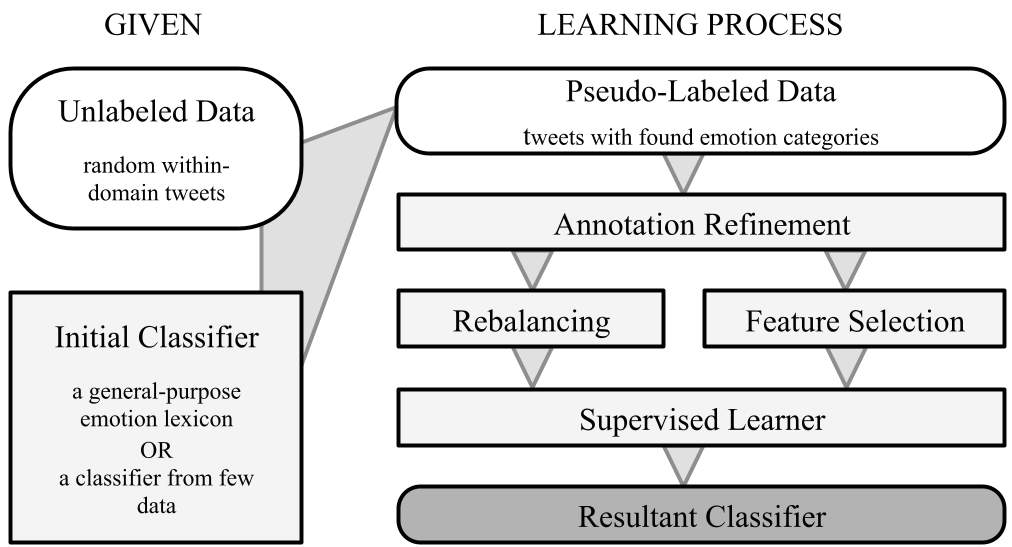
The authors propose a multi-stage pipeline that starts with "weak" knowledge and scales up:
- Pseudo-Labeling: An initial limited classifier (e.g., the GALC lexicon) labels a massive set of unlabeled tweets.
- Feature Selection: N-grams are extracted and filtered using Pointwise Mutual Information (PMI) to ensure only "emotionally charged" words are kept.
- The BWV Algorithm: Instead of a simple vote, BWV calculates a weight for every word-emotion pair while applying a rebalancing coefficient (). This ensures that a word's association with a rare emotion isn't drowned out by its frequent occurrence in dominant classes.
Crushing the Baselines
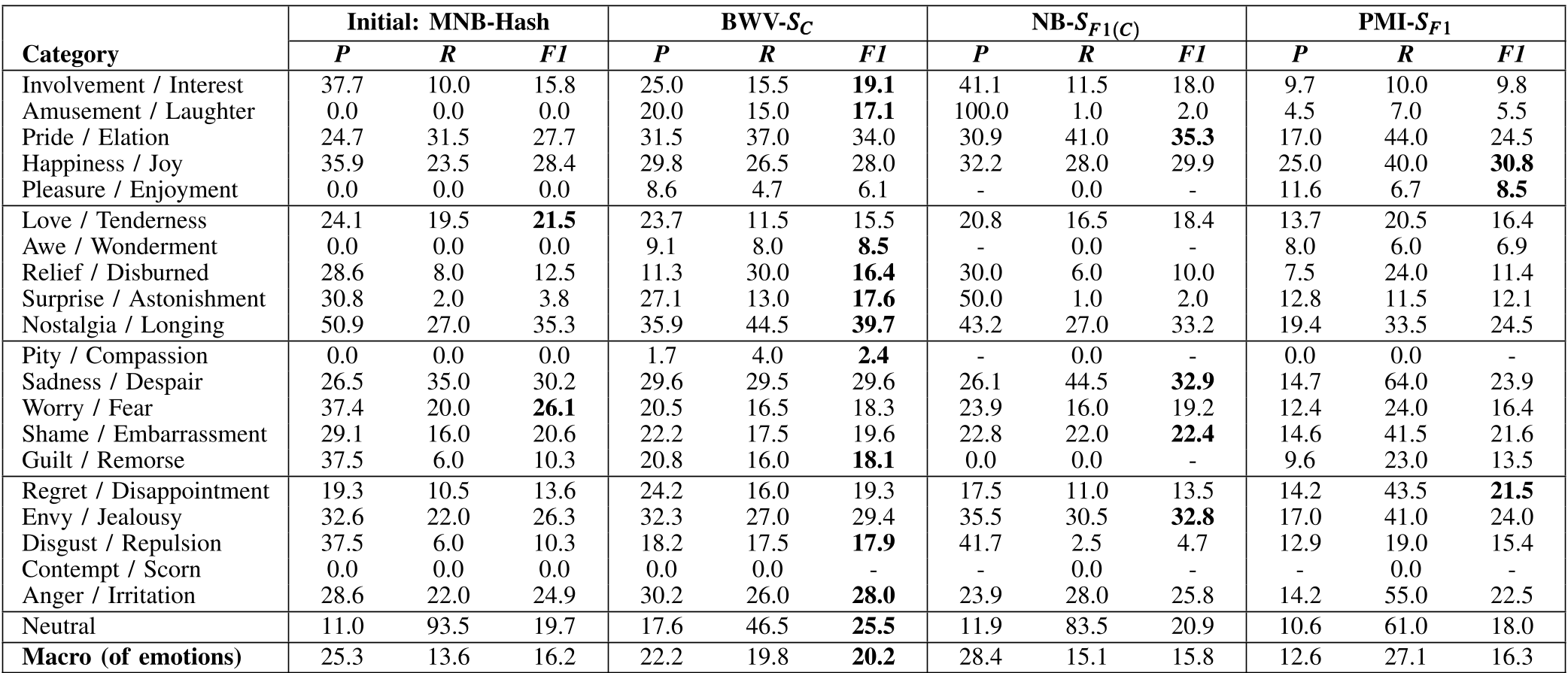
The research tested BWV against three starting points: a general lexicon (GALC), a crowdsourced sports lexicon (OlympLex), and a Naïve Bayes model trained on hashtags (MNB-Hash).
The results were striking. The Centered Setting (SC) of BWV consistently outperformed traditional Naïve Bayes and PMI-based classifiers. Specifically, it didn't just boost the "easy" categories; it revived performance in categories where the initial models had a 0% F1-score, such as "Amusement" and "Surprise."
Academic Insight: Why it Works
The secret sauce is the rebalancing coefficient. In standard Weighted Voting, the model projects the existing skewness of the labels onto the features. If 90% of your data is "Joy," every word starts looking like "Joy." BWV mathematically forces the model to treat each emotion category with equal importance during the feature-weight learning phase. This "Inductive Bias" towards balance is what allows the model to achieve a stable Macro F1-score across 20 granular categories.
Final Verdict
Takeaway: This paper is a masterclass in "data-centric" AI before the term became trendy. It proves that clever algorithmic rebalancing can extract high-quality signals from noisy, imbalanced, and unlabeled "Big Data."
Limitations: The model still struggles with extremely under-represented classes (like Contempt) where the initial signal is simply too weak to amplify. Future work involving LLMs or Transfer Learning could potentially bridge this "zero-shot" gap.