
SSL-Policy: Scaling Privacy Management in Social Networks via Label Propagation
Semi-supervised policy recommendation for online social networks
The paper introduces a specialized semi-supervised learning (SSL) framework for recommending fine-grained privacy policies in Online Social Networks (OSNs). By combining iterative graph-based label propagation with Active Learning and a novel Collaborative Active Learning (CAL) mechanism, the system achieves over 94% accuracy and 91% precision on real Facebook datasets while significantly reducing the manual labeling effort required from users.
TL;DR
Specifying who can see your "Religious Views" vs. your "Email" for every friend on Facebook is a nightmare. This paper proposes an Iterative Semi-Supervised Learning (SSL) framework that "guesses" your privacy preferences by propagating a few manual labels across your social graph. By using Active Learning, it only asks you to label the most informative friends, achieving 94% accuracy with minimal effort.
Background: The Privacy Paradox
Fine-grained privacy controls are a double-edged sword. While they offer protection, the cognitive load of managing them for thousands of friend-object pairs is overwhelming. Most users either leave defaults (leakage) or block everything (reduced utility).
Previous solutions (like Privacy Wizards) relied on Supervised Learning (SVMs), which suffer from the "Cold Start" problem—they need too much data to start working effectively. The authors of this paper shift the paradigm to Graph-based SSL, leveraging the fact that social network users naturally form clusters with similar permission profiles.
Methodology: How SSL Propagates Trust
The core of the strategy is the Consistency Assumption: similar users (in terms of profile and network position) should receive similar privacy labels.
1. The Multi-Dimensional Feature Vector
The system doesn't just look at mutual friends. it builds a feature vector for each user combining:
- Profile Attributes (): Age, location, interests.
- Network Metrics (): Betweenness centrality, degree, and status.
- Spectral Coordinates (): Structural eigenvectors of the adjacency matrix.
2. Iterative Label Propagation
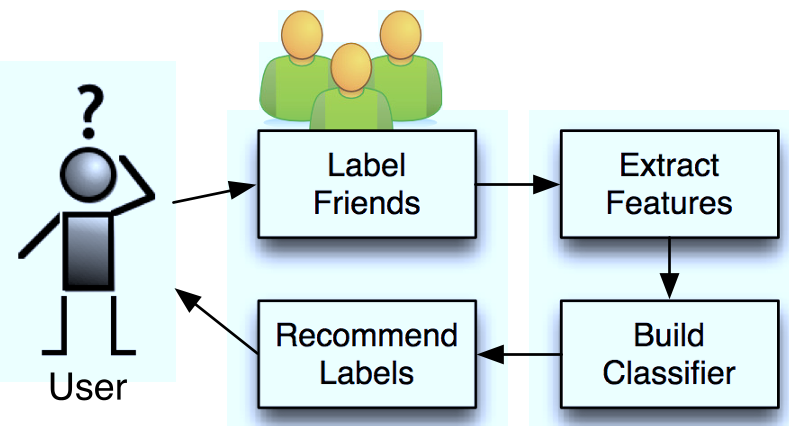
Using a graph Laplacian and an initial label matrix , the system iterates the function: This formula effectively "spreads" the Allow/Deny labels from the nodes you marked out to their neighbors, weighted by similarity.
3. Collaborative Active Learning (CAL)
The "Secret Sauce" of this paper is CAL. Instead of asking you to label friends for your Photos and then again for your Work History, the system clusters similar objects. If you label a friend for one object in a group, the recommendation for all other objects in that cluster is updated instantly, cutting user effort by up to 66%.
Experimental Performance
The researchers tested their prototype on a dataset of 222 real Facebook users. The results were striking:
- Efficiency: With only 5% effort (labeling a tiny fraction of friends), the SSL model reached 94% accuracy.
- Superiority: It consistently beat SVM (Supervised) and Random Walk baselines in both precision and recall.
- Robustness: In an "Incremental Study" simulating the addition of new friends, the precision remained stable, proving the model can handle the dynamic nature of real social networks.
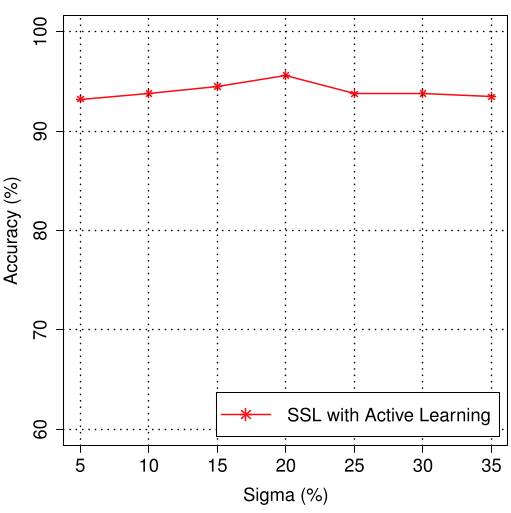 The charts above demonstrate that the SSL with Active Learning (blue line) consistently maintains higher precision across varying levels of training effort compared to standard SSL or Random Walk.
Critical Insight: Why This Works
The success of this method hinges on Homophily. In social networks, we tend to group friends (College friends, Family, Colleagues). These groups usually have homogeneous access rights. By selecting the "most informative" nodes within these clusters (Active Learning), the SSL algorithm can capture the boundary of a "trust zone" far faster than a linear classifier.
Conclusion & Future Work
The paper successfully demonstrates that privacy doesn't have to be a manual chore. By treating the social network as a graph-based propagation field, we can achieve high-fidelity privacy settings with negligible user intervention.
Limitations: The model currently assumes users have consistent logical groupings. If a user’s "friendship" connections are noisy or random, the similarity propagation might lead to "False Allows." Future work could integrate context-aware features, such as the time of day or the user's current location, to further refine recommendations.
Keywords: Semi-Supervised Learning, Graph Propagation, Privacy Policy, Active Learning, OSN Security.