
Deciphering the E-Wallet Pulse: A Hybrid Approach to Fintech Sentiment
A semi-supervised approach in detecting sentiment and emotion based on digital payment reviews
This study presents a semi-supervised hybrid framework for sentiment and emotion detection in the Malaysian e-wallet sector (Maybank2U, Touch N Go, Boost). The researchers combine supervised learning (SVM, Random Forest, Naïve Bayes) with unsupervised Latent Dirichlet Allocation (LDA) to classify user perceptions and extract dominant service themes.
TL;DR
This paper investigates the emotional landscape of Malaysia’s digital payment revolution. By applying a hybrid machine learning approach—combining Supervised Learning (Random Forest, SVM) with Unsupervised Topic Modeling (LDA)—the authors analyzed thousands of app store reviews to identify what makes users tick. The verdict? While convenience is appreciated, technical fragility is driving widespread consumer "Anger."
Background Positioning
In the academic coordinate system, this work sits at the intersection of Consumer Behavior and Natural Language Processing (NLP). It moves beyond "positive vs. negative" binary sentiment, diving into the multidimensional space of emotions (Anger, Joy, Anticipation) to provide actionable intelligence for the Fintech industry.
Problem & Motivation: The Noise of the Digital Street
Most fintech adoption studies rely on structured surveys, which suffer from social desirability bias. App store reviews, while "honest," are notoriously messy—filled with slangs ("ur", "yeah"), abbreviations, and emoticons.
The researchers recognized that traditional Lexicon-based approaches (like SentiWordNet) fail in this context because words are domain-dependent. For instance, a "long" wait time is negative in banking, but a "long" battery life is positive in hardware. To solve this, a machine-learning approach capable of learning context was required.
Methodology: The Hybrid Engine
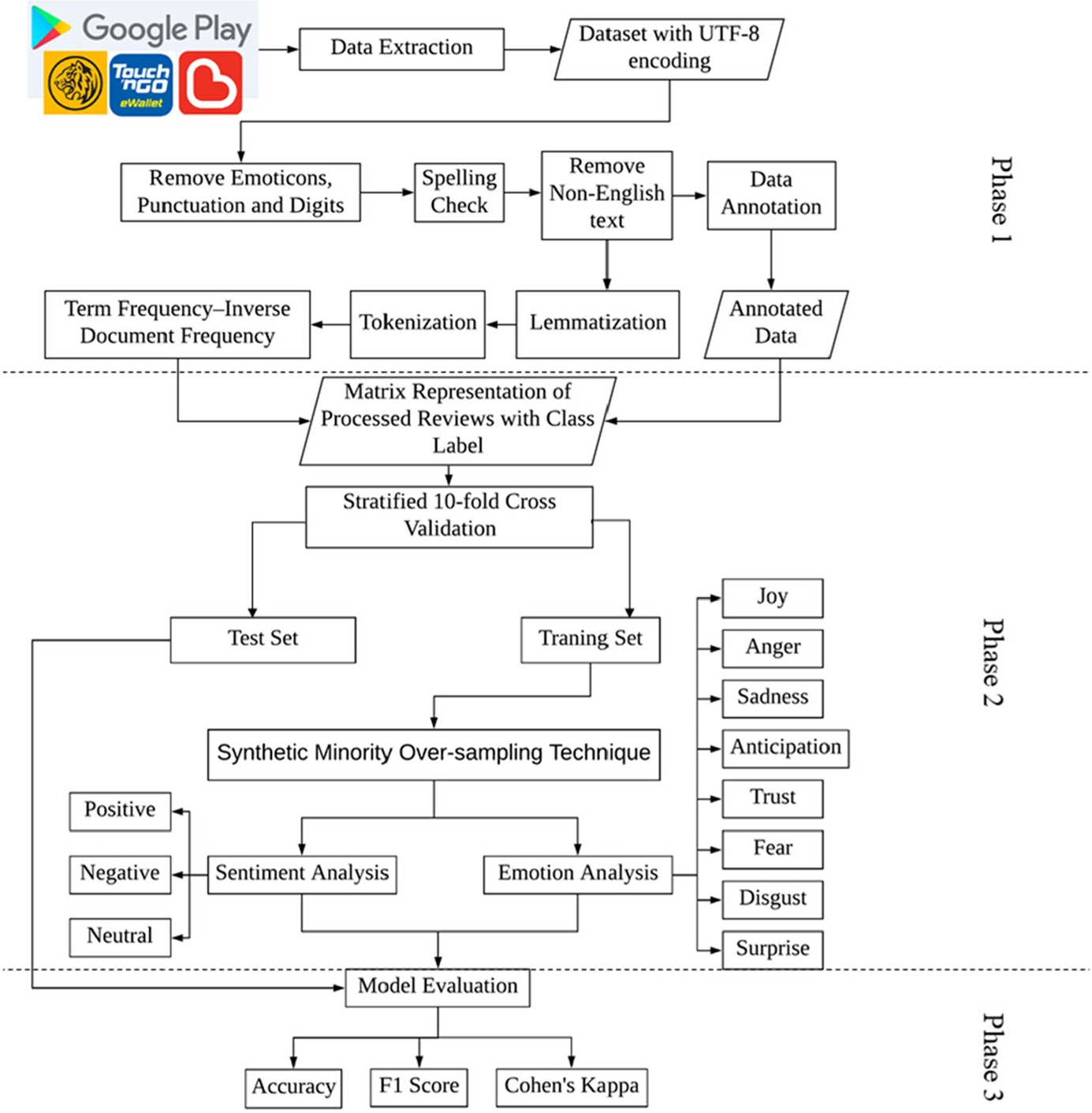
The study utilized a sophisticated three-phase pipeline to transform raw text into strategic insights.
1. The Architecture of Analysis
The authors didn't just rely on one algorithm; they staged a "bake-off" between Support Vector Machines (SVM), Naïve Bayes, and Random Forest.
2. Handling Imbalance
Emotion datasets are notoriously imbalanced—users complain (Anger) far more than they praise (Joy). The authors utilized SMOTE (Synthetic Minority Over-sampling Technique) during training to ensure the minority classes weren't ignored by the models.
3. Extracting "The What" via LDA
While supervised models told them how users felt, Latent Dirichlet Allocation (LDA) told them what they were talking about. By clustering words, they identified five pillars of the user experience:
- App Service: General UI/UX.
- Transaction: The core utility of sending money.
- Reload Features: The friction point of adding funds.
- Connectivity: Backend stability.
- Reward: The incentive layer.
Experiments & Results: Random Forest Reigns Supreme
The experimental results highlighted a clear winner in the quest for accuracy. Random Forest achieved the highest F1-scores, likely because its "ensemble" nature (growing multiple independent trees) allows it to ignore the "noise" of digital slangs that often confuse SVMs.
Performance Comparison
| Classifier | Sentiment F1-Score | Emotion F1-Score |
|---|---|---|
| Support Vector Machine | 72.2% | 60.5% |
| Naïve Bayes | 70.5% | 53.0% |
| Random Forest | 73.8% | 58.8% |
Note: While SVM had a higher F1 for emotion, Random Forest led in Accuracy and Cohen's Kappa, making it more robust overall.
The Emotional Breakdown
The visualization of top keywords for specific apps (Maybank2U vs. Touch N Go) reveals a stark contrast in brand perception.
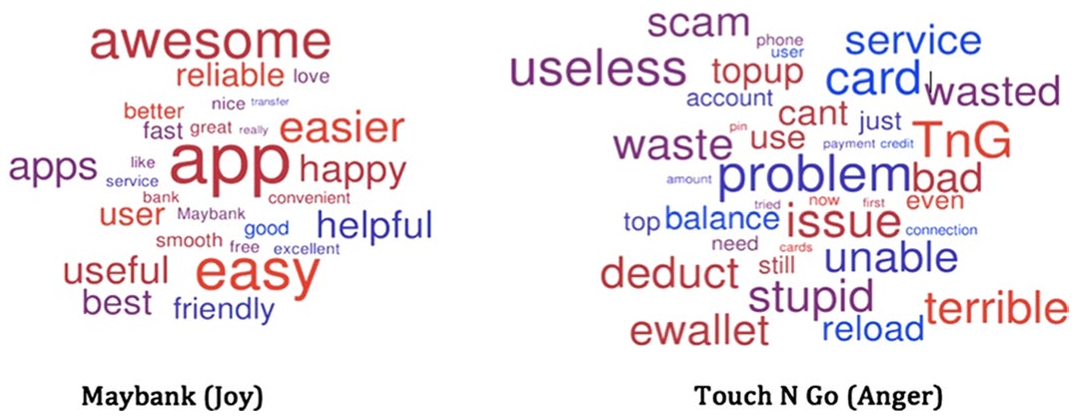
Maybank2U users frequently cited "Joy" (words like awesome, easy, reliable), whereas Touch N Go reviews were dominated by "Anger" (words like terrible, waste, refund).
Critical Analysis & Conclusion
Takeaway
For product managers, this paper provides a roadmap: Technical stability (Connectivity) is the foundation of trust. No amount of "Reward" or "Gamification" can offset the "Anger" generated by a failed "Transaction" or "Reload."
Limitations
- Language Barrier: The study only analyzed English reviews. In a multilingual society like Malaysia, a significant portion of the "Voice of the Customer" in Bahasa Malaysia or Mandarin remains unheard.
- Accuracy Ceiling: With emotion detection hovering around 60% accuracy, there is clear room for Deep Learning (Transformer-based models) to handle the nuanced sarcasm and context that classical ML struggles with.
Future Outlook
The logical next step is Hierarchical Processing: first classifying sentiment (Positive/Negative) and then running sub-classifiers to pinpoint the specific emotion. Combining this with real-time LDA could allow fintech companies to detect service outages or "review bombs" within minutes of a bad deployment.