
S3D: Defeating Evolving Twitter Spam with Semi-Supervised Real-Time Detection
Semi-Supervised Spam Detection in Twitter Stream
This paper introduces S3D, a Semi-Supervised Spam Detection framework designed for real-time tweet-level filtering on Twitter. The system combines four lightweight detectors—Blacklisted Domain, Near-Duplicate, Reliable Ham, and Multi-Classifier—with a batch-mode update module to adaptively learn new spam patterns from a massive tweet stream.
TL;DR
Twitter spammers are shapeshifters. Most traditional filters fail because they either focus on blocking accounts (too slow) or use static models (quickly outdated). S3D (Semi-Supervised Spam Detection) solves this by using a four-tier real-time pipeline that labels tweets in milliseconds and a batch-update engine that "self-teaches" by identifying high-confidence samples from the previous day’s stream.
Context: The Limitations of Account Blocking
In the Twitter ecosystem, spam accounts often mimic legitimate users by mixing benign content with malicious links. Relying solely on Account Blocking is problematic:
- Fine-grained detection: It misses individual spam tweets from compromised legitimate accounts.
- Concept Drift: Spammers change their vocabulary and URL redirection strategies daily.
- The Labeling Bottleneck: Supervised models require constant manual labeling to stay effective against new hashtags and trending topics.
Methodology: The S3D Architecture
S3D operates on a "Waterfall" architecture, sending tweets through four increasingly complex filters. This ensures high throughput without sacrificing accuracy.
1. The Real-Time Pipeline
- Tier 1: Blacklisted Domain Detector: Instant rejection based on known malicious URLs.
- Tier 2: Near-Duplicate Detector: Uses MinHash signatures (uni/bi/tri-grams) to catch variants of known spam.
- Tier 3: Reliable Ham Detector: A "Whitelist" check. If a trusted user (who has never spammed) posts a tweet without "spammy words," it's instantly cleared.
- Tier 4: Multi-Classifier Ensemble: For the "hard" cases, an ensemble of Naive Bayes, Logistic Regression, and Random Forest decides the label.
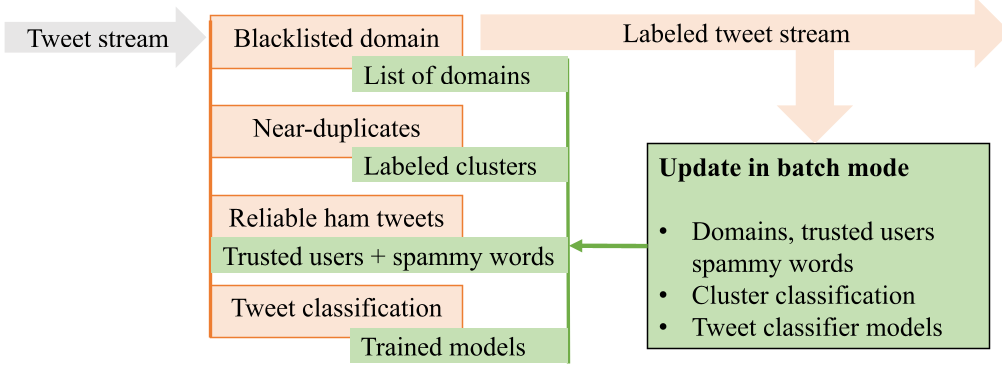
2. The Semi-Supervised Loop (Batch Mode)
The real "magic" happens in the batch update. Every 24 hours, the system identifies Confidently Labeled Tweets. If all three classifiers in Tier 4 agree, the sample is added to the training set for the next day.
The system also performs Cluster-Level Labeling. By grouping near-duplicates and analyzing collective metadata (e.g., "Are all these accounts created at the same time?"), S3D can identify new spam campaigns that a single-tweet classifier might miss.
Experiments & Results
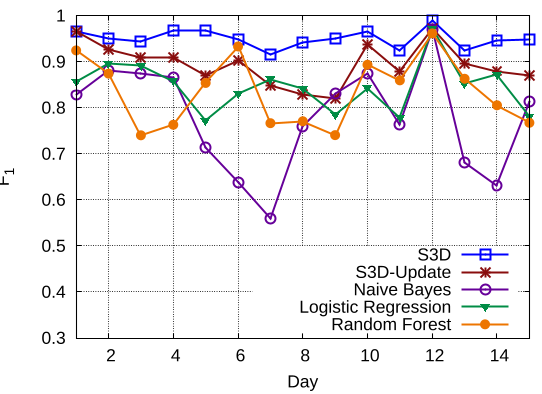
Using the HSpam14 dataset, the researchers compared S3D against standard supervised classifiers.
Performance Gains
- Superior F1-Score: S3D consistently outperformed Random Forest and Logistic Regression because it adapted to the trending hashtags of the day.
- Efficiency: Processing a tweet takes only 0.495 ms, making it suitable for the massive firehose of the Twitter stream.
- Stability: While static models' performance plummeted as spam patterns shifted, S3D's F1-score remained robust.
Insights from Feature Analysis
The authors discovered an interesting nuance: for single tweets, vocabulary features (like "follow back" or "ipad") are most effective. However, for clusters, user metadata (follower-followee ratio, account age) becomes the dominant signal for distinguishing botnets from humans.
Critical Analysis & Conclusion
Takeaway: S3D proves that a semi-supervised "self-update" mechanism is the only viable way to handle the non-stationary nature of social media spam. By promoting its own high-confidence predictions to the training set, it effectively creates an "immune system" for the tweet stream.
Limitations:
- The current framework relies heavily on URL and text-based features.
- As spammers move toward adversarial text (obfuscating words) or image-based spam, S3D would need to incorporate deep learning components like Transformers or OCR.
Future Work: Integrating deeper social graph analysis into the "Reliable Ham" module could further reduce false positives and improve the identification of hijacked accounts.