
S3D: Mastering the Twitter Spam Stream via Semi-Supervised Learning
Semi-Supervised Spam Detection in Twitter Stream
The paper introduces S3D, a Semi-Supervised Spam Detection framework designed for tweet-level identification in real-time streams. It combines four lightweight detectors for immediate filtering with a periodic batch-update module to adaptively learn from newly labeled data, achieving more consistent F1 scores compared to static supervised baselines.
Executive Summary
Twitter has become a primary target for spammers due to its high click-rates and rapid message propagation. While traditional methods focus on blocking accounts, this approach is often too slow and misses fine-grained malicious activity. S3D (Semi-Supervised Spam Detection) shifts the focus to the tweet-level, employing a tiered architectural approach that combines real-time lightweight filtering with a periodic "self-learning" batch update. By utilizing confident labels from previous windows, S3D effectively tackles the problem of evolving spam patterns, maintaining high F1 scores where static models decay.
Problem & Motivation: Why Tweet-Level Detection?
Most prior work in this space treats spam as a "user classification" problem. However, the authors argue this is insufficient for several reasons:
- The Compromised Account Dilemma: Legitimate users might grant permissions to malicious third-party apps, sending spam without being "spammers" themselves.
- Behavioral Camouflage: Modern spammers intersperse spam with legitimate content to evade account-level heuristics.
- Feature Drift: Spam vocabulary is highly volatile, often tied to trending daily hashtags, making a model trained on Monday obsolete by Wednesday.
The technical challenge lies in identifying these tweets in real-time without the heavy computational overhead of complex social graph analysis.
Methodology: The S3D Architecture
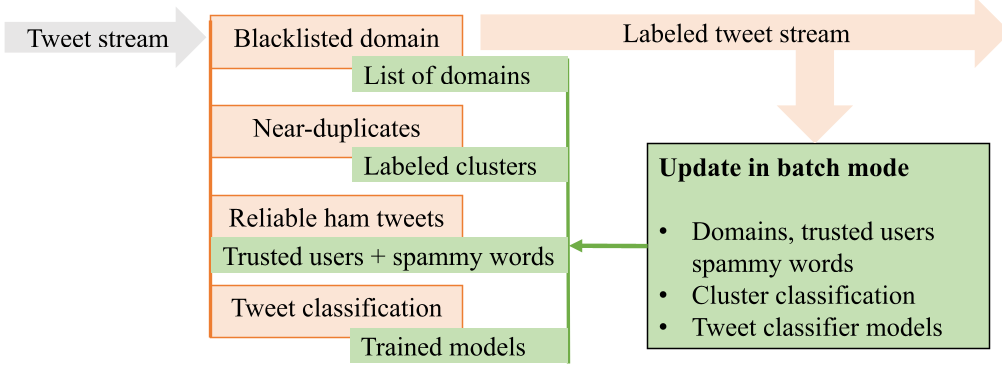
The S3D framework consists of a real-time detection module and a batch update module.
1. Real-Time Detection Pipeline
To maximize efficiency, tweets pass through four detectors ordered from "easiest to hardest":
- Blacklisted Domain Detector: Instant filtering of known malicious URLs.
- Near-Duplicate Detector: Uses MinHash signatures to identify tweets that are virtually identical to previously labeled spam or ham.
- Reliable Ham Detector: Labels tweets as safe if they come from a "trusted user" (a history of >5 ham tweets) and contain no known "spammy words."
- Multi-Classifier Ensemble: For the remaining "hard" tweets, the system uses an ensemble of Naive Bayes, Logistic Regression, and Random Forest. A majority vote (2 out of 3) decides the label.
2. Semi-Supervised Model Update (The Logic of Growth)
The "magic" of S3D happens in batch mode (every 24 hours). The system identifies Confident Labels—tweets where all detectors or ensemble members agreed with high certainty. These labels are used to:
- Update the Trusted Users list.
- Find new Spammy Words (where ).
- Expand the URL Blacklist.
- Retrain the underlying classifiers with the fresh data distribution of the day.
Experiments & Results
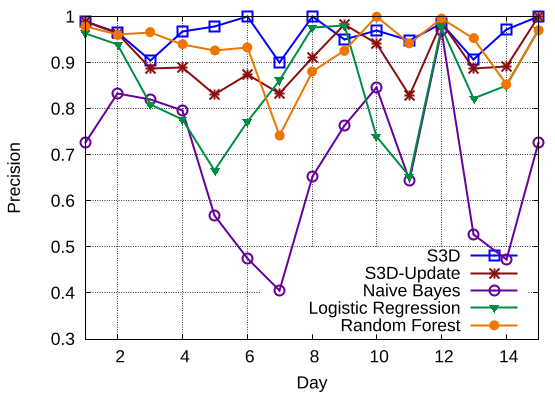
Testing on the HSpam14 dataset (14 million tweets) demonstrated that S3D's adaptive nature is its greatest strength.
Key Metrics:
- F1 Score Stability: While standalone Random Forest (RF) or Logistic Regression (LR) models showed significant performance fluctuations, S3D maintained a consistent and higher F1 score baseline.
- Processing Speed: The system average 0.495 ms per tweet, proving it is "Twitter-scale" ready.
- Label Precision: The semi-supervised feedback loop is highly accurate; manual verification showed that "confident ham/spam clusters" identified by the system maintained near 100% precision.
Feature Insights
The research highlighted that Cluster-level features (analyzing a group of near-duplicate tweets) are more effective than individual tweet features. For instance, the ratio of spam tweets within a cluster and the fraction of capitalized tweets in a group provide much stronger signals of a botnet operation than a single message's text content.
Critical Analysis & Conclusion
Takeaway: S3D proves that a tiered, semi-supervised approach is safer and more robust than a single complex model. By filtering the "easy" spam first, it reserves compute for the ensemble, while the daily update keeps the system resilient against the "evolving vocabulary" of social media.
Limitations:
- Cold Start: The system requires an initial manually labeled set to "seed" the trusted users and blacklists.
- Dataset Bias: As noted by the authors, the HSpam14 dataset is hashtag-oriented, which limited the "Reliable Ham" detector's coverage (only 0.64%) because users' full histories weren't available.
Future Outlook: Integrating more sophisticated user-level social graph features (without sacrificing real-time speed) and applying this framework to other micro-blogging platforms could further validate its generalizability.