
S3D: Adaptive Real-Time Spam Detection via Semi-Supervised Learning
Semi-Supervised Spam Detection in Twitter Stream
This paper introduces S3D (Semi-Supervised Spam Detection), a framework designed for real-time, tweet-level spam detection in the Twitter stream. The system employs a dual-mode architecture: a light-weight four-stage detection module for real-time labeling and a semi-supervised batch update module that retrains models using high-confidence labels from previous time windows.
TL;DR
S3D is a high-performance framework for Twitter spam detection that operates at the individual tweet level rather than just blocking accounts. By combining four cascading real-time detectors with a daily batch-update module, it achieves an optimal balance between low-latency inference (0.5ms/tweet) and long-term adaptability to evolving spam patterns.
Background & Positioning
In the Twitter "arms race," spammers are no longer just mindless bots; they act as "cyborgs" or hijack legitimate accounts to bypass account-level filters. Previous state-of-the-art (SOTA) methods often relied on static supervised learning, which decays quickly as hashtags and spammy vocabulary shift. S3D positions itself as a robust semi-supervised pipeline that treats the Twitter stream as a living data source for continuous self-improvement.
The Core Motivation: Why Tweet-Level?
Existing research often focuses on Account Blocking. However, this has two major flaws:
- Collateral Damage: Legitimate users whose accounts are compromised by malicious 3rd-party apps get banned.
- Detection Lag: Waiting for enough evidence to ban an account allows thousands of spam tweets to reach users in the interim. S3D shifts the focus to the content and context of each tweet, ensuring immediate mitigation.
Methodology: The Cascading Architecture
The S3D framework operates like a filter funnel, moving from computationally "cheap" checks to "expensive" machine learning inferences.
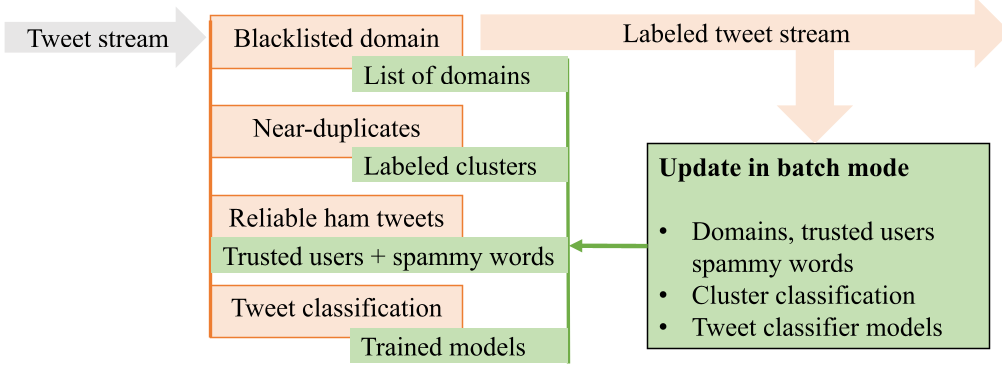
1. The Real-Time Detection Funnel
- Blacklisted Domain Detector: Instant matches against known malicious URLs.
- Near-Duplicate Detector: Uses MinHash signatures (combined uni/bi/tri-grams) to identify tweets that are virtually identical to previously labeled spam clusters.
- Reliable Ham Detector: Filters out noise by identifying "trusted users" ( those who never post spam and have 5+ confident ham posts) whose messages lack "spammy words."
- Multi-Classifier Ensemble: The final gatekeeper using Naive Bayes, Logistic Regression, and Random Forest. A tweet is labeled spam if at least two classifiers agree (Majority Voting).
2. The Semi-Supervised "Self-Correction" Loop
The true innovation lies in the batch update. Every 24 hours, S3D identifies Confident Labels. A tweet is "confident" if all three classifiers in the ensemble agree. These labels, along with new near-duplicate clusters, are used to:
- Update the Blacklisted Domain list.
- Refresh the Trusted User list.
- Refine the Spammy Vocabulary (probability of word in spam vs. ham).
- Retrain the underlying ML models to handle new trending keywords.
Experiments and Performance
The authors tested S3D against static baselines (NB, LR, RF) using the 14-million tweet HSpam14 dataset.
Key Findings:
- Superior Stability: While static models saw their F1-scores fluctuate or decline as word distributions shifted, S3D maintained consistent performance due to its daily updates.
- Cluster-Level Insight: The study found that feature extraction at the cluster level (groups of near-duplicates) is more effective than the tweet level, as collective metadata (e.g., account creation time of 50 similar posters) reveals bot-net behavior.
- Efficiency: With an average processing time of 0.495 ms, the system is well-suited for the "Firehose" of high-volume social media streams.
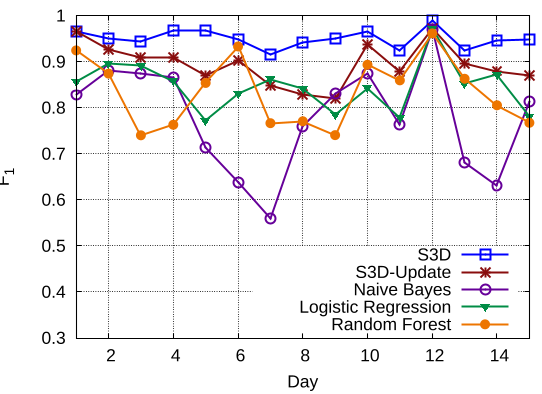 Note: S3D consistently maintains the highest and most stable F1-score compared to static supervised counterparts.
Critical Analysis & Takeaways
S3D proves that Inductive Bias built into a system—such as the assumption that near-duplicates likely share a label—can drastically reduce the need for manual labeling in dynamic environments.
Limitations:
- The system relies heavily on URL and hashtag features. Modern "stealth" spammers using purely linguistic sarcasm or image-based spam might bypass these.
- The "Reliable Ham" detector had low coverage (0.64%) in the study, suggesting that user-based trust requires longer historical windows than the 15 days tested.
Future Outlook: Integrating S3D with graph-based neural networks (GNNs) to map user relationships in real-time could further increase the "Reliable Ham" coverage and improve the detection of sophisticated "Social Bots."