
Semiautomatic Behavioral Change-Point Detection: Streamlining Cognitive Science Research
Semiautomatic Behavioral Change-Point Detection: A Case Study Analyzing Children Interactions With a Social Agent
This paper introduces a semiautomated methodology for detecting and classifying behavioral change points in human motor data, specifically children's interactions with a virtual agent. Utilizing an SVM-based classifier and statistical moment-based signatures, the system achieves a high F1-score of approximately 0.95 in typical development scenarios, significantly outperforming traditional baseline methods.
TL;DR
Researchers have developed a semiautomated system to identify shifts in human behavior—known as "change points"—by combining high-order statistical descriptors with machine learning. Tested on children with typical development and neurodevelopmental disorders, the system drastically reduces manual labeling effort by 70% while maintaining high accuracy, even when faced with the erratic motor patterns typical of ASD.
The Annotation Bottleneck in Cognitive Science
In the study of human behavior, the "gold standard" has always been manual annotation by experts. However, this process is famously slow and prone to inter-rater variance. While deep learning offers an alternative, it typically requires thousands of labeled examples—a luxury the clinical psychology field rarely possesses.
The core challenge lies in the Change Point: the precise moment a behavior shifts from one state to another (e.g., from "starting a movement" to "reaching a peak"). These transitions are rarely abrupt; they are fluid, noisy, and highly subjective, especially in children with neurodevelopmental disorders (NDD) whose movements may be "clumsy" or "uncoordinated."
Methodology: Beyond Simple Statistics
The authors suggest a shift from looking at what a behavior is to looking at how a behavior changes. They implement a sliding-window feature extraction pipeline that moves beyond simple means and variances.
1. The Context-Aware Descriptor
Instead of just looking at a window of time, the proposed C-SW (Contextual Sliding Window) descriptor captures:
- Statistical Moments: 1st to 4th order (Mean, Covariance, Skewness, Kurtosis).
- Physics of Motion: Velocity, Acceleration, and Jerk.
- Temporal Context: Features from the periods immediately preceding and following the current window.
This "temporal surround" allows the SVM (Support Vector Machine) classifier to understand the contrast between behavioral states, effectively "seeing" the transition.
 Figure 1: The proposed framework, from signal acquisition (Kinect) to SVM classification and DBSCAN clustering.
2. Temporal Refinement
Because a sliding window might trigger "positive" detections for several consecutive frames, the authors use DBSCAN clustering. This groups adjacent detections and picks the centroid, providing a singular, precise timestamp for the event.
Experimental Results: Testing the Limits with NDD
The system was validated using a "Tightrope Walker" (TW) task, where children mimic a virtual agent.
SOTA Comparison
The system significantly outperformed the baseline concavity-based method across all metrics.
- F1-Score: ~0.95 (Proposed) vs. 0.71 (Baseline).
- Mean Absolute Error (MAE): ~4.07 frames vs. 9.38 frames.
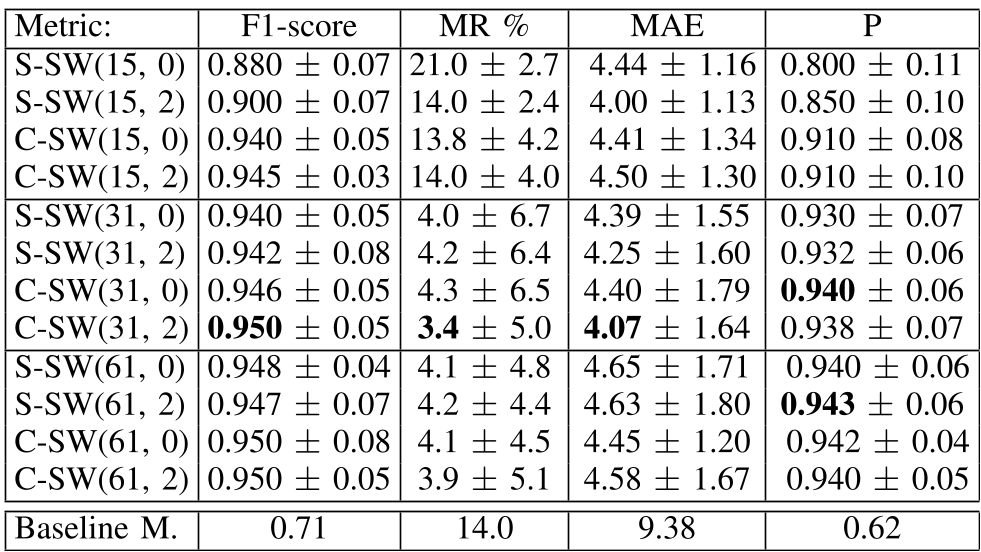 Table 1: Performance metrics across different window sizes (W) and thresholds (τ). Note how C-SW consistently leads.
The "Abnormal Behavior" Stress Test
The true test was how the model handled children with ASD (Autism Spectrum Disorder). These signals are notoriously "noisy" due to motor control deficits. While performance dropped (F1-score 0.82), the system remained effective enough to serve as a "pre-annotation" tool, allowing experts to simply verify results rather than labeling from scratch.
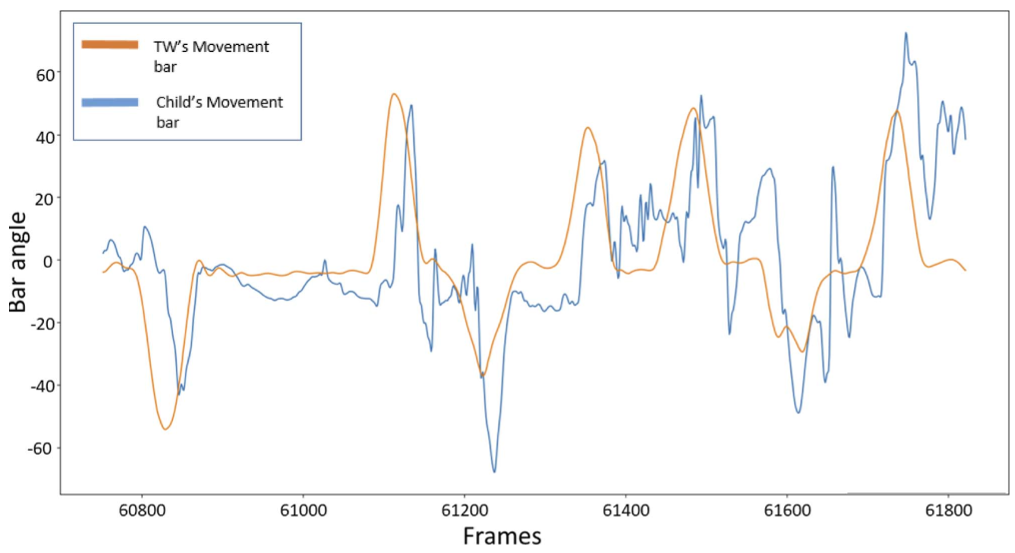 Figure 2: The complex, erratic tilt-angle signal of an ASD child—a challenging scenario for any automated system.
Impact: The 70% Rules
One of the most impactful findings is the learning curve analysis. The authors found that with only 30% of the subjects used for training, the system achieved 90% of its peak F1-score.
The Takeaway: For large-scale behavioral studies, researchers can manually annotate a small subset (one-third) of their data, and let this system handle the remaining 70% with high reliability.
Critical Analysis & Future Outlook
While the system is robust, it current relies on 1D/3D skeletal signals. Its applicability to "softer" behavioral cues—like facial micro-expressions or gaze—remains to be seen. Furthermore, the drop in performance for ASD subjects suggests that Domain Adaptation (transferring knowledge from "normal" to "atypical" movements) is the next logical frontier for this research.
Ultimately, this work represents a vital bridge between the precision of machine learning and the practical needs of clinical cognitive science.