
RingTrust: Mastering Trust and Distrust via Semiring Mathematics in Social Networks
Semiring-based trust evaluation for information fusion in social network services
The paper introduces RingTrust, a trust inference framework for Social Network Services (SNS) that utilizes a novel distrust-semiring structure. By modeling trust as a 2D vector (trust level and certainty), it achieves high-accuracy trust propagation and fusion, effectively handling both positive trust and negative distrust in sparse networks.
TL;DR
In the vast, sparse world of Social Network Services (SNS), knowing who to trust is often a matter of "who your friends know." This paper introduces RingTrust, an inference framework that treats trust and distrust as a 2D vector. By leveraging semiring algebra, the authors provide a rigorous mathematical way to propagate trust across a network and fuse conflicting opinions, ensuring that "fake news" or low-quality information is filtered out through certainty-based aggregation.
Problem & Motivation: The Sparsity and Silence of Distrust
Most trust models in social computing suffer from two major flaws:
- Link Sparsity: Users only interact with a tiny fraction of the population.
- Distrust Erasure: Many systems treat "distrust" as zero. However, there is a fundamental difference between not knowing someone (zero trust) and knowing they are unreliable (distrust).
The authors argue that trust is not a scalar but a relationship. They identify that the transitivity of distrust is "complicated"—if Alice distrusts Bob, and Bob distrusts Charlie, does Alice trust Charlie? Intuitively, no. Standard linear algebra often fails here; we need a more flexible algebraic structure.
Methodology: The Distrust-Semiring
The core innovation lies in the 2D Opinion Vector and the Distrust-Semiring.
1. The 2D Vector:
- Trust (): is total disagreement/distrust, is total agreement/trust.
- Certainty (): How much the truster believes in the trustee's integrity.
2. Algebraic Operators
To move through the network, the paper defines:
- Propagation (): How trust decays as it passes through intermediaries. Crucially, if two nodes in a chain both hold negative trust (), the transitivity is "cut" (result becomes 0), preventing the mathematically valid but socially illogical "negative x negative = positive" trap.
- Fusion (): How to combine opinions from different paths. The authors use an "optimistic" certainty-based approach: if you hear two opinions, you weigh the one with the higher certainty more heavily.
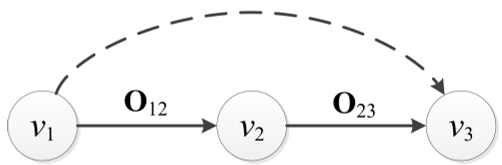 Fig 1. Trust Propagation across a path using the operator.
3. FATP vs. FPTA
The paper advocates for First Aggregate Then Propagate (FATP). Unlike the traditional approach of calculating every path result then averaging them, FATP aggregates at every node. This acts as a low-pass filter, smoothing out noise at each step and preserving privacy, as intermediate results are merged before reaching the requester.
Experiments: RingTrust in Action
The authors demonstrate the algorithm's logic through a complex social graph involving six neighbors.
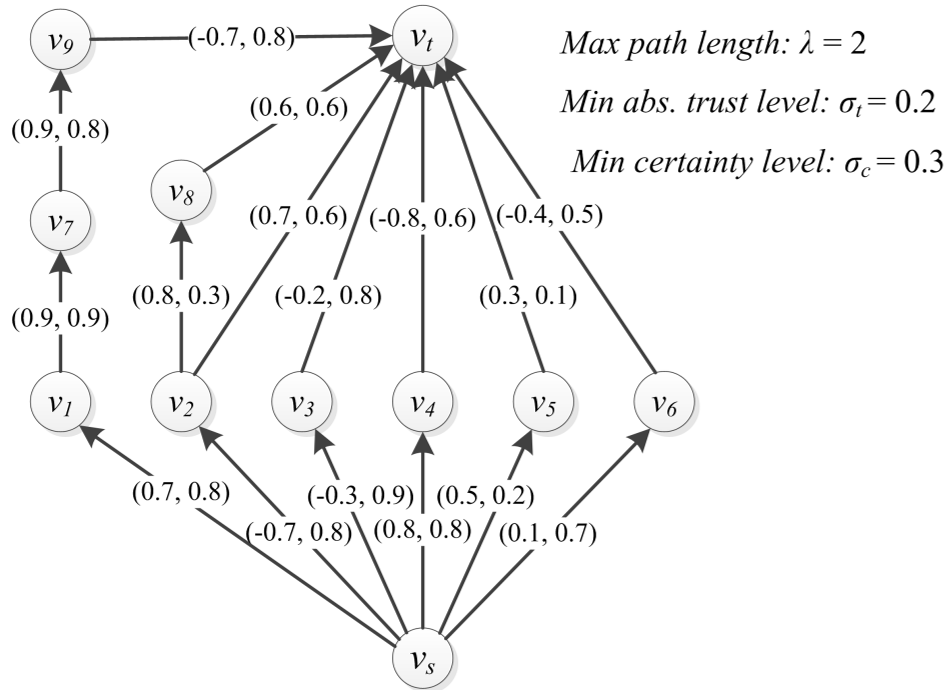 Fig 2. Example of RingTrust resolving indirect trust between source (vs) and sink (vt).
In the example:
- Neighbors with low certainty (below a threshold ) are discarded.
- Conflicting opinions are resolved: if one path suggests and another , the algorithm utilizes the certainty levels to find the most "reliable" collective truth.
- Outcome: The final inferred vector correctly identifies a high-certainty distrust relationship, which would have been lost in simpler models.
Critical Analysis & Conclusion
Takeaway
RingTrust's strength is its mathematical rigor. By using semirings, it transforms trust inference from a heuristic "guessing game" into a formal algebraic computation. This is particularly valuable for Recommender Systems and Ad Targeting, where distinguishing between an unknown user and a known "bad actor" is the difference between a good recommendation and a catastrophic one.
Limitations & Future Work
The current model uses an "optimistic" fusion (preferring higher magnitude trust when certainties are equal). Future research could explore "pessimistic" or "Bayesian" fusion operators. Additionally, trust is often domain-specific (I trust my doctor for medical advice, but not for fashion), which will require moving from 2D vectors to multi-dimensional tensors.
The RingTrust framework represents a significant step toward making social networks more reliable, transparent, and resilient to misinformation.