
Senior Users & Social Networks: Beyond Digital Isolation to the Internet of Everything
Senior users of social networks: Technological experience and use habits analysis
The paper explores the adoption and use habits of social networks among senior users (aged 55+), specifically linking these behaviors to the Internet of Everything (IoE) and the M5SAR project's Adaptive User Interface (AUI). Through a descriptive statistical analysis of a questionnaire-based study, it identifies key motivations such as communication, information seeking, and entertainment.
TL;DR
This research investigates why and how people over 55 use social networks. It moves beyond the stereotype of "digitally excluded" seniors to show that social media is a vital tool for knowledge acquisition, entertainment, and social inclusion. By mapping these habits, the researchers aim to build better Adaptive User Interfaces (AUI) for museums and IoE systems.
Problem & Motivation
As life expectancy rises, the digital divide threatens to isolate the elderly. While younger generations are "digital natives," seniors often struggle with digital literacy and complex UI designs. The authors argue that if we understand the "why" behind senior social media usage, we can create more inclusive technology that improves well-being and reduces loneliness.
The motivation is practical: applying these insights to the M5SAR project, which designs augmented reality guides for museums, ensuring the interface adapts perfectly to an older user's cognitive and technological profile.
Methodology: The Core
The study pivots on a conceptual model relating personal characteristics to four usage pillars:
- Education/Information: Searching for news, technology, or health.
- Communication: Staying in touch with family to fight isolation.
- Trends: Discovering new hobbies to enhance well-being.
- Entertainment: Purely for fun and leisure.
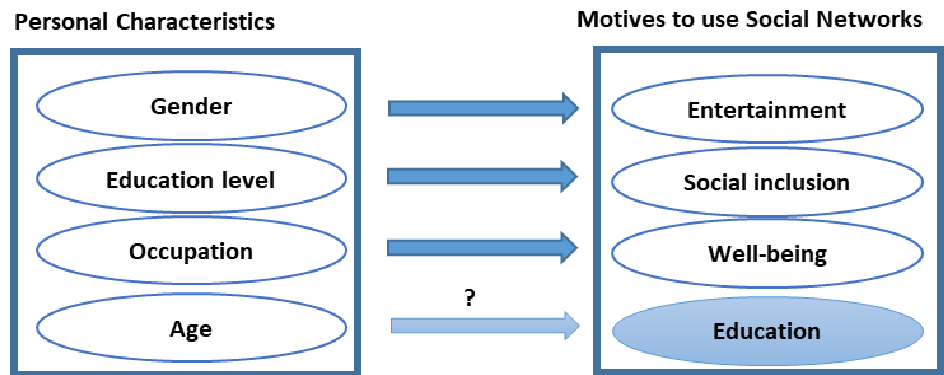
The researchers used a combination of Pearson Correlation and non-parametric tests (U-Mann-Whitney) to see if age or gender significantly changed these behaviors.
Experimental Insights & Results
The data revealed several "surprises" regarding senior habits:
- The Gender Gap: Women are significantly more active on social networks. They lead in using platforms to "find information" and "discover new trends," which directly correlates to a sense of well-being.
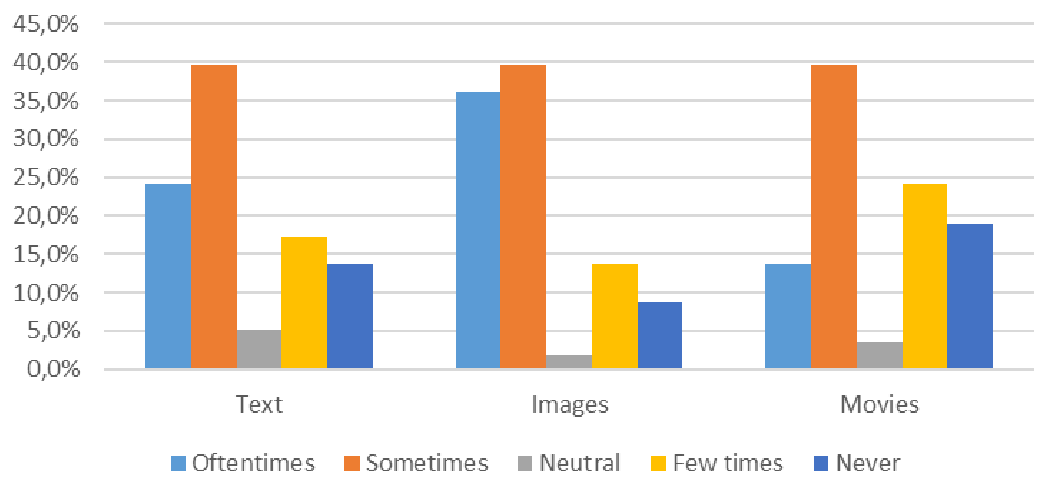
- Content Preference: Forget short-form video; seniors vastly prefer Images and Text. Sharing "movies" (videos) ranked the lowest across almost all demographics.
- Platform Dominance: Facebook (93.1%) and YouTube (67.2%) are the "Big Two." Platforms like Snapchat and Twitter (now X) have virtually zero traction in this age group (6.9%).
- The Education Paradox: Interestingly, the study found a "U-shaped" relationship with entertainment. Those with basic education and those with PhDs were the most likely to use social networks for entertainment, while those in the middle (Graduates) were more utilitarian.
Deep Insight & Conclusion
Takeaway
The core contribution of this work is the validation that social networks are a form of self-education for the elderly. For a senior user, "scrolling" isn't just a time-killer; it's a way to maintain digital literacy and social capital.
Limitations & Future Work
The study’s sample size (n=58) is relatively small and used "convenience sampling," which may skew results toward more tech-savvy seniors already on Facebook. Future research should look into "Experience Economy" concepts—how the quality of the technological experience, rather than just the frequency, impacts the psychological health of the elderly.
In the context of the Internet of Everything (IoE), this paper provides a blueprint for a "Senior User mode": a simplified, image-centric, and communication-heavy interface that treats the elderly not as passive consumers, but as active learners.