
Seniors on SNS: The Counter-Intuitive Path to Digital Loyalty
Seniors' loyalty to social network sites: Effects of social capital and attachment
This study investigates the drivers of senior citizens' loyalty to Social Network Sites (SNSs) within the tourism context. By integrating Social Capital (SC) and Attachment theories, the authors establish a structural model linking bonding/bridging SC to interpersonal, group, and site attachments, ultimately influencing brand loyalty.
TL;DR
As the global population ages, senior citizens are becoming power users of Social Network Sites (SNSs) for tourism planning. This study reveals that to keep seniors loyal, platforms shouldn't just focus on private family chats. Instead, building bridging social capital and group identity are the real keys to digital "stickiness."
The Silver Tsunami in Digital Tourism
The segment of the population aged 50 and over is expanding rapidly, particularly in tech-forward nations like South Korea. Unlike younger digital natives, seniors often use SNSs to combat isolation and seek specialized travel information. Despite their growing influence, there has been a significant gap in understanding what makes a senior user loyal to a platform rather than a transient visitor.
Motivation: Why "Strong Ties" Aren't Enough
Common intuition suggests that seniors value "Bonding SC" (close friends and family) above all else. However, the researchers suspected that "Bridging SC" (weak ties and broader community connections) might play a hidden, more powerful role in how seniors navigate information-heavy domains like tourism.
Methodology: The Attachment Hierarchy
The study proposes a sophisticated chain of psychological events. It doesn't just look at "Attachment" as a single block, but splits it into:
- Interpersonal Attachment: Bonds with specific individuals.
- Group Attachment: Identification with the community or "tribe" as a whole.
- Site Attachment: The emotional bond with the platform itself.
Theoretical Framework
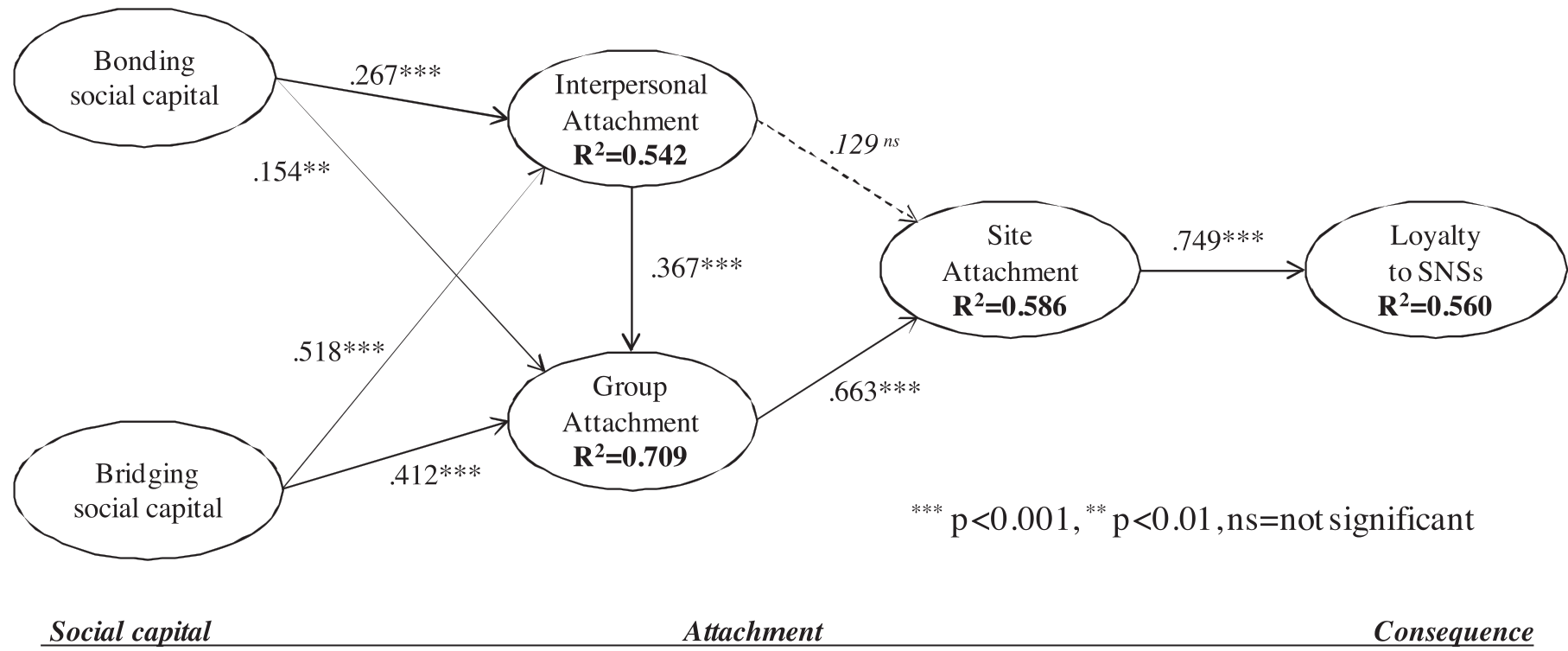 The Figure above illustrates the validated structural model where Bridging and Bonding SC serve as the bedrock for multi-layered attachments.
Key Findings: The "Group First" Rule
The most striking discovery was the failure of Hypothesis 6. Interpersonal attachment had no significant direct effect on site attachment.
- The Mediation Path: For seniors, liking a specific person on a site isn't enough to make them loyal to the site. They must first feel like they belong to a group.
- Bridging > Bonding: Bridging SC had a much stronger impact on creating identity () than bonding SC (). Seniors use these platforms to expand their horizons, not just to talk to people they already know.
Performance Metrics
The study used SEM to calculate the variance explained () for each stage:
- Group Attachment: 70.9% of the variance was explained by the model.
- Site Loyalty: 56.0% of the variance was captured by site attachment.
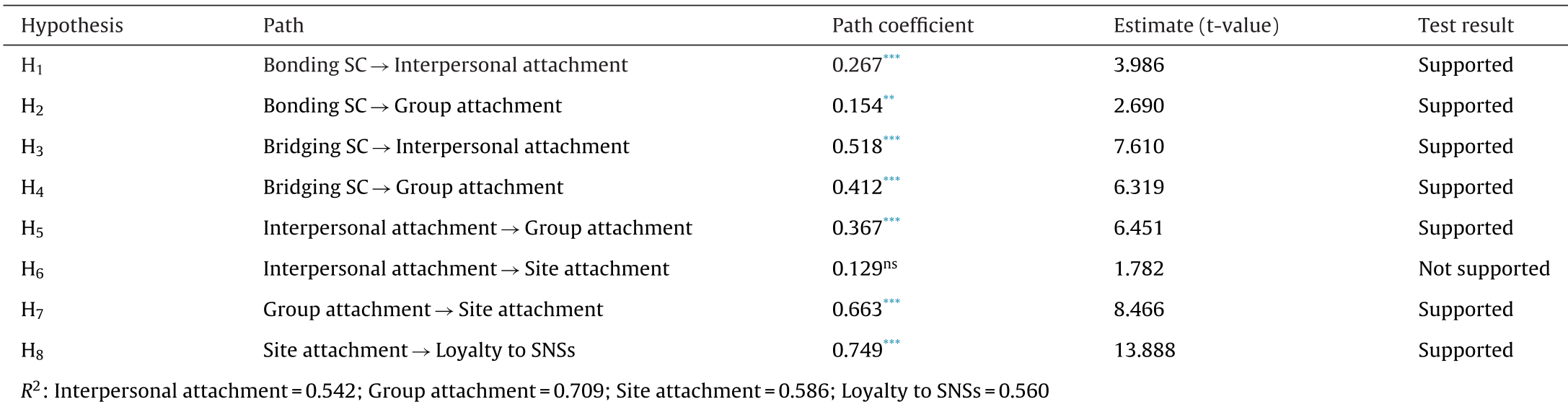 Quantitative support for the hypotheses, showing high significance for the Bridging SC paths.
Critical Insight & Practical Application
This research shatters the myth that seniors only want "private" spaces.
For Product Designers:
- Emphasize Groups: Don't just build messaging tools; build community forums where seniors can adopt a "typical user" identity.
- Facilitate Weak Ties: Suggest new connections and broader community topics (Bridging SC) to increase the "bigger picture" feeling.
- Accessibility as Loyalty: Small changes, like larger font sizes or senior-specific rewards, convert "Group Attachment" into "Site Attachment."
Conclusion
The road to a senior's loyalty is paved with group identity. By helping elderly users feel like part of a larger community through bridging social capital, SNS providers can move beyond being a mere "utility" and become an indispensable part of their social lives.
Limitations: The study is localized to South Korea. Future research should investigate if Western cultures—which may value individualism differently—mirror these group-centric attachment patterns.