
SenseWorld: Bridging the Gap Between Social Media and the Physical World
SenseWorld: Towards Cyber-Physical Social Networks
SenseWorld is a pioneering cyber-physical social network (CPSN) that integrates real-world sensory data with social structures. It extends the geographical indexing of Microsoft SensorMap to human-centric entities, enabling community-centric sensing through a distributed architecture of data mules and secure gateways.
TL;DR
SenseWorld is an early visionary framework that transforms social networks from purely digital platforms into Cyber-Physical Social Networks (CPSN). By leveraging sensors in phones and cars, it creates "Virtual Sensors" for people and communities, using data mining to infer social habits while protecting privacy through statistical perturbation.
Background: Beyond Digital Profiles
In the mid-2000s, social networks like Facebook and LinkedIn were confined to what users manually typed. Meanwhile, sensor networks were largely "object-centric" (e.g., monitoring a bridge or a forest). SenseWorld was among the first to argue that the person should be the primary logical abstraction in a sensor network. It positions itself as an evolution of Microsoft’s SensorMap, moving from a map of things to a map of human activity.
The Core Challenge: Data vs. Insight
Raw sensor data is "dumb." A stream of GPS coordinates doesn't tell a story on its own. The authors identified two major hurdles:
- Semantic Gap: How do we turn (Lat, Long) into "This person is at their favorite coffee shop"?
- Privacy Paradox: People want the benefits of community data (like traffic updates) but don't want their exact movements tracked.
Methodology: The SenseWorld Architecture
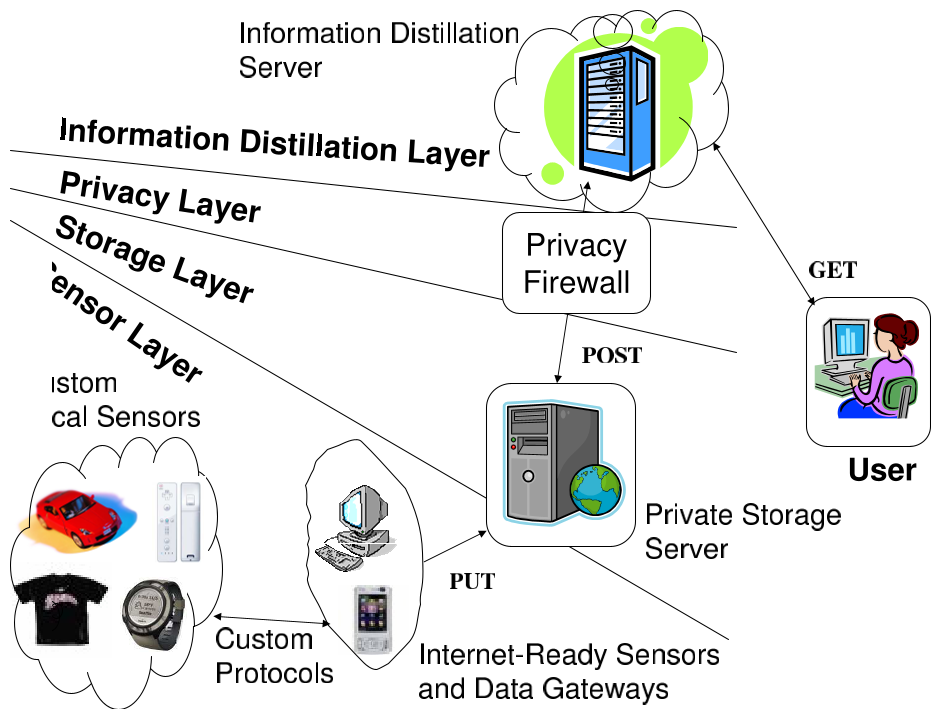
The system uses a sophisticated 3-layer approach:
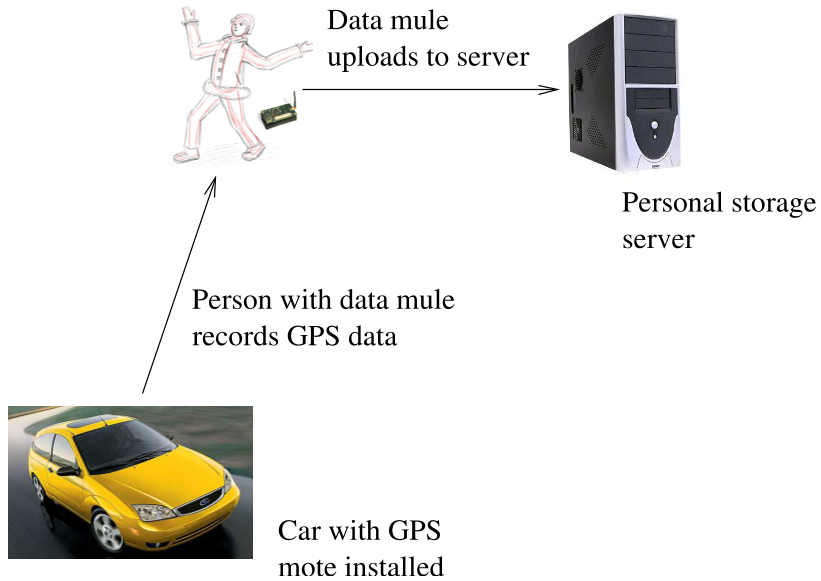
- The Sensor Layer: MicaZ motes and GPS boards attached to vehicles.
- The Data Mule: A wearable device (or mobile phone) that "picks up" data from surrounding sensors and carries it to a gateway.
- The Logic Layer: Where Frequent Itemset Mining is applied to find patterns in the chaos.
Inference and Privacy
To bridge the semantic gap, SenseWorld uses data mining to identify "stay points" and routines. To protect the user, the "Privacy Filter" perturbs the data before it leaves the personal storage area. This allows the community server to calculate aggregate statistics (e.g., "The average speed on Main St is 20mph") without ever knowing where a specific individual was at 9:00 PM.
Experiments: Vehicular Participatory Sensing
The authors demonstrated the system using a fleet of GPS-instrumented vehicles at the University of Illinois.
Key Findings:
- Accuracy of Inferences: The frequent itemset mining successfully mapped out "hot hangouts" and work-life patterns.
- Privacy-Utility Trade-off: By using perturbation, the system could provide community-wide traffic insights that were statistically significant while "blacking out" sensitive personal locations.
Critical Analysis
Strengths
- Human-Centric Design: It correctly identified that the future of the internet would be the "Internet of People," not just things.
- Privacy First: The inclusion of a privacy layer as a core architectural component was ahead of its time.
Limitations & Future Work
The dependence on hardware "motes" (MicaZ) was a bottleneck. While the authors planned to move to cell phones, the modern smartphone ecosystem (iOS/Android) has since solved the "mule" problem but introduced new centralized privacy concerns that SenseWorld's distributed model actually sought to avoid.
Takeaway
SenseWorld provides a blueprint for how we can live in a "measured" world without living in a monitored one. It remains a foundational reference for anyone working on Participatory Sensing or Ubiquitous Computing.