
Sensing the Pulse of Twitter: A Deep Dive into Real-Time Trending Topic Detection
Sensing Trending Topics in Twitter
This paper presents a comprehensive comparative study of trending topic detection in Twitter, proposing a novel method called BNgram. The approach leverages n-gram co-occurrence, named entity boosting, and a time-dependent ranking score (df-idf) to achieve state-of-the-art performance across diverse event types.
TL;DR
Twitter has become a "global nervous system," but extracting meaningful stories from its noisy, 140-character (at the time) pulses is notoriously difficult. This paper benchmarks six topic detection methods—including four novel ones—across three major historical datasets. The winner? BNgram, a method that ditches simple word bags for n-gram co-occurrences and a clever temporal ranking system, proving that the secret to social sensing lies in "burstiness" and context.
The Problem: Why LDA Fails at Social Sensing
Traditional NLP methods like Latent Dirichlet Allocation (LDA) were designed for static, well-structured documents (like news articles or academic papers). When applied to Twitter, they fall flat because:
- Noise: Tweets are riddled with typos, slang, and "IRL" noise.
- Shortness: There isn't enough co-occurrence data in a single tweet to build a robust statistical model.
- Topic Churn: In events like the US Elections, hundreds of sub-stories (state results, victory speeches, local referendums) evolve in parallel.
The authors found that standard techniques simply cannot handle the "heterogeneous stream" of a major global event, where multiple stories compete for attention simultaneously.
Methodology: The BNgram Breakthrough
The researchers proposed several strategies, including Soft Frequent Pattern Mining (SFPM) and Graph-based Feature-pivoting, but BNgram emerged as the most robust.
1. N-Grams over Unigrams
Instead of treating "Obama," "wins," and "Florida" as independent terms, BNgram looks at n-grams. This naturally captures phrases that carry more information than single keywords.
2. Time-Dependent Ranking (df-idf)
The "Burstiness" factor is calculated using a modified version of the classic TF-IDF, specifically df-idf:
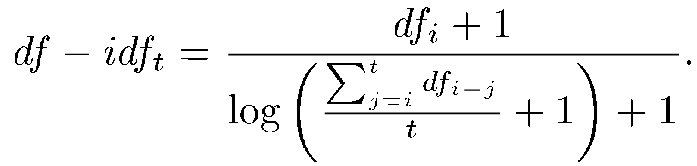 This formula compares the current document frequency of a term against its historical average. If a term spikes suddenly, it's flagged as a "trending" candidate.
3. Named Entity Boosting
The authors recognized that real-world events are centered on people and places. By using a Named Entity Recognizer (NER), they assigned higher weights to proper nouns, drastically improving the relevance of candidate topics.
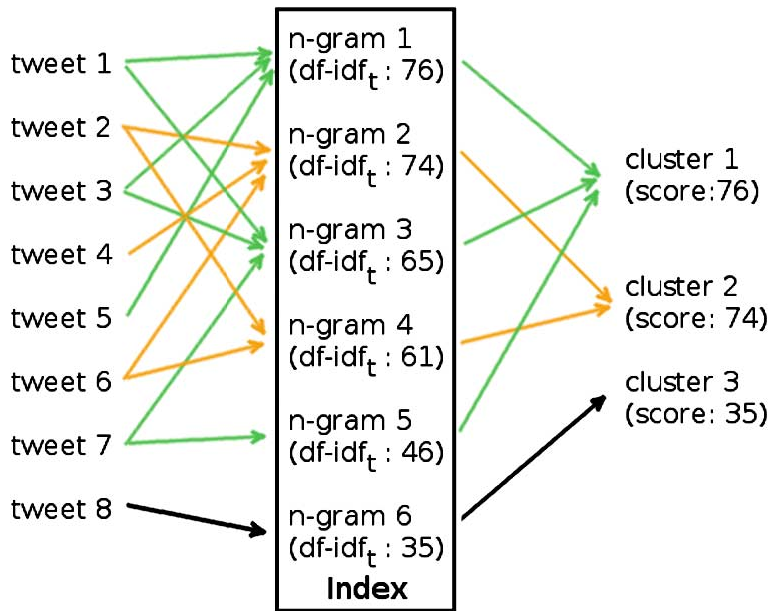 Figure: The Topic Detection Pipeline, highlighting the ranking and clustering stages.
Experiments & Results
The methods were tested on three high-stakes datasets: the FA Cup Final, Super Tuesday Primaries, and the 2012 US Elections.
- Topic Recall: BNgram achieved a recall of ~77% for the FA Cup and nearly 50% for complex political events, while LDA often dropped to 0% recall on noisy datasets.
- The "Stemming" Trap: A key finding was that stemming (reducing words to their roots) actually hurt performance. In social media, the specific variation of a word often holds semantic or emotional weight that helps group topics.
- Aggregation Matters: Grouping "near-duplicate" tweets (retweets) before analysis helped document-pivot methods stay stable and reduced fragmentation.
 Table: Comparison of Topic Recall and Keyword Precision across the six methods.
Critical Analysis & Professional Insight
This work is a masterclass in Heuristic Alignment. The authors didn't just throw a complex model at the data; they observed the physics of how information spreads on Twitter:
- Inductive Bias: By favoring Named Entities and Bursty terms, they encoded human-like judgment into the algorithm.
- Scalability: The use of LSH (Locality Sensitive Hashing) and Parallel FP-Growth ensures these methods can run against the millions of tweets per hour generated during global events.
Limitations: While BNgram is excellent for detection, it still struggles with de-fragmentation. Similar stories (e.g., "Obama wins Florida" and "Florida goes to Democrats") might still be reported as separate topics.
Conclusion
The study proves that in the fast-paced world of social sensing, temporal context is king. As we move toward more advanced Transformer-based models, the core intuition from this paper—that signals must be weighted by their novelty in time—remains the gold standard for real-time monitoring and computational journalism.