
SenSocial: Bridging the Gap Between Online Social Life and Physical Reality
SenSocial: A Middleware for Integrating Online Social Networks and Mobile Sensing Data Streams
SenSocial is a distributed middleware designed to integrate Online Social Networks (OSNs) and mobile sensing data streams in real-time. It enables ubiquitous computing applications to trigger physical sensor sampling (e.g., GPS, accelerometer) based on specific social actions (e.g., Facebook posts, likes), effectively bridging the gap between digital social behavior and physical context.
TL;DR
SenSocial is a middleware that allows developers to link what a user does online (on Facebook or Twitter) with what they are doing in the physical world (sensed via smartphone). By using social media actions to trigger specific mobile sensors, it solves the "always-on" battery drain problem while providing a richer, holistic picture of user behavior.
Background Positioning
In the landscape of ubiquitous computing, we've long had two parallel tracks: Mobile Sensing (understanding physical context like movement or location) and Online Social Networks (OSNs) (understanding interpersonal relationships and sentiment). SenSocial acts as a "connective tissue," enabling a new category of "socially-triggered" context-aware applications.
The Core Challenge: The Disconnect
Why is this hard? Before SenSocial, developers faced a "silo" problem:
- Synchronization: Tracking an OSN post and instantly grabbing the poster's heart rate or location required complex, custom-built infrastructure.
- Resource Bottlenecks: Continuous sensing kills batteries.
- Programmability: Building these apps from scratch meant writing thousands of lines of boilerplate code to handle sensors, OSN APIs, and server-client communication.
Methodology: The "Social Event-Based" Stream
The technical brilliance of SenSocial lies in its Social Event-Based Streams. Instead of continuous polling, it treats an OSN action as a remote interrupt.
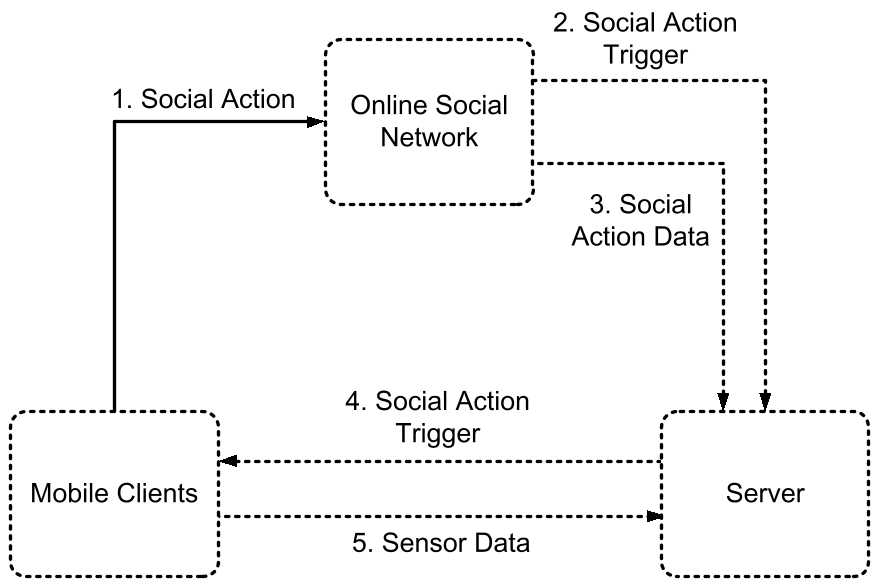
How it Works:
- OSN Plugins: Specialized hooks monitor Facebook or Twitter for specific activities (posts, likes).
- MQTT Triggers: When an event occurs, the server sends a lightweight MQTT message (using the Mosquitto broker) to the mobile device.
- Dynamic Filtering: Developers can push XML-based filters to the device, telling it to only send data if specific conditions are met (e.g., "Send location only if the user is posting a status AND is currently walking").
Experimental Results & Scalability
The researchers didn't just build a toy; they measured the performance cost of professional-grade middleware.
1. Developer Productivity
The most striking result is the massive reduction in coding effort. By providing high-level abstractions like Stream and Filter, SenSocial reduced the code required for a "Contextual Web Browser" from 3,223 lines to just 130.
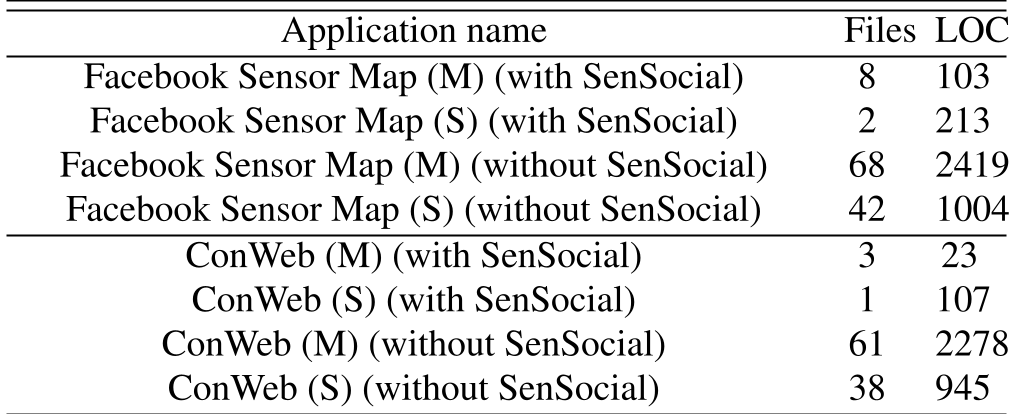
2. Efficiency
The middleware proved that it could handle multiple concurrent sensor streams (GPS, Bluetooth, Accelerometer, etc.) with a CPU load of less than 10%. By classifying raw accelerometer data into high-level activities (still, walking, running) on-device, it halved the energy cost compared to sending raw sensor data.
Prototype Showcases
The authors demonstrated the middleware with two ingenious apps:
- Facebook Sensor Map: A map that populates not just with posts, but with the "physical vibe" (noise levels, activity) of the user at the moment of posting.
- ConWeb: A contextual web browser that adapts its content based on the user's environment—for example, changing font contrast when the light sensor detects high sun exposure.
Critical Insight & Future Outlook
SenSocial marks a shift from Passive Sensing to Intelligent Intent-Driven Sensing.
Limitations: The primary bottleneck identified is the dependency on third-party OSN notification speeds (averaging ~47-56 seconds). Furthermore, as a user-space library, it doesn't quite have the "system-level" stability of a native service like Google Play Services.
Future Implications: Imagine a world where your health app only records your stress levels (via microphone and heart rate) precisely when you are engaged in an argument on social media. This "socially localized" longitudinal data is far more valuable for psychological research than a random stream of 24/7 noise. SenSocial laid the groundwork for this deep synthesis of our digital and physical lives.