
Sensing Solitude: Deciphering the Digital Signatures of Social Isolation in the Elderly
Sensor-Driven Detection of Social Isolation in Community-Dwelling Elderly
This study presents a sensor-driven framework for detecting social isolation among community-dwelling elderly using non-intrusive PIR (Passive Infrared) motion and door contact sensors. By correlating sensor-derived behavioral features with established psychological scales, the researchers achieved significant associations between daily routines and specific dimensions of loneliness and social isolation.
TL;DR
Social isolation is a "silent killer" among the elderly, linked to cardiovascular disease and early mortality. This study bypasses the limitations of subjective surveys by using non-intrusive PIR motion sensors and door contacts to detect isolation risks. Researchers found that behavior—such as reduced time spent outside, excessive daytime napping, and prolonged living room dwelling—serves as a statistically significant proxy for the psychological state of seniors living alone.
The "Stigma" Problem in Elderly Care
While direct self-reporting is the gold standard for measuring loneliness, it is fundamentally flawed by social stigma. Many elderly individuals are reluctant to admit they are lonely, or they may lack the cognitive clarity to track their own social participation accurately.
The technical challenge lies in creating a "Smart Home" that isn't a "Prison":
- Cameras are perceived as invasive and violate privacy in sensitive areas.
- Wearables (like smartwatches) are often forgotten, left on chargers, or uncomfortable for those with skin sensitivities.
The SHINESeniors project proposes a middle ground: Ambient Intelligence through minimalist sensors.
Methodology: Mapping Behavior to Psychology
The study monitored 46 elderly participants in Singapore. The researchers didn't just look at movement; they extracted high-level "behavioral features" from low-level binary sensor triggers.
The Feature Matrix
- Going Out: Calculated when the flat is empty (no motion) between door events. Duration and frequency were key.
- Sleep Patterns: Extracted from bedroom sensors, distinguishing between night sleep and daytime napping.
- Spatial Preference: Measuring "Living Room Time" as a potential indicator of passive activity (e.g., watching TV).
- Activity Intensity: Using the frequency of kitchen sensor "firings" as a proxy for the ability to perform Activities of Daily Living (ADL).
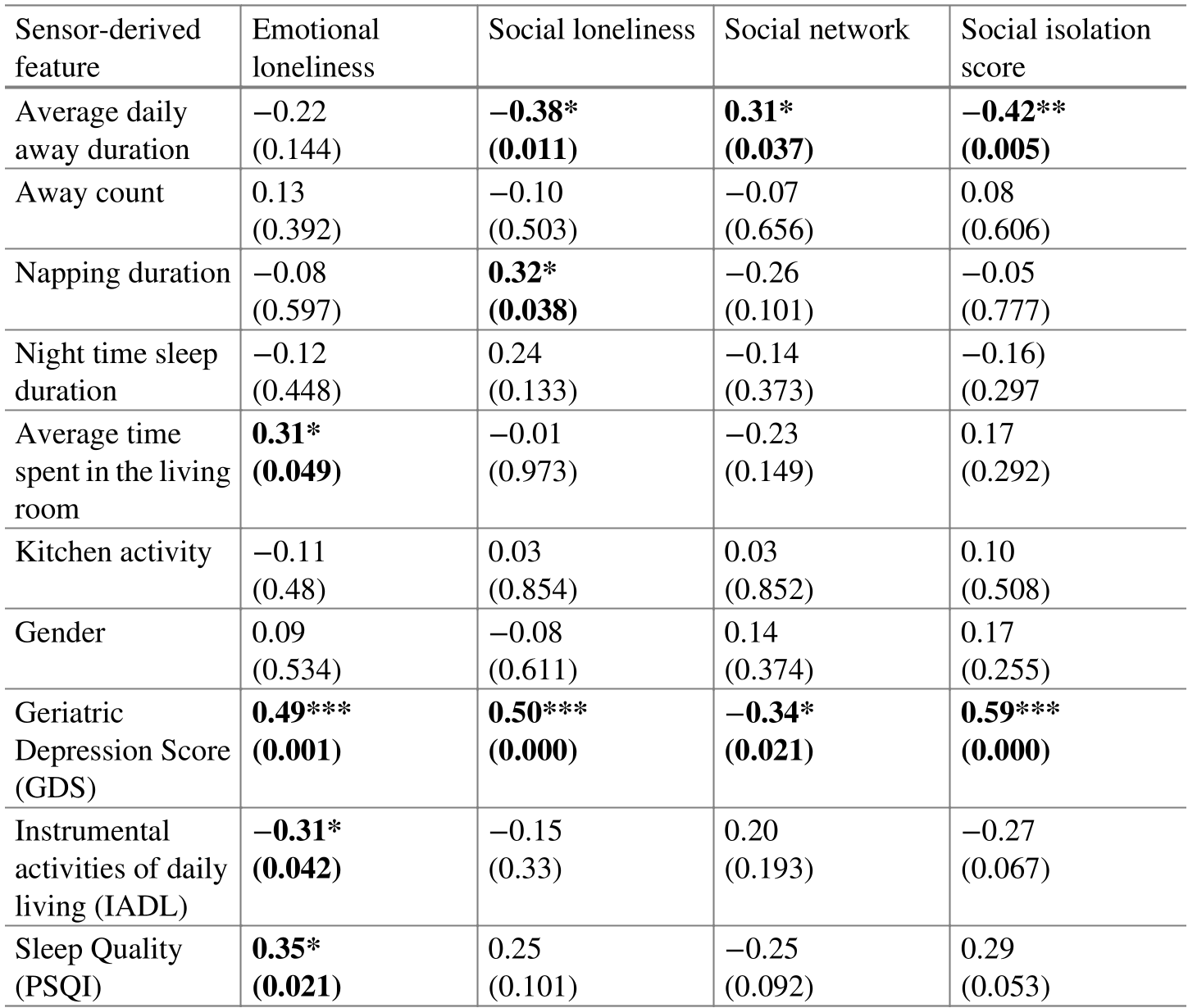 Table: Correlation between sensor-derived features and psychological dimensions.
Key Insights: The Anatomy of a Lonely Routine
The study’s most compelling finding is the breakdown of loneliness into Social vs. Emotional dimensions, each with its own "digital signature":
- The "Stay-at-Home" Effect: There is a strong linear negative relationship (r = -0.42) between the duration spent outside and overall social isolation. Seniors who are more isolated simply cross their threshold less often.
- Living Room as a Refuge: Higher emotional loneliness (absence of a close attachment figure) correlates with more time spent in the living room. This suggests that the living room becomes a primary site for "coping" behaviors like passive entertainment.
- Napping as Social Withdrawal: A positive correlation exists between social loneliness and napping between 7 AM and 7 PM. When social networks are absent, the day is filled with sleep to pass the time.
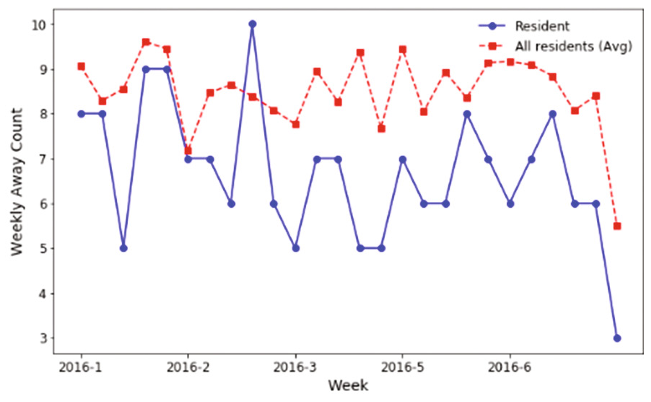
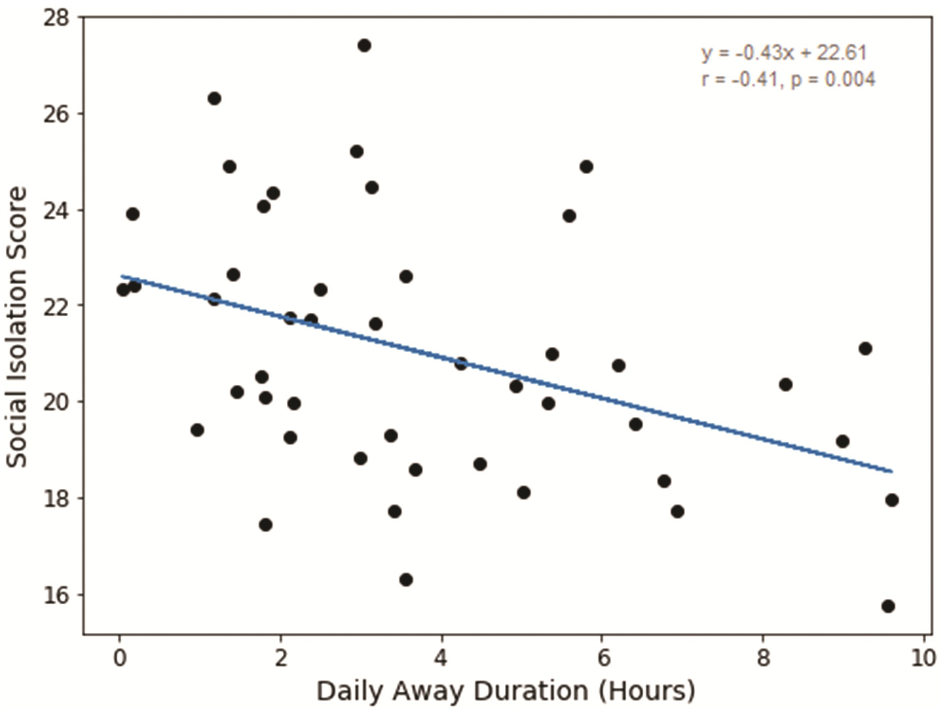 Visual Perspective: Isolated individuals consistently stay below the community average for going out (Away duration).
Deep Dive: Validation through Heatmaps
The researchers used hourly heatmaps to visualize the daily routines of at-risk individuals. As seen in the study's qualitative analysis, a lonely senior (Elderly #2) showed a distinct pattern: waking up late, returning to the bedroom frequently, and showing sparse activity in common areas. This "fragmented" or "delayed" start to the day is a hallmark of low social engagement.
 Heatmap indicating the hourly activity levels within different rooms of a senior's home.
Critical Insight & Future Directions
The value of this work lies in its minimalism. It proves that you don't need expensive AI-equipped cameras to understand a person's social health; simple PIR sensors—the same type used in basic burglar alarms—are sufficient when combined with the right behavioral logic.
Limitations: The study is cross-sectional, meaning it captures a snapshot in time. It cannot yet prove whether isolation causes reduced activity or if reduced mobility causes isolation. Future longitudinal research is needed to determine the "causal spiral" between depression, physical decline, and social withdrawal.
Conclusion: For the future of Ageing-in-Place, this data provides a blueprint for passive screening systems. By alerting caregivers when a senior's "Away Duration" drops below their personal baseline, we can intervene before social isolation leads to irreversible health decline.