
Utilizing Sensor-Social Cues: A Lightweight Approach to Outdoor OOI Recognition
Utilizing Sensor-Social Cues to Localize Objects-of-Interest in Outdoor UGVs
This paper introduces a framework for Object-of-Interest (OOI) recognition in outdoor User-Generated Videos (UGVs) by integrating geo-sensor data and social network cues. It leverages a saliency-guided selection process and spatial pyramid representations to achieve high-accuracy OOI labeling, reaching up to 91.94% recognition accuracy.
TL;DR
With the explosion of social media videos (UGVs), managing and searching this content is becoming a monumental task. This paper presents a novel framework that doesn't just look at pixels; it listens to geo-sensors and looks at social cues. By combining saliency-based tracking with GPS-recommended object categories, the authors achieve over 91% recognition accuracy in a lightweight manner suitable for mobile applications.
Problem & Motivation: The Heavy Burden of Vision
Standard object recognition in the wild faces two massive hurdles:
- Latency vs. Cloud: Offloading every frame to a cloud server for recognition creates lag, while processing locally drains mobile batteries.
- The "Complete Dataset" Trap: Unlike closed-set datasets, the "real world" is infinite. Building a complete image library for every possible outdoor object is inefficient.
The authors' insight is simple yet profound: Context is everything. If we know where (GPS) and when (Timestamp) a video was taken, we can drastically narrow down what might be in it by looking at what social media users have tagged in that specific vicinity.
Methodology: Fusing Saliency and Social Data
The framework operates through three sophisticated stages:
1. Adaptive Frame Selection
To avoid processing every redundant frame, the system uses a Markov Chain-based saliency model. It calculates the divergence of salient regions between frames. If the shift in saliency () exceeds a threshold, the frame is kept. This ensures only informative, diverse moments are analyzed.
2. Salient-Object-Assisted Track Learning Detection (TLD)
The system employs the TLD framework but enhances it. If the standard detector fails to find an object, the saliency detector steps in to assist in identifying and tracking the patch. This creates a more resilient loop for long-term tracking in shaky, handheld UGVs.
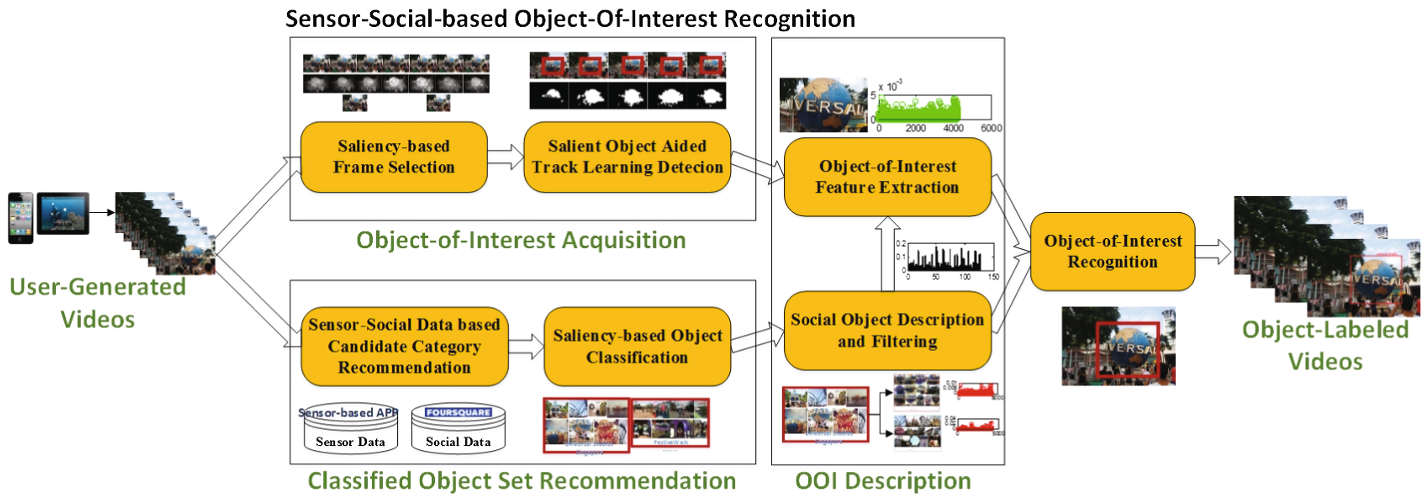
3. Social Filtering and Description
While social media provides reference images, these images are often noisy. The paper uses a Spatial Pyramid Representation to describe both the UGV objects and the social reference images. Crucially, they use a "Salient-object-based social image filtering" scheme (as seen in Fig. 4) to clean the social data before matching.
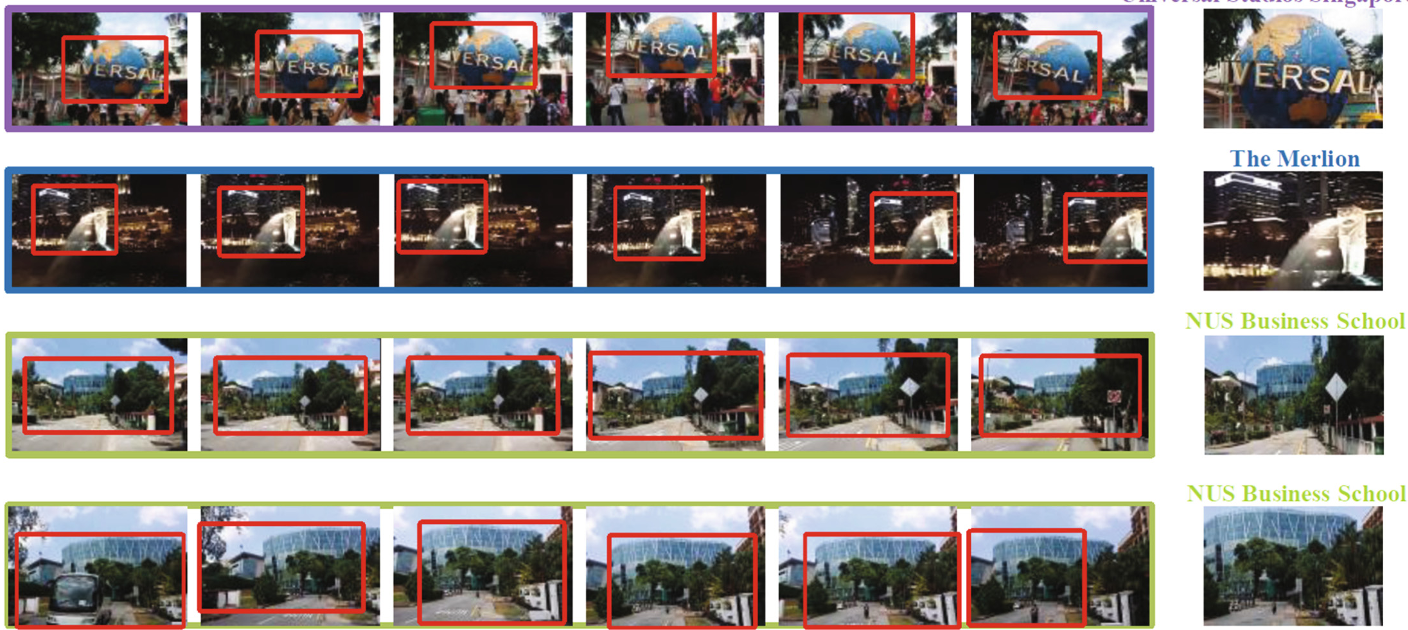
Experiments: Real-World Testing in Asia
The authors tested their system on a multi-source dataset from Nanjing and Singapore.
- Diversity and Efficiency: By using the PSNR-loss histogram (Fig. 6), the authors proved that their frame selection method discards redundant data while keeping "high-information" segments.
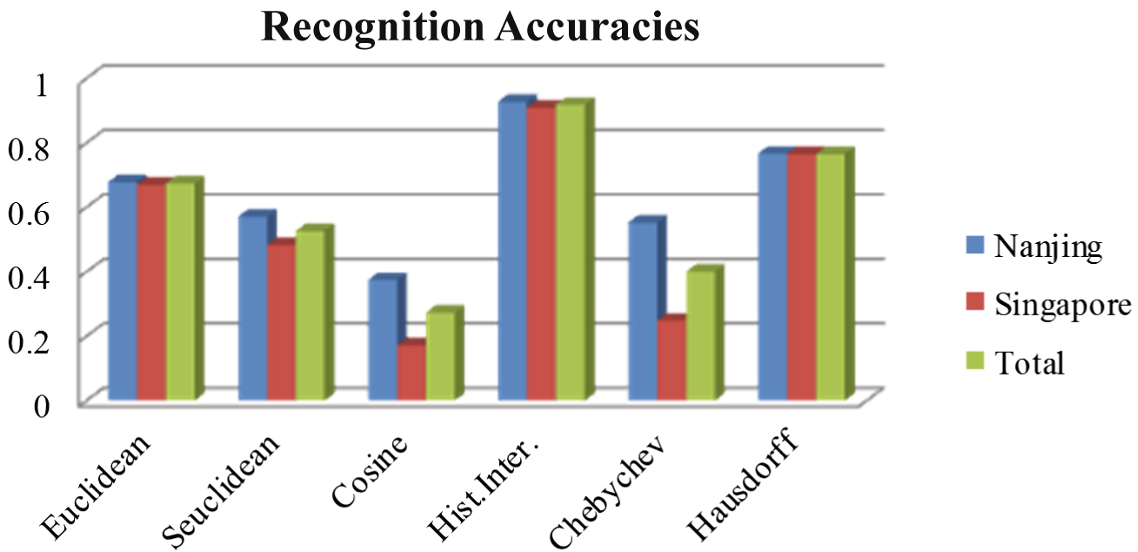
- Accuracy: They tested 6 different distance metrics. The Histogram Intersection metric performed best, yielding an average accuracy of 91.94%.
Critical Analysis & Conclusion
Takeaway
The core contribution here is the structural fusion of sensor data and social internet data. By treating the UGV not just as a sequence of images but as a "sensor-rich" event, the system bypasses the need for massive "black-box" models.
Limitations
- Social Dependency: The system relies heavily on the availability of geocoded social media photos. In sparsely populated areas, the "recommendation" part of the pipeline might struggle.
- Boundary Precision: As noted in the user study, some participants were dissatisfied with the "sizing" of the bounding boxes, suggesting that while the recognition is strong, the localization (segmentation) could be tighter.
Future Outlook
This lightweight approach is a precursor to the "Edge AI" trend. As mobile hardware continues to evolve, integrating these types of "Sensor-Social" priors could allow Augmented Reality (AR) systems to identify landmarks and objects instantly without waiting for a server heartbeat.