
Sentic Maxine: Bridging the Gap Between Discrete Emotion Labels and Continuous Affective Paths
Sentic Maxine: Multimodal Affective Fusion and Emotional Paths
The paper introduces Sentic Maxine, a multimodal affective framework that integrates Sentic Computing and facial expression analysis into a 3D virtual agent engine. It achieves SOTA-level emotional tracking by mapping diverse categorical inputs into a continuous 2D "emotional path" within the Whissell evaluation-activation space.
TL;DR
Sentic Maxine is an innovative architecture that transforms the way virtual agents perceive human emotion. By bypassing the limitations of rigid, discrete categories (like "Happy" or "Angry"), it maps text and facial expressions onto a continuous 2D Whissell space. Through a combination of decay-based weighting and Kalman filtering, it generates a smooth "Emotional Path" that tracks a user's feelings in real-time, even when one sensor (like a webcam) fails.
Problem & Motivation: The "Discrete" Trap
Most affective computing systems treat emotions like a multiple-choice test. You are either "Happy," "Sad," or "Neutral." However, human emotion is a fluid, high-dimensional spectrum. Previous research faced three major hurdles:
- Asynchronous Signals: Facial expressions change at the speed of milliseconds (video frames), while text analysis depends on the completion of a sentence.
- Label Inconsistency: One module might output "Frustration" while another outputs "High Sensitivity." How do you mathematically merge them?
- Sensor Fragility: If a user turns their head and the facial tracker fails, the agent suddenly "loses" the user's emotional context.
The authors' insight was to treat emotion as kinematics—a point moving through a physical space—allowing them to use classical signal processing to solve psychological problems.
Methodology: The Core Engine
The architecture is built upon the Maxine 3D engine, but the magic happens in the Affective Analysis Module.
1. The Whissell Space Mapping
Instead of outputting a label, every input is mapped to a coordinate representing Evaluation (pleasantness) and Activation (energy). If a text snippet has multiple weights, the system calculates the barycenter of these points in the Whissell space.
2. Temporal Fusion with Decay
Since emotions aren't instantaneous flashes but have "persistence," the system uses an exponential decay model: This ensures that a text-based sentiment stays "active" in the agent's memory for a short duration, slowly fading unless reinforced by new input.
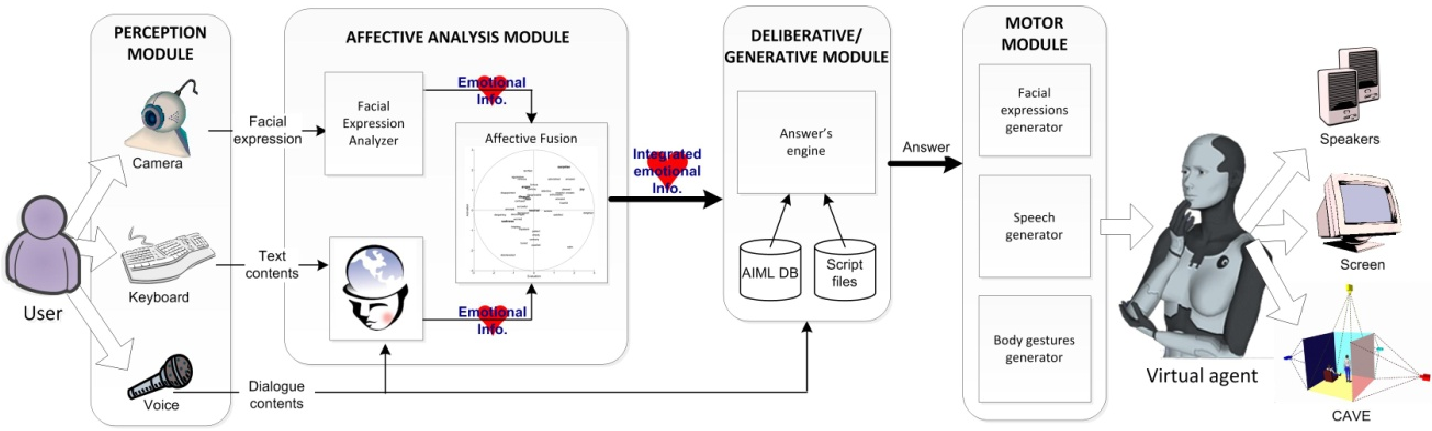 Figure 1: The Sentic Maxine architecture integrating Perception, Affective Analysis, and Motor modules.
3. Emotional Kinematics (Kalman Filtering)
This is the most technically sophisticated part. The system models the "position" and "velocity" of a user's emotion in the 2D space. When the webcam loses track of the face, the Kalman Filter doesn't just stop; it predicts where the emotion was "heading," maintaining a continuous path until the sensor recovers.
Experiments & Results: The Power of Fusion
The researchers tested the system with a scenario where a user talks about buying a new car (positive) and then denting it (negative).
- Unimodal Failure: When using only facial analysis, a 14-second occlusion (the user looking away) caused a complete gap in emotional tracking.
- Multimodal Success: By fusing the Sentic text analysis with the facial data, the gap was bridged. Even better, when both signals were present, the "Emotional Path" was much more stable and less prone to "jumps."
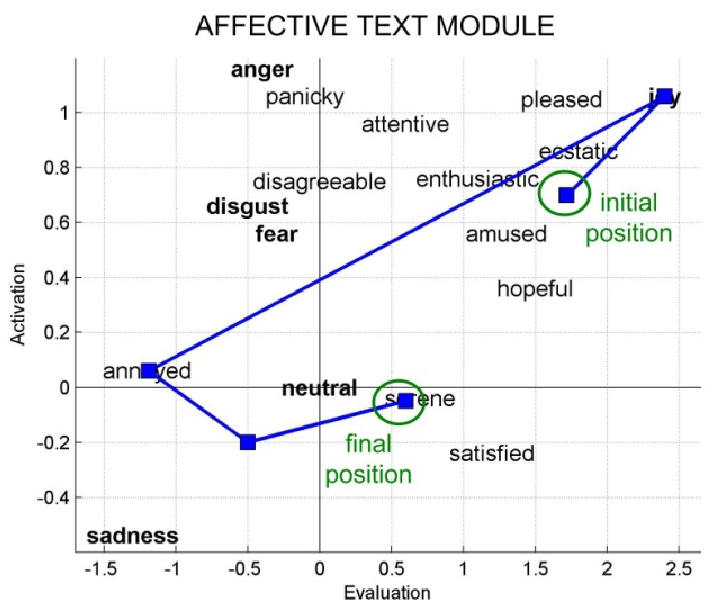 Figure 2: Individual emotional paths showing the massive gaps in facial tracking (right) vs the sparse nature of text (left).
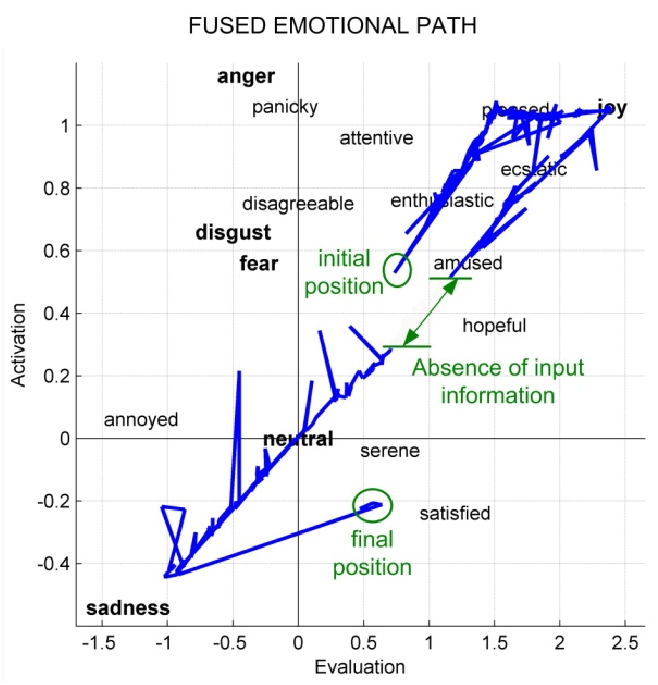 Figure 3: The final fused path. Note the smoothness (b) provided by the Kalman filter compared to the unfiltered path (a).
Critical Analysis & Conclusion
Takeaway
Sentic Maxine proves that multimodality is not just about accuracy; it's about continuity. By treating emotion as a vector in a continuous space, the system handles the messy, asynchronous nature of human communication far better than traditional classifiers.
Limitations
- Empirical Tuning: Parameters like the decay rate () and Kalman noise () were established empirically. These may need to be dynamic to account for different cultural expressions or personality types.
- Complexity: Mapping 9,000 words from the Whissell dictionary is powerful but computationally expensive for real-time edge devices without optimization.
Future Outlook
This work sets the stage for "Empathic AI." Future iterations could extend this to physiological sensors (heart rate, skin conductance) or apply it to VR/AR environments where maintaining the "believability" of a virtual avatar is critical for user immersion.