
Sentient City-Bike: Solving the Urban Mobility Data Gap with Low-Cost WiFi Mesh
Sentient Bikes for Collecting Mobility Traces in Opportunistic Networks
The paper presents "Sentient City-Bike," a low-cost, city-wide tracking platform designed to collect large-scale human mobility traces. Using a hybrid sensor network architecture (WiFi Mesh + mobile sensors), the system enables real-time location monitoring and social networking integration for urban cyclists.
TL;DR
Researchers from Cambridge and HKU have developed the Sentient City-Bike system, a hybrid sensor network designed to track thousands of urban cyclists. By pivoting from expensive GPS to a low-power WiFi Mesh architecture, the team achieved city-wide tracking with a 50m accuracy at a fraction of the cost ($53/node) of existing theft-prevention measures.
Context: The Data Scarcity in Opportunistic Networking
In the world of opportunistic networks (communication via human proximity), we are starving for data. Most public traces involve only about 100 nodes. To design protocols that actually work in a bustling city like Cambridge or Paris, we need "Large-scale mobility traces." The Sentient City-Bike project addresses this by turning everyday bicycles into mobile sensors, creating a platform that serves both researchers (data collection) and citizens (theft prevention and social networking).
The "WiFi Over Zigbee" Insight
A common misconception in IoT design is that Zigbee (802.15.4) is always better for low-power applications. The authors argue the opposite for urban tracking.
- The Energy/Bit Argument: While 802.11b/g (WiFi) draws more instantaneous power, its massive bitrate (up to 54 Mbps) means it can transmit data and return to sleep significantly faster.
- The Formula: . The Marvell 8686 WiFi chip requires only ~53 nJ/bit, whereas the common CC2420 Zigbee chip requires 122 nJ/bit.
System Architecture: Basic vs. Super Nodes
The architecture is a hierarchical "Event-Based" model:
- Mobile Nodes (Basic): Low-cost units that scan for WiFi AP signal strengths (Fingerprinting) and push data to the infrastructure.
- Super Nodes: Comprising 15-30% of the fleet, these carry GPS and higher processing power to "calibrate" the system and update the radio map of the city in real-time.
- Trackside Infrastructure: A mesh of WiFi routers (like the ORiNOCO AP400) that acts as the gateway to central servers.
 Figure 1: Conceptual deployment of Sentient Bikes in an urban environment.
Experimental Results
The team tested the Cambridge Sensor Kit (CSK)—an open-source WiFi board—mounted inside a standard bike light.
- Connectivity: In urban tests, a cyclist could maintain a robust signal while approaching and passing base stations. However, the study revealed a significant challenge: Human body attenuation. As the cyclist passes the AP, their body blocks the signal, causing an uneven drop in RSSI (Received Signal Strength Indication).
- Latency Challenges: Testing iPhones as nodes revealed worrying Round-Trip Time (RTT) variance (3ms to 1000ms), suggesting that mobile OS task scheduling often de-prioritizes background networking tasks.
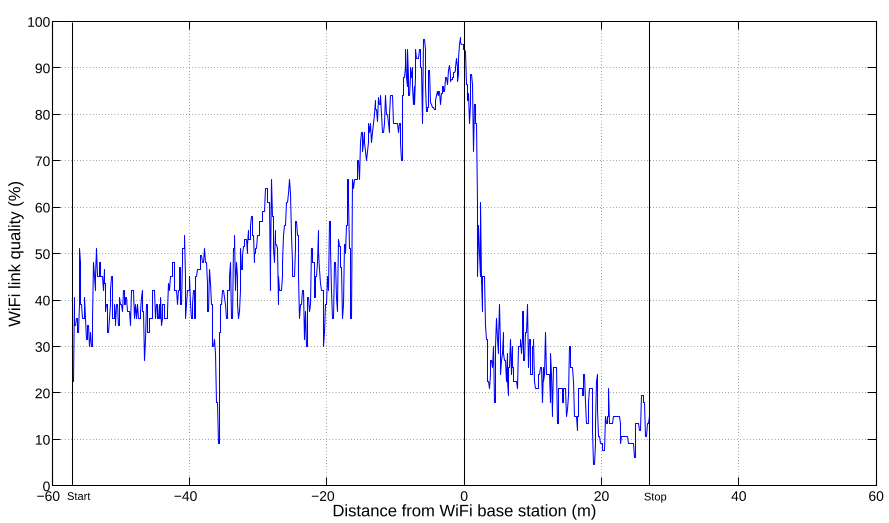 Figure 2: Signal strength vs. distance, highlighting the "Human Body Shadowing" effect as the cyclist passes the station.
Security & Theft Prevention
Bike theft is the "killer app" for this system. With a unit cost of $53, it is significantly cheaper than the 400 Euros lost per stolen bike in programs like Paris's Vélib'. The system proposes:
- Software Geofencing: Triggering alarms if a bike leaves a designated "cycling zone."
- Immobilizers: Potential for remote-locking mechanisms controlled via the tracking device.
Critical Analysis & Future Outlook
While the "Sentient City-Bike" provides a compelling blueprint, two major hurdles remain:
- Power Autonomy: While the authors suggest using wheel-hub dynamos for energy harvesting, real-world efficiency and the impact on cyclist effort need further validation.
- Privacy: Tracking movements in a "University Town" like Cambridge is sensitive. The authors advocate for an "Iterative Design" where users trade data for rewards (Social networking status or virtual credits).
Conclusion: This work is a seminal example of "Application-Driven Research," proving that for city-scale IoT, leveraging existing WiFi infrastructure is often more practical and cost-effective than building specialized sensor networks from scratch.