
CAAS: Beyond Keywords—Leveraging Fuzzy Logic for Arabic Sentiment Analysis
Sentiment Analysis on Arabic Content in Social Media: Hybrid Model of Dictionary Based and Fuzzy Logic
The paper introduces CAAS (Classical Arabic Analysis System), a hybrid sentiment analysis framework for Arabic social media content. It combines a dictionary-based approach using SentiWordNet with Fuzzy Logic to classify text into seven granular categories ranging from "Very Positive" to "Very Negative."
TL;DR
Analyzing sentiment in Arabic social media is notoriously difficult due to the language's complexity. The Classical Arabic Analysis System (CAAS) tackles this by moving beyond simple word-counting. It uses a hybrid model of SentiWordNet and Fuzzy Logic that considers not just what was said, but who said it and how much social validation (likes) it received, resulting in a granular 7-category emotion scale.
The "Arabic Problem" in Sentiment Analysis
Most sentiment analysis tools are designed for Latin languages. When applied to Arabic, they often stumble over:
- Morphological Complexity: A single Arabic root can produce hundreds of words.
- Social Context: A post from a consistently negative account might have a different pragmatic meaning than one from a neutral source.
- Granularity Gap: Most models use a crude 3-point scale (Positive, Negative, Neutral), which is insufficient for the nuance of social commentary.
Methodology: The Fusion of Logic and Lexicons
The CAAS framework operates on a multi-stage pipeline, but its "secret sauce" lies in how it handles uncertainty through Fuzzy Logic.
1. The Dictionary Layer
Because specialized Arabic polarity lexicons are scarce, CAAS translates Arabic terms via Google Translate and queries SentiWordNet. This provides a base numerical score for each word.
2. The Fuzzy Logic Controller
Instead of relying solely on the dictionary, the system feeds three variables into a Fuzzy Inference System:
- Sentence Polarity: The raw score from the dictionary.
- Account Orientation: A dynamic metric tracking the user's historical sentiment.
- Likes Ratio: A "popularity indicator" that measures the post's reception relative to the account's best-performing content.
 The workflow of CAAS: From data collection to fuzzy-refined classification.
Experiments and Continuous Learning
The authors tested CAAS on data from major Arabic news outlets like Al Jazeera, Al Arabiya, and public figures.
Granular Classification (7 Categories)
The system maps results to:
- Very Positive
- Positive
- Good
- Neutral
- Not Good
- Negative
- Very Negative
The "Social" Correction
A key finding was that classifications were not static. In "Round 2" of analysis, as the system gathered more data on a specific account, it recalculated the Account Orientation.
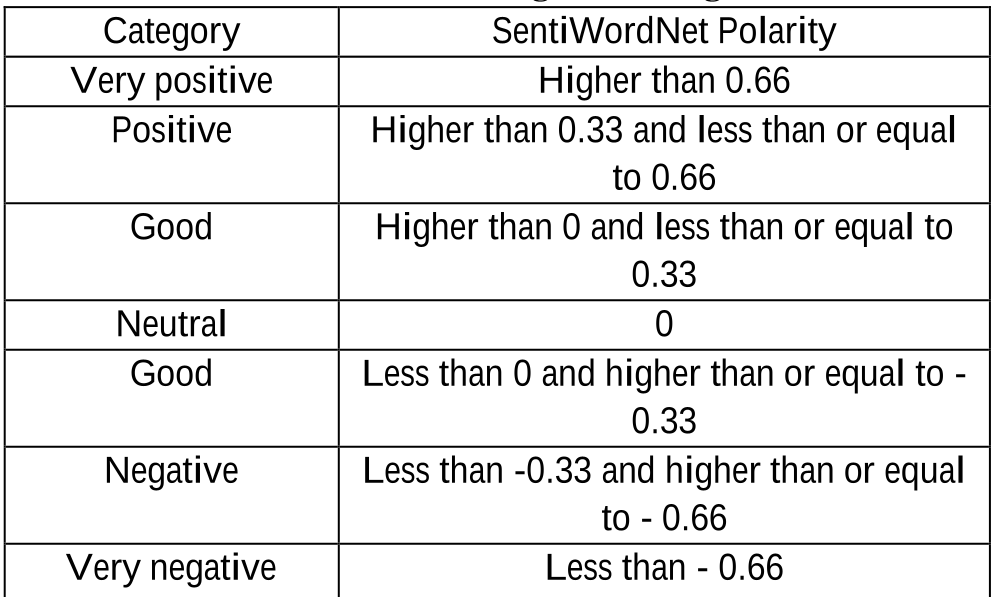 Table showing the polarity ranges used to map SentiWordNet scores to CAAS categories.
Critical Insight: Why This Matters
The brilliance of CAAS isn't just in the NLP—it’s in the mathematical modeling of social behavior. By recognizing that a "like" or the author's past behavior acts as a weight on the text's meaning, the authors provide a pathway for more human-like interpretation of digital text.
Limitations & Future Work
- Translation Dependency: Using Google Translate as a middleman introduces potential errors.
- Dialectal Absence: The current model focuses on Classical Arabic, ignoring the rich (and dominant) world of Arabic dialects (Ammiya) used on social media.
- Facebook Data Constraints: Privacy changes often disrupt scrapers, highlighting a need for more robust API-based integration.
Conclusion
CAAS represents a significant step toward "contextual intelligence" in Arabic NLP. By bridging the gap between linguistic dictionaries and the fuzzy nature of social interaction, it offers a blueprint for more sensitive, accurate, and multi-dimensional sentiment tools.
Keywords: Arabic NLP, Fuzzy Logic, Sentiment Analysis, Social Media Mining, SentiWordNet.