
Beyond Positive and Negative: A Pattern-Based Deep Dive into Twitter Sentiment
Sentiment analysis: From binary to multi-class classification: A pattern-based approach for multi-class sentiment analysis in Twitter
This paper introduces a pattern-based approach for multi-class sentiment analysis on Twitter, expanding the typical binary classification into seven distinct categories: happiness, sadness, anger, love, hate, sarcasm, and neutral. By employing a feature extraction framework that combines PoS-tag patterns, SentiStrength scores, and WordNet-derived unigrams, the method achieves 87.5% accuracy in binary tasks and 56.9% in the complex 7-class task.
TL;DR
While most sentiment analysis tools stop at "Thumbs Up" or "Thumbs Down," this research by Bouazizi and Ohtsuki breaks the mold by classifying tweets into seven emotional categories. By moving beyond simple word counts to "writing patterns"—the structural way we arrange parts of speech when we are angry or happy—the authors achieve a high accuracy of 87.5% in binary tasks and provide a roadmap for navigating the complexities of multi-class emotion mining.
The Granularity Gap: Why Binary Isn't Enough
In the world of social media monitoring, knowing a customer is "unhappy" is only half the battle. There is a fundamental difference between a user expressing Sadness over a broken phone screen and expressing Anger over a lack of customer support. Current State-of-the-Art (SOTA) methods often collapse these distinct signals into a single "Negative" bucket, losing valuable intelligence.
The authors argue that the challenge of microblogging is three-fold:
- Brevity: 140 characters provide little context.
- Slang: Informal language defeats standard dictionaries.
- Overlap: Negative classes (Hate, Anger, Sadness) often share similar lexicons but different structural "vibes."
Methodology: The Four Pillars of Feature Extraction
The core innovation lies in the author's feature engineering, which looks at the "DNA" of a tweet from four angles:
1. The Sentiment Engine (SentiStrength)
The model calculates a "Sentiment Polarity Ratio" using SentiStrength, which assigns scores from -5 to +5. They also track emoticons and "sentiment contrast"—the jarring presence of a positive word near a negative hashtag, which often signals sarcasm.
2. Syntax and Punctuation
Does the user use five exclamation marks? Do they write in ALL CAPS? Do they say "looooove" instead of "love"? These features capture the intensity of the emotion, a critical dimension often ignored in bag-of-words models.
3. WordNet Unigrams
Instead of just searching for specific words, they used WordNet to build a hierarchy of synonyms and hyponyms. This expands the model's vocabulary, allowing it to recognize that "fury" and "rage" belong to the "Anger" class.
4. Pattern-Based Features (The Secret Sauce)
This is the most sophisticated module. The authors convert tweets into "Pattern Vectors" based on Part-of-Speech (PoS) tags.
- Example: "He is dummy" →
[PRONOUN VERB NEG-ADJECTIVE]By comparing a new tweet's structure against known patterns for specific emotions (like the "Sarcasm Pattern" or "Hate Pattern"), the model identifies the way a person is speaking, not just what they are saying.
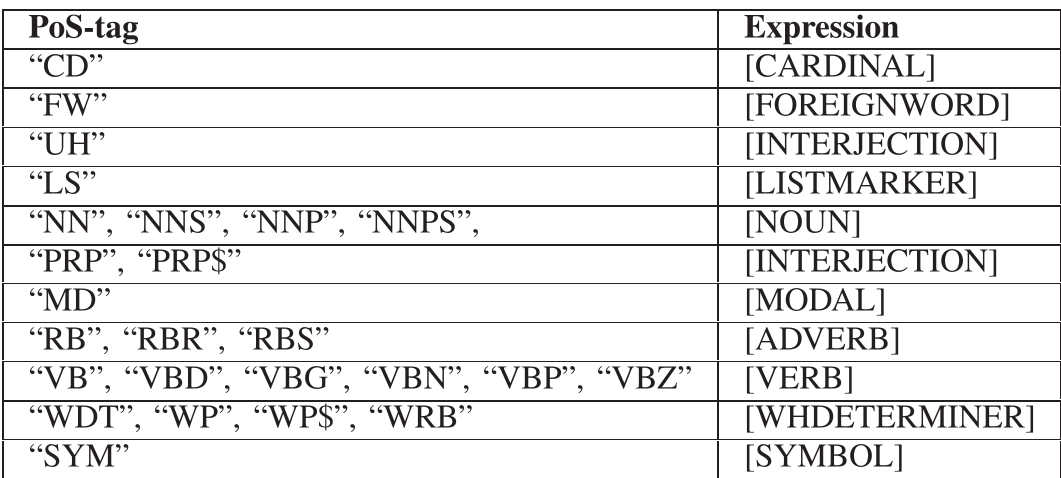 The mapping of PoS-tags to generalized expressions used for pattern matching.
Experimental Battleground: From Binary to 7-Class
The authors tested their approach using a manually labeled dataset of 21,000 tweets.
- Binary Performance: When simplified to Positive vs. Negative, the model is a powerhouse, reaching 87.5% accuracy.
- Ternary Performance: Adding a "Neutral" class dropped accuracy slightly to 83.0%.
- The 7-Class Challenge: In the full emotional spectrum, accuracy sat at 56.9%.
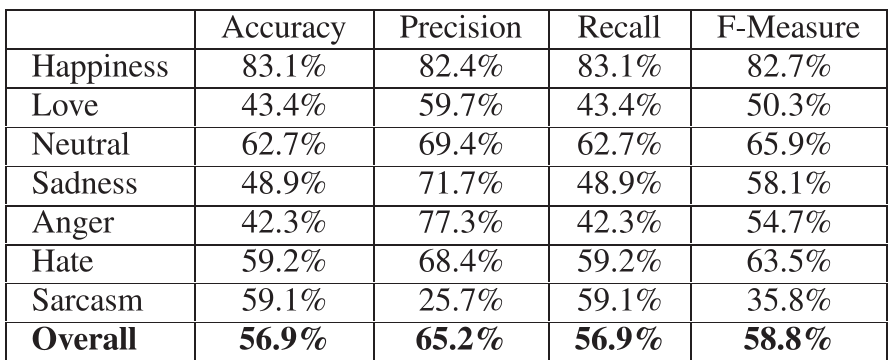 Performance metrics across seven classes show that 'Happiness' is the easiest to detect, while 'Love' and 'Sarcasm' pose significant challenges.
Why the drop in 7-class?
The Confusion Matrix reveals a fascinating insight: Negative emotions are "sticky." Users frequently express both Anger and Hate in the same breath ("I really hate when this crap doesn't work!"). Because the model forces a single choice (Multi-class), it often struggles to pick the "primary" emotion when multiple are present.
Critical Insight: The Sarcasm Problem
The biggest "noise" in the data came from Sarcasm. Sarcastic tweets often look like "Happiness" (positive words) but feel like "Anger" (negative context). The authors concluded that to truly solve multi-class sentiment, a dedicated Sarcasm Detector must be run as a first-pass filter before trying to categorize the specific emotion.
Conclusion & Future Outlook
This paper proves that structural patterns (syntax and PoS-tags) are a viable path toward understanding human emotion in short-text formats. While 56.9% accuracy might seem low compared to binary tasks, it represents a significant step toward Sentiment Quantification—the move from "Is this user happy?" to "How much of their anger is mixed with sadness?"
For future researchers, the message is clear: Stop looking at words in isolation. Look at the patterns in which they are woven.