
Inside the Culture: Predicting Firm Earnings through Employee Sentiment Analysis
Sentiment Analysis and the Impact of Employee Satisfaction on Firm Earnings
This paper presents a sentiment analysis framework using Glassdoor employee reviews to predict firm earnings surprises. By employing a joint aspect-polarity model (combining LDA-extracted "firm outlook" topics with dictionary-based sentiment scores), the authors demonstrate that internal employee satisfaction is a leading indicator of future financial performance, particularly for predicting negative earnings surprises.
TL;DR
Can a company's own employees predict its financial future better than Wall Street analysts? This paper argues "Yes." By analyzing thousands of anonymous reviews on Glassdoor using LDA and sentiment analysis, the researchers found that employee sentiment—specifically regarding a firm's future outlook—is a statistically significant predictor of quarterly earnings surprises. Remarkably, this effect is asymmetric: poor employee sentiment is a powerful harbinger of financial disappointment.
Background: The Neglected Stakeholder
For decades, financial sentiment analysis has focused on external voices: tweets from consumers, news headlines, and analyst reports. However, employees possess "inside information" regarding corporate efficiency and management effectiveness long before these manifest in a balance sheet. While prior work like Edmans (2011) used the "Fortune 100 Best Companies" list, that data is updated only once a year. This study pivots to the high-frequency, granular world of online employee reviews to bridge the gap between intangible culture and tangible profit.
Problem & Motivation: The Timing and Coverage Gap
The authors identify two primary failures in existing internal reputation research:
- Untimeliness: Annual lists cannot help investors predict quarterly earnings "surprises" (Standardized Unexpected Earnings, or SUE).
- Selection Bias: The "Best Companies" list only looks at the winners. To truly understand the impact of culture, one must look at the full spectrum, including those struggling with toxic environments.
The core insight is that sentiment alone isn't enough. A generic "I love the free snacks" comment carries less weight for an investor than "I am worried about our product roadmap." Therefore, the study seeks to isolate "Firm Outlook" as a specific aspect of sentiment.
Methodology: The Joint Aspect-Polarity Approach
The researchers developed a pipeline to turn unstructured text into a financial forecasting feature.
1. Aspect Discovery (LDA)
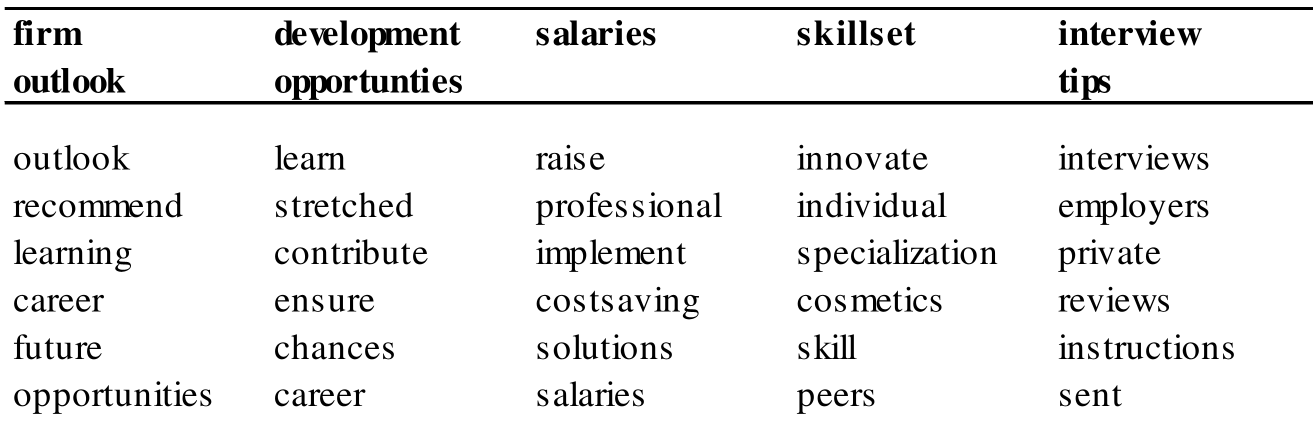
Using Latent Dirichlet Allocation (LDA), the authors extracted latent topics from over 41,000 reviews. They successfully isolated five clusters, with the most relevant being "Firm Outlook," characterized by keywords like recommend, future, opportunities, and career.
2. Sentiment Polarity
The authors calculated a "Tone" score using the General Inquirer dictionary, applying a standard polarity formula: . They notably conducted a multivariate t-test to ensure that former employees (who might be biased) didn't skew the results significantly compared to current staff, finding the data robust for aggregation.
3. The Interaction Model
The breakthrough comes from the Joint Polarity-Aspect Model. Instead of just looking at sentiment, they created an interaction term: This ensures that the model places higher weight on sentiment specifically tied to the company's future prospects.
Experiments & Results: The Power of Asymmetry
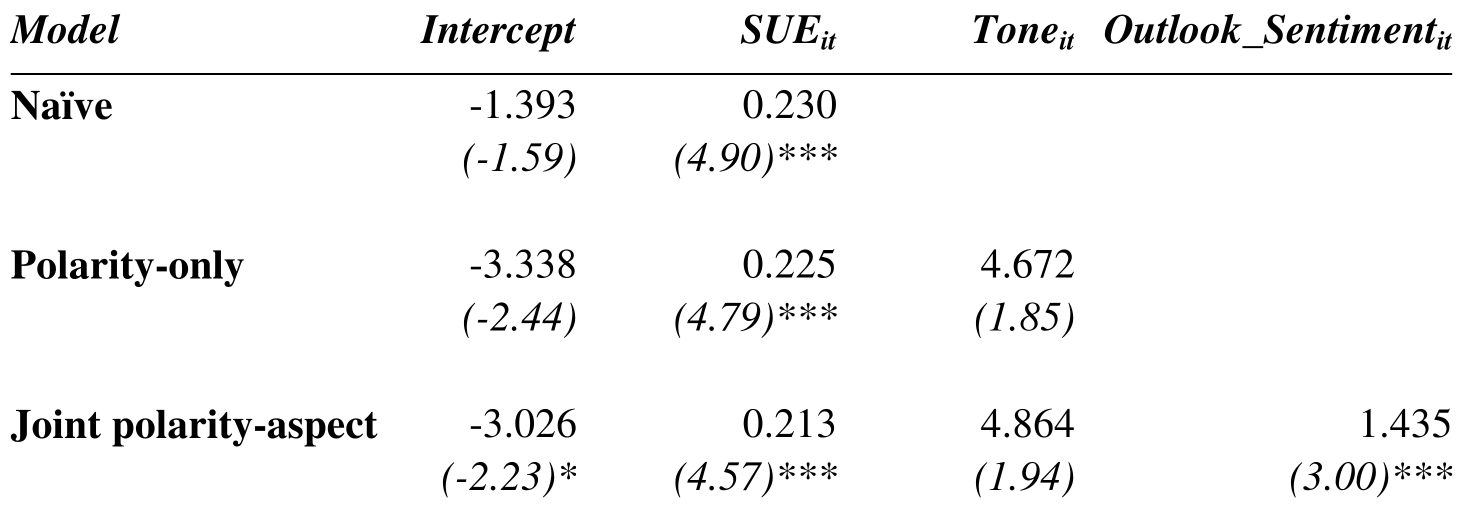
The authors tested three models: a Naive baseline (using past earnings), a Polarity-only model, and the Joint Polarity-Aspect model.
Key Findings:
- Incremental Value: The coefficient was highly significant (p < 0.001), proving it contains information not captured by past financial performance or general sentiment.
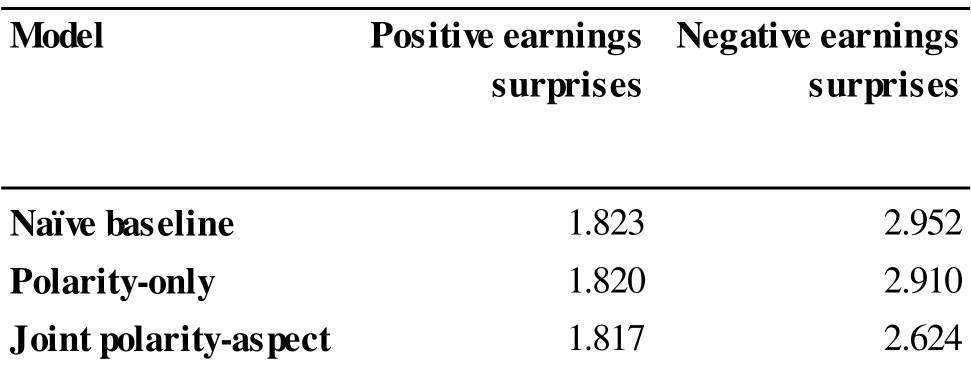
- Asymmetric Prediction: The model is significantly better at predicting negative surprises than positive ones. As shown in Table 3, the RMSE for negative earnings surprises dropped from 2.952 (Baseline) to 2.624 (Joint Model)—an 11% improvement.
Critical Insight: Why Does It Work?
The study suggests that culture acts as a "leading indicator." When employees sense a decline in the firm's outlook, it reflects internal inefficiencies, talent flight, or poor management decisions that haven't yet been priced in by the market. The asymmetry is particularly fascinating: it suggests that while great culture is a sustainable asset, toxic culture or lack of direction acts as a fast-acting poison to the bottom line that analysts often miss.
Conclusion & Future Work
This research moves sentiment analysis from "what people feel" to "what insiders know." By quantifying the "intangible" through LDA and interaction modeling, the authors provide a blueprint for modern quantitative investing.
Future Directions:
- Applying more advanced NLP (like LLMs) to better capture nuance beyond dictionary term-counting.
- Expanding the dataset beyond Glassdoor to global platforms like Indeed or LinkedIn to account for regional cultural differences.
In the words of IBM’s former CEO: "Culture is the game." This paper proves that for investors, understanding that game is the key to avoiding the next earnings miss.