
BERTurk in Banking: High-Precision Sentiment Analysis for Low-Resource Scenarios
Bankacılık Alanında Müşteri Yorumlarının BERT Tabanlı Yaklaşımlar ile Duygu Analizi Sentiment Analysis of Customer Comments in Banking using BERT-based Approaches
This paper presents a comprehensive study on sentiment analysis for the Turkish banking sector using Net Promoter Score (NPS) comments. It evaluates the performance of the BERTurk model against traditional machine learning baselines across various data availability scenarios, including full-resource, low-resource, and zero-shot settings.
TL;DR
This research tackles the challenge of automating customer feedback analysis in the Turkish banking sector. By leveraging BERTurk, the authors achieved a 91% F1-score, proving that transformer-based models are far more resilient to data scarcity than traditional ML. Most importantly, the study introduces a Zero-shot Learning approach that yields an 83% F1-score without requiring a single piece of labeled banking data.
Context & Motivation
In the banking industry, the Net Promoter Score (NPS) is a vital metric for customer satisfaction. However, manual analysis of thousands of open-ended Turkish comments is labor-intensive and error-prone. While sentiment analysis is mature for English, Turkish presents unique challenges as a morphologically rich, low-resource language in the NLP landscape.
The authors identified two critical "pain points" in current industrial applications:
- The Data Scarcity Trap: Labeled domain-specific data is expensive to produce.
- Domain Shift: Models trained on social media (like Twitter) fail miserably when applied to formal or semi-formal banking feedback.
Methodology: From Traditional ML to BERT and Zero-Shot
The study compares three distinct paths:
- Baseline Models: SVM, Naive Bayes, and Logistic Regression using TF-IDF and Word2Vec.
- Fine-tuning BERT: Utilizing BERTurk (specifically pre-trained on Turkish corpora) and Multilingual BERT.
- Zero-Shot via NLI: Using XLM-Roberta-Large-XNLI. Instead of classifying "Positive/Negative," the model checks if the premise (customer comment) entails the hypothesis (e.g., "This text is positive").
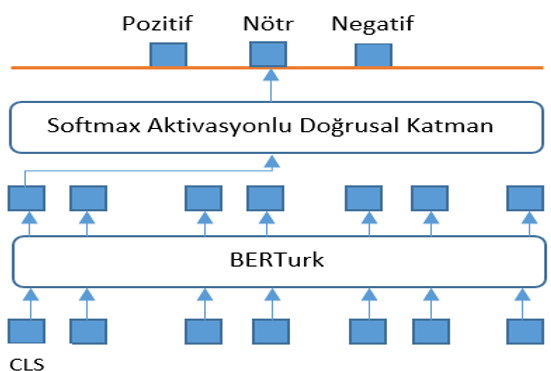 Figure 1: The standard fine-tuning pipeline for BERT-based Sentiment Analysis.
Experimental Insights
1. Superiority of BERTurk
With a full training set, BERTurk outperformed all models with a 91% F1-score. Interestingly, traditional models like SVM (90%) and Naive Bayes (89%) were close, suggesting that with abundant data and proper preprocessing, traditional ML remains competitive.
2. Resilience in Low-Resource Settings
The true power of BERT appeared when the training data was slashed. When using only 5% of the data (approx. 185 comments):
- BERTurk dropped only 7% (from 91% to 84%).
- Traditional Models collapsed, losing up to 14% of their performance.
- Multilingual BERT consistently underperformed, highlighting the value of language-specific pre-training.
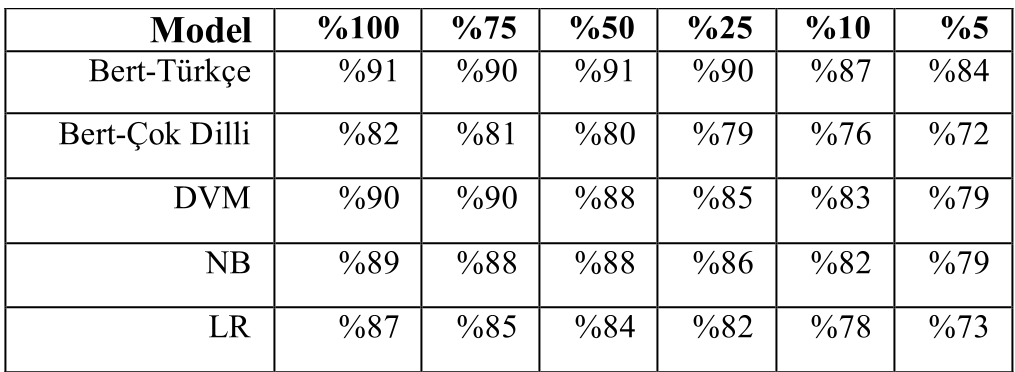 Table 1: Weighted F1-scores as a function of training data percentage.
3. The "Zero-Shot" Breakthrough
Perhaps the most significant finding was the failure of Cross-Domain Transfer. A BERT model trained on Twitter data (BounTi dataset) achieved only 51% when tested on banking data. However, the Zero-shot XLM-Roberta model achieved 83% without any banking-specific training. This suggests that the semantic understanding of NLI-pretrained models is better at generalizing than supervised models trained on "noisy" out-of-domain data.
Critical Analysis & Conclusion
Takeaway
For enterprise NLP in specialized domains:
- Don't rely on out-of-domain social media data; the linguistic "slang" of Twitter does not translate to the professional concerns of bank customers.
- Embrace Zero-shot NLI if you have zero budget for labeling; it provides a "cold start" capability that is remarkably close to fully supervised models.
Limitations & Future Work
The authors noted that BERTurk still struggles with specific banking terminology (domain-specific entities). Future work involves domain-adaptive pre-training (DAPT), where the model is further pre-trained on unlabeled banking documents before fine-tuning, potentially pushing the F1-score even closer to 100%.
By integrating these models into CRM systems, banks can transition from "analysing the past" to "reacting in real-time" to customer dissatisfaction.