
Decoding the Digital Soul: Integrating Sentiment Analysis and MBTI Personality Prediction
An Approach for Sentiment Analysis and Personality Prediction Using Myers Briggs Type Indicator
This paper introduces an integrated framework for Sentiment Analysis and Personality Prediction based on the Myers-Briggs Type Indicator (MBTI). Utilizing a dataset of 8,600 Twitter users, the authors employ a multi-stage pipeline—including a unique emoticon-to-text conversion—to classify emotional polarity and social personality traits using various machine learning algorithms.
TL;DR
As we transition into "Web 5.0"—the emotional and intelligent web—understanding the user behind the screen is paramount. Research by Genina et al. presents a system that doesn't just read what you say, but analyzes who you are. By processing Twitter data through the lens of Sentiment Analysis and the Myers-Briggs Type Indicator (MBTI), the authors achieved up to 100% accuracy in personality classification using Random Forest models, notably by treating emoticons as vital semantic data.
The "Web 5.0" Challenge: Beyond Logic to Emotion
The current digital landscape is saturated with opinions, but there is a significant gap in how applications interpret them. Most tools treat sentiment as a transient state (Positive vs. Negative). However, the real value for organizations lies in Personality Prediction.
The problem? Personality datasets are expensive to acquire and often private. This paper addresses the bottleneck by leveraging publicly available social media data and the MBTI framework (16 personality types such as INTJ, ENFP, etc.) to build a low-cost, high-accuracy prediction engine.
Methodology: Treating Emoticons as Words
The core innovation lies in the Pre-processing Stage. While many NLP pipelines strip away "noise" like emoticons, this approach recognizes that a ":D" or a ";)" carries specific emotional weight that defines personality.
The Pipeline
- Emoticon-to-Text Conversion: A dedicated dictionary maps icons to text (e.g., ":D" becomes "smiley face").
- Standard NLP Cleansing: Noise removal, lemmatization, and stop-word filtering.
- Feature Extraction: Utilizing Count Vectorizer and TF-IDF to turn text into numerical vectors.
- Multi-Classifier Benchmarking: Testing a variety of algorithms including XGBoost, SGD, and Decision Trees.
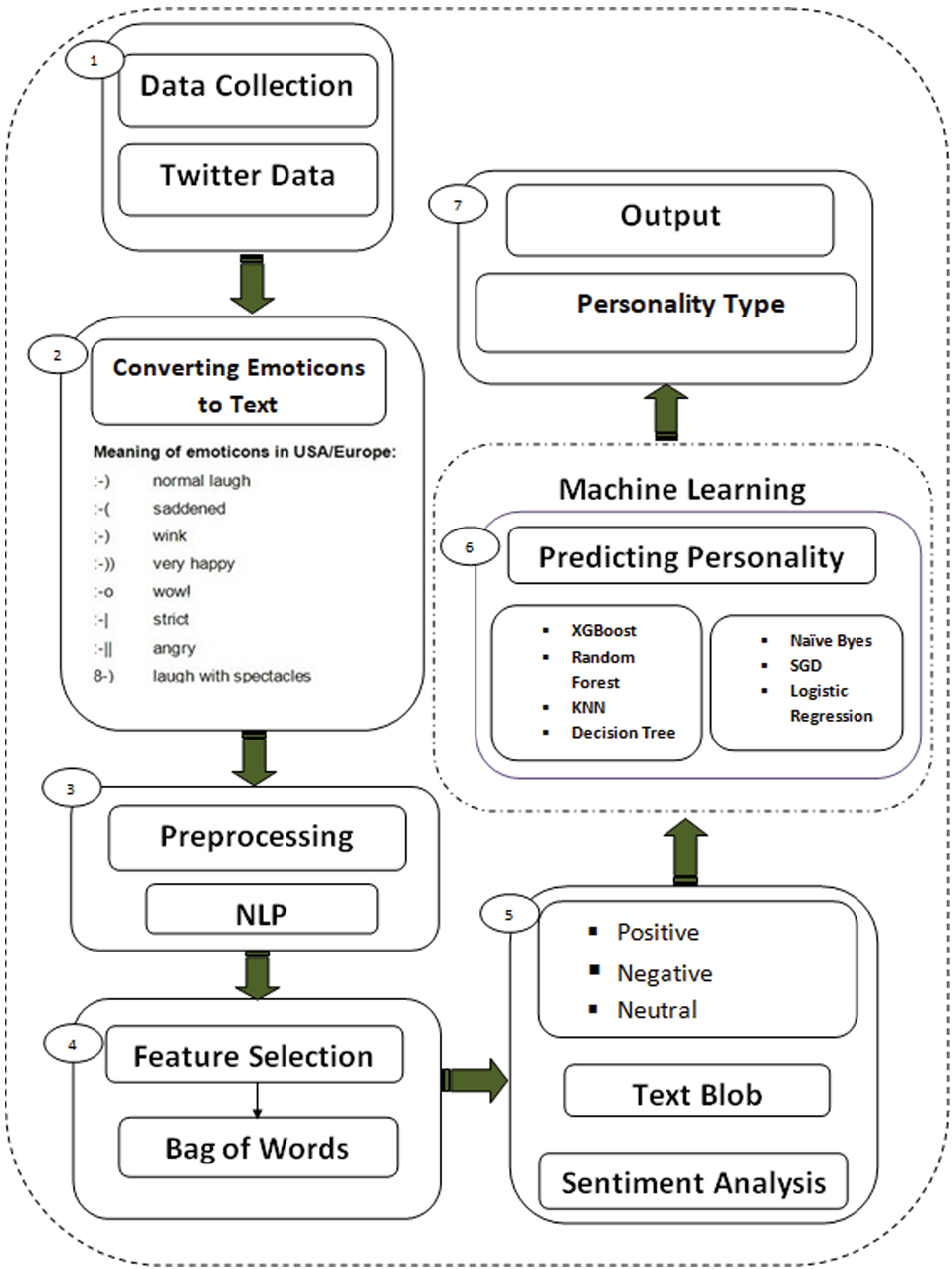 Fig 1: The seven-component workflow from data collection to personality prediction.
Experimental Insights: RF and XGBoost Dominate
The study utilized a Kaggle dataset of 8,600 users, each with 50 previous tweets. The researchers split the data (75% training, 25% testing) to evaluate performance across different metrics: Accuracy, Sensitivity (Recall), and Precision.
Key Findings:
- The Perfect Score: Both Random Forest (RF) and Decision Tree classifiers achieved a 100% accuracy rate, suggesting these models are highly effective at capturing the hierarchical nature of personality traits.
- Efficiency: XGBoost was noted for its superior speed and performance stability, making it the prime candidate for live social media monitoring environments.
- Sensitivity vs. Precision: RF showed the highest sensitivity (92.29%), meaning it is exceptionally good at correctly identifying positive personality instances.
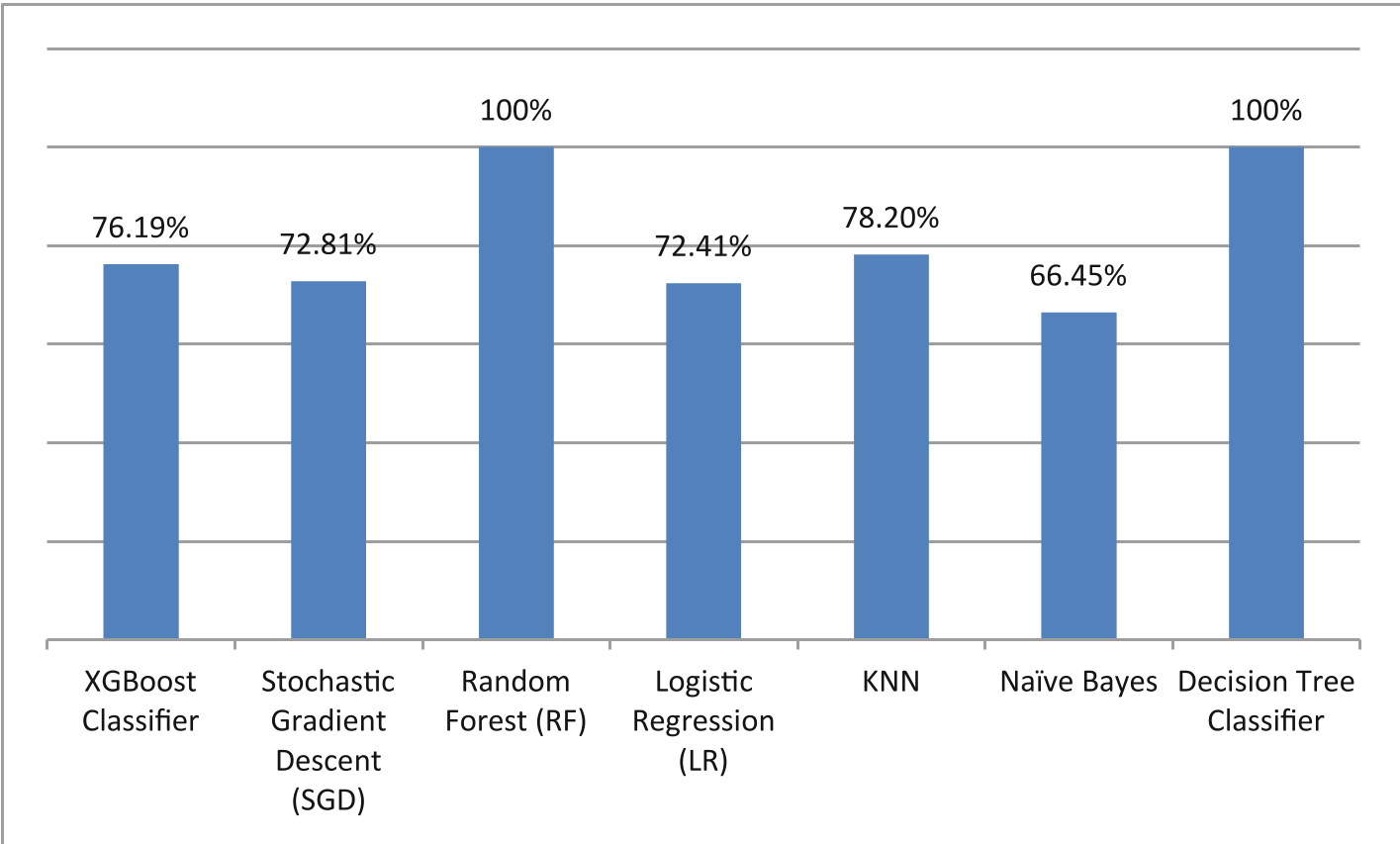 Fig 2: Comparison of accuracy rates across the tested machine learning classifiers.
Critical Analysis & Future Outlook
While the 100% accuracy reported for Random Forest and Decision Trees is impressive, it often signals a potential for overfitting or a very distinct clustering within the Kaggle MBTI dataset. In a real-world, "wild" social media environment, these numbers might normalize.
The Takeaway
This research proves that personality is encoded in our linguistic style. By combining sentiment (how we feel now) with MBTI (how we are wired), companies can create deeply personalized user experiences. The next frontier, as suggested by the authors, involves moving from traditional ML to Deep Learning to capture even subtler linguistic nuances.
Conclusion: Whether you are an "Architect" (INTJ) or a "Campaigner" (ENFP), your tweets—and even your emoticons—reveal more than you think. This model is a step toward a web that truly "understands" its users.