
Deciphering Polarity: Sentiment Analysis in the Wild World of Polish Political Forums
Sentiment Analysis in Polish Web-Political Discussions
This paper investigates sentiment analysis in the highly polarized context of Polish online political forums during the 2015 elections. The authors propose a hybrid approach, comparing dictionary-based and machine learning methods while introducing Word2Vec-based lexicon enrichment to achieve performance closely matching human evaluation.
TL;DR
Analyzing political sentiment is notoriously difficult due to slang, insults, and extreme polarization. This study tackles the Polish political landscape by comparing traditional lexicons with Machine Learning (ML). The breakthrough comes from using Word2Vec to "fill in the gaps" of sentiment dictionaries, achieving over 80% accuracy in distinguishing political support from opposition.
Background & Positioning
In the hierarchy of NLP tasks, sentiment analysis of "clean" reviews (like Amazon or IMDB) is a solved problem. However, political web forums are a different beast. In Poland, these spaces are defined by high-intensity emotions and a specific vocabulary of nicknames and coded insults. This paper positions itself as a practical bridge between linguistic-heavy dictionary methods and data-hungry machine learning, specifically optimized for the Polish language and its unique "partisan combatant" discourse style.
The Problem: Slang and Sparsity
The authors identify two major hurdles:
- Domain Mismatch: Models trained on Twitter data (TRAIN-TWIT) performed abysmal (~30% accuracy) on political blog comments because the language used in tweets (emoticons, short tags) is structurally different from long-form forum debates.
- The Sparsity Trap: Dictionary-based methods only work if the specific word exists in the lexicon. If a user uses a new political nickname like "Szogun", the system fails if that word wasn't manually tagged before.
Methodology: The Core of the Innovation
The researchers didn't just rely on manual tagging. They used Pointwise Mutual Information (PMI) to statistically determine the "emotional weight" of words.
The true "secret sauce" is the Word2Vec Oriented Dictionary Enrichment. When the system encounters a word not in its sentiment dictionary, it calculates the top 10 most similar words in the vector space (using Word2Vec). If one of those neighbors has a known sentiment, the system "borrows" that value for the unknown word.
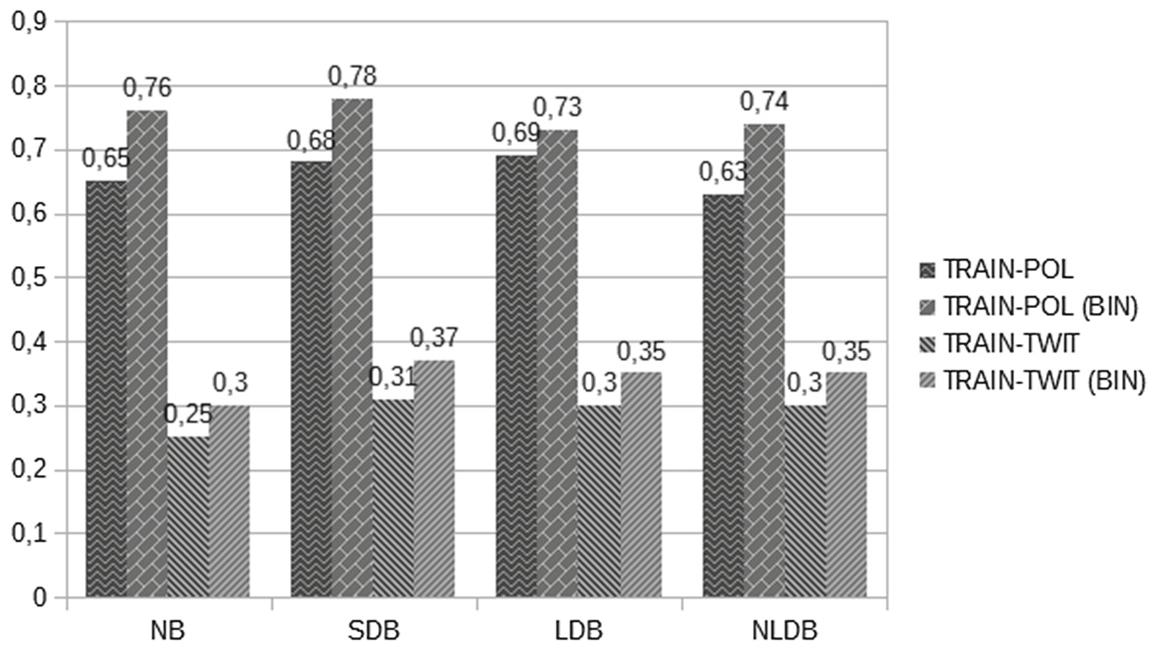 Figure 1: Accuracy comparison showing that models trained on specific political data (TRAIN-POL) vastly outperform general Twitter-trained models.
Experiments and Insights
The authors tested five methods across several datasets spanning 2010 to 2015.
Key Findings:
- Maximum Entropy (ME) was the king of 3-class classification (Positive, Negative, Neutral) but required data from the same source to stay accurate.
- Simple is Better: The Simple Dictionary Based (SDB) method often matched or beat complex ML models in cross-dataset scenarios.
- Temporal Stability: One of the most shocking findings was that a lexicon built on 2012 political data performed exceptionally well on 2015 data. This suggests that while political actors change, the underlying linguistic patterns of Polish political insults and praise are highly stable.
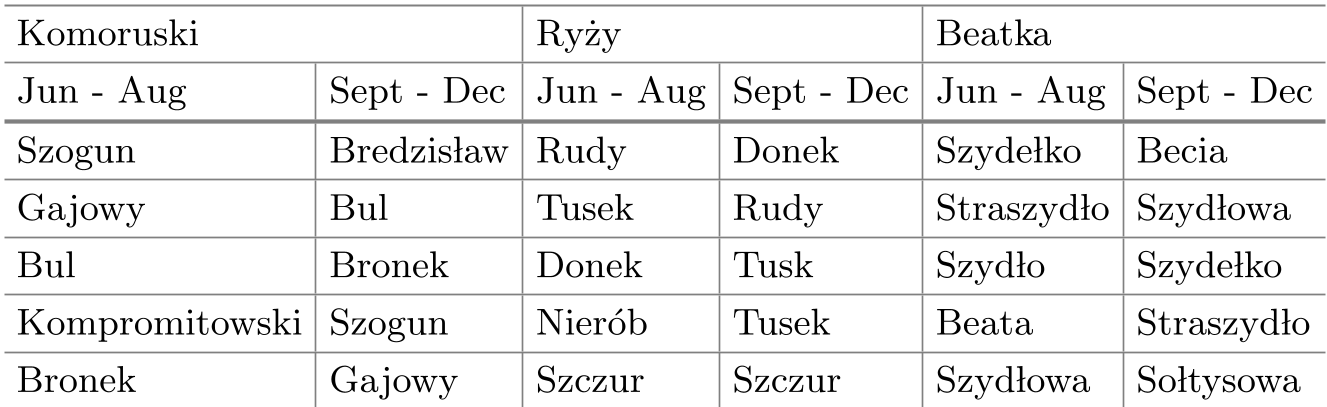 Table 1: Evolution of political nicknames (e.g., Ryzy, Beatka) and their semantic neighbors over time.
Critical Analysis & Conclusion
Takeaway
For niche, high-slang domains like regional politics, you don't necessarily need more data—you need smarter lexicons. By utilizing word embeddings to create a "searching dictionary," the authors bypassed the need for massive manual annotation.
Limitations
The study notes that neutrality detection remains the "Final Boss" of sentiment analysis. Most algorithms struggle to distinguish between a truly neutral statement and one where extreme positive/negative emotions cancel each other out. Additionally, relying on a single human annotator for the "Gold Standard" introduces a subjective bias that might not reflect the broader population's view.
Future Outlook
The authors hint that the next frontier isn't just text. Integrating Social Network Analysis (SNA)—looking at who is talking to whom—could provide the extra context needed to push 3-category sentiment accuracy past the 75% threshold.