
Decoding the Digital Troll: Sentiment Fingerprints of the Russian IRA in 2016
Sentiment Analysis of Russian IRA Troll Messages on Twitter during US Presidential Elections of 2016
This paper investigates the sentiment of Twitter messages generated by the Russian Internet Research Agency (IRA) during the 2016 US Presidential Election using the VADER sentiment analysis tool. By analyzing 51.3 million election-related tweets and 8.77 million IRA-linked tweets, the study identifies a systematic pro-Trump and anti-Clinton bias in troll activity.
TL;DR
Researchers at the Lahore University of Management Sciences have quantitatively exposed the "sentiment strategy" used by the Russian Internet Research Agency (IRA) during the 2016 US Elections. By analyzing millions of tweets via the VADER sentiment engine, the study confirms that IRA trolls were not just loud—they were strategically biased, maintaining a significantly more negative tone toward Hillary Clinton than the average social media user.
Background: Beyond Misinformation
The 2016 US Presidential Election is often cited as the "Ground Zero" for modern digital interference. While the Mueller report and social media audits confirmed the existence of IRA activities, this research dives into the valence of that activity. The authors contrast organic election discourse against confirmed troll data to identify how these actors tried to reshape public perception through emotional manipulation.
Methodology: The VADER Engine
To process the chaotic nature of political Twitter—filled with slang, ALL-CAPS shouting, and emojis—the authors utilized VADER (Valence Aware Dictionary for sEntiment Reasoning).
Unlike traditional NLP models that might struggle with sarcasm or social media shorthand, VADER is specifically "gold-standard" attuned for microblogging. It assigns a compound score from -1 (Extremely Negative) to +1 (Extremely Positive).
The Datasets:
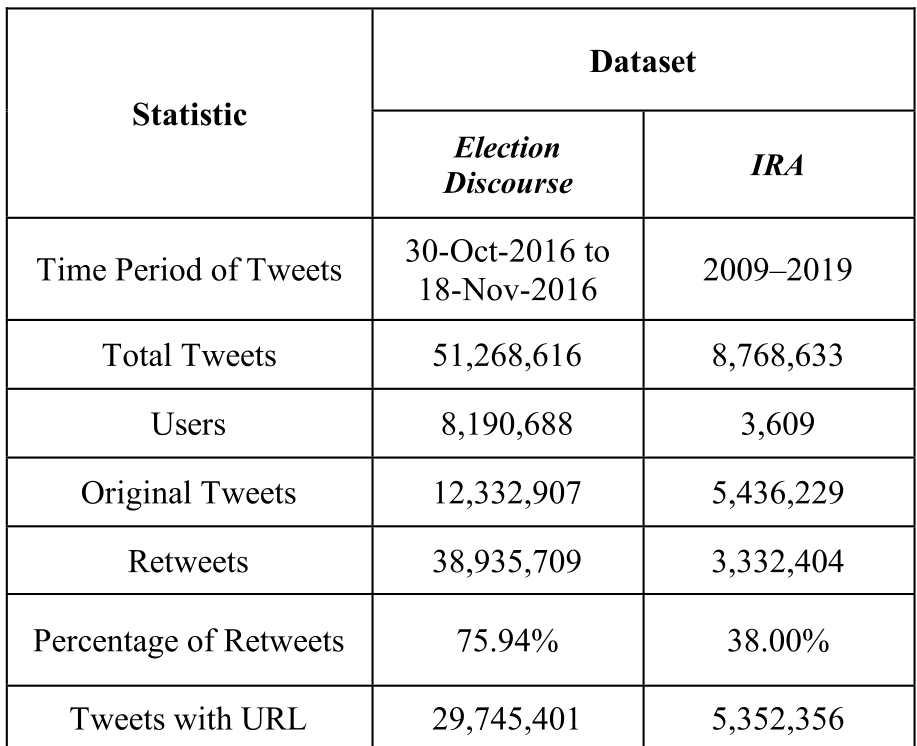
- Election Discourse Dataset: 51.3 million tweets (Oct 30 – Nov 18, 2016).
- IRA Dataset: 8.77 million tweets shared by Twitter in 2018, specifically linked to the Russian agency.
Core Findings: A Two-Pronged Attack
1. Intentional Pro-Trump Bias
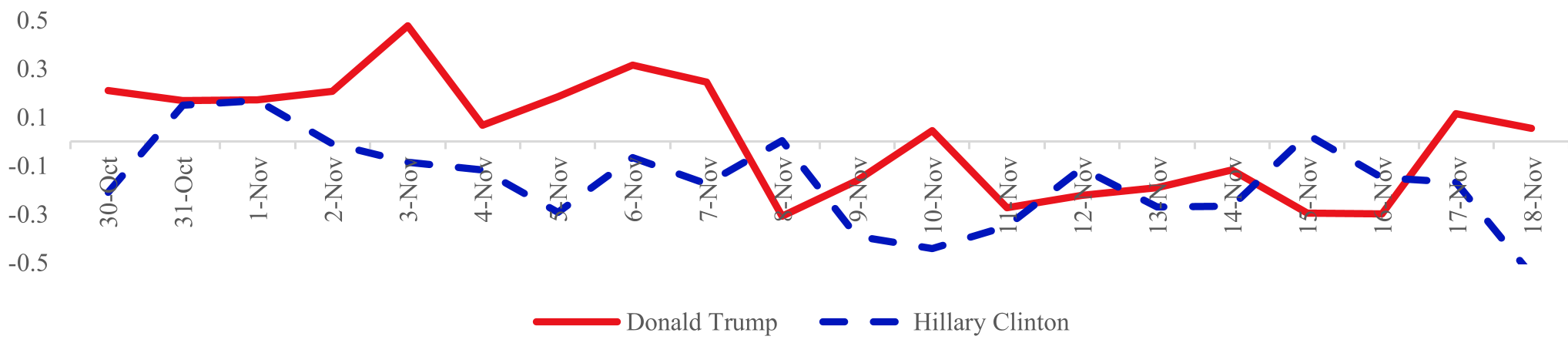
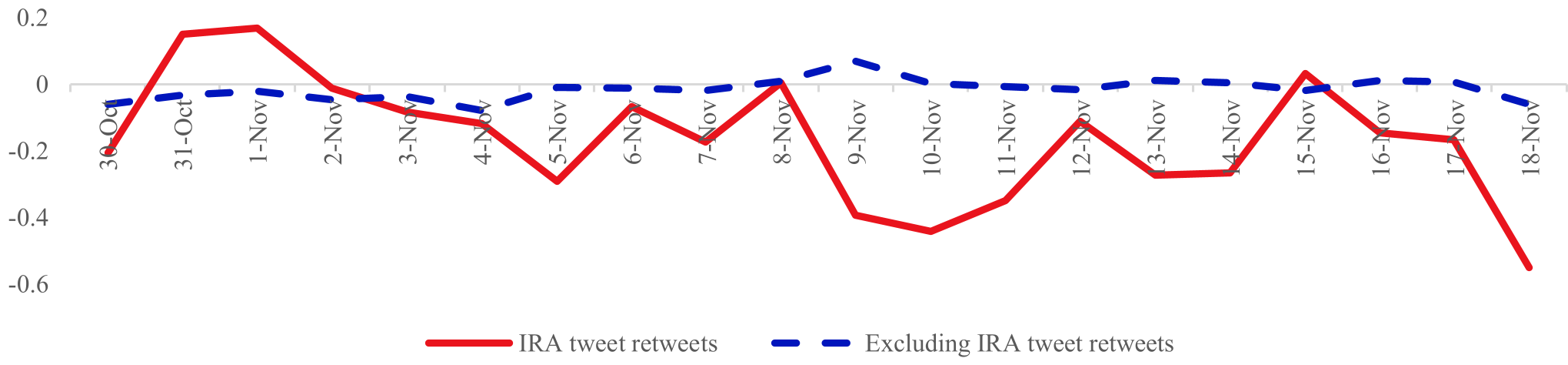
The analysis reveals a stark contrast in how IRA trolls treated the two candidates. The unique IRA tweets discovered in the election discourse were consistently favorable toward Donald Trump and unfavorable toward Hillary Clinton. This wasn't just limited to the original posts; the 110,766 retweets of IRA content followed the same bias, serving as an echo chamber that amplified positive Trump sentiment and negative Clinton sentiment.
2. Deepening the Divide
The most technical contribution of the paper is the comparison between IRA sentiment and non-IRA sentiment.
- For Trump: The sentiment from IRA accounts did not significantly differ from the organic, pro-Trump noise already present on Twitter.
- For Clinton: The IRA messages were statistically more negative (p < 0.01) than the general negative sentiment directed at her by ordinary users.
This suggests that the IRA's primary "value add" to the interference campaign was not just boosting Trump, but aggressively engineering a deeper level of vitriol against Hillary Clinton.
Critical Insight: The "Echo" Effect
The study highlights that human users are just as likely to retweet a bot or a troll as they are a real person if the message aligns with their existing biases. The fact that 1,308 IRA tweets generated over 100,000 retweets during a critical 20-day window demonstrates the high "return on investment" for state-sponsored sentiment manipulation.
Conclusion and Limitations
The researchers conclude that the Russian IRA successfully utilized Twitter to inject a biased narrative into the American political landscape. However, the study acknowledges a major caveat common in this field: while we can measure the sentiment and reach of these tweets, determining the actual impact on voter behavior remains a complex, unsolved variable.
Future Outlook: As we move toward more sophisticated AI-generated content (LLMs), the "troll" of tomorrow will likely be even harder to distinguish from organic users than the IRA accounts of 2016.