
Beyond Adjectives: Why Verbs are the Key to Deciphering Public Opinion on Social Issues
Sentiment Analysis of Social Issues
This paper introduces a verb-oriented approach for sentiment analysis specifically tailored for social issues, a domain distinct from product reviews. By identifying "opinion verbs" as core semantic drivers, the method achieves 65% accuracy on social issue datasets, outperforming traditional Bag of Words (BOW) models by 10%.
TL;DR
While product reviews (e.g., "The iPhone has a great screen") rely heavily on adjectives, social issues (e.g., "I believe women should choose") are driven by verbs. This paper argues that traditional sentiment analysis fails on social discourse because it ignores the predicate. By shifting the focus to high-strength "opinion verbs," the authors achieved a 10% performance boost over standard Bag-of-Words models.
Contextual Positioning
Most sentiment analysis research is "commercial-centric," focusing on product features. This work targets the "Social Domain," where the goal isn't to buy/sell but to support/oppose. It sits between basic sentiment classification and the more complex field of Stance Detection.
The Core Insight: Social Issues vs. Products
The authors' fundamental hypothesis is that the linguistic anatomy of a social issue debate differs significantly from a consumer review. Their statistical investigation yielded three critical findings:
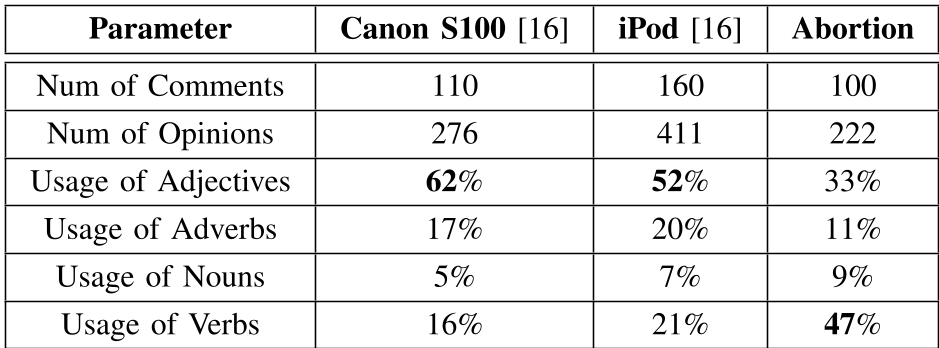
- Feature Absence: Unlike a camera with "resolution" or "size," a social issue like "Abortion" does not have a finite list of objective features.
- Implicitness: Social issues are mentioned implicitly 40% of the time, compared to ~20% for electronic products.
- The Verb Pivot: In social issue datasets, verbs account for 47% of emotional indicators, whereas in product reviews, adjectives dominate (up to 62%).
Methodology: The Verb-Oriented Framework
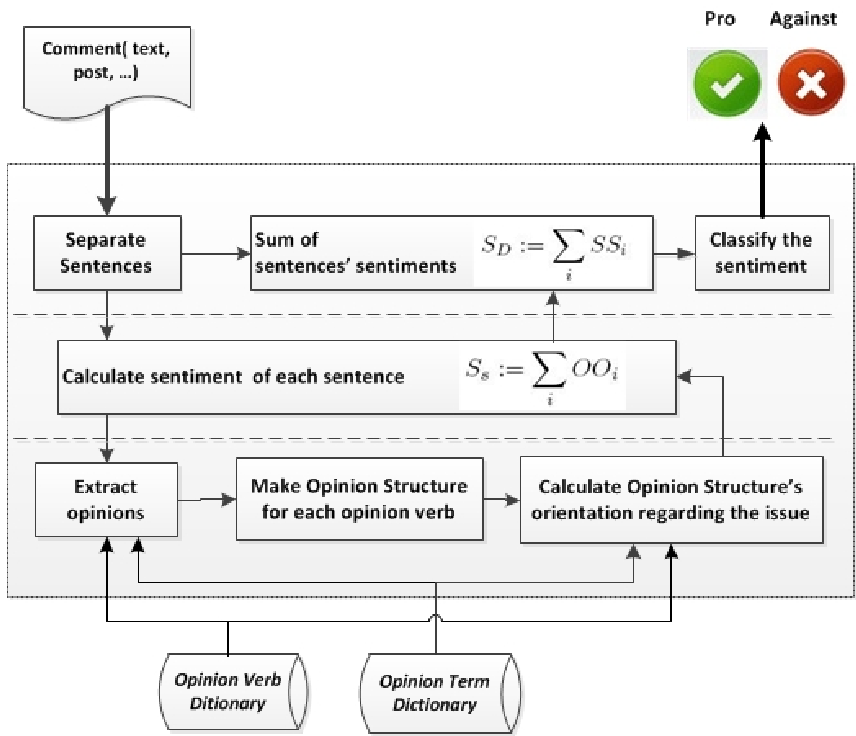
To capture the nuance of social debate, the researchers moved away from the "Bag of Words" (which loses syntax) to an Opinion Structure.
1. Opinion Dictionary
They developed a specialized lexicon of 440 verbs. Unlike standard lists, this dictionary tracks:
- Transitivity: Does the verb take an object? (e.g., "I hate X")
- Strength: A scale of 1 to 3 (e.g., "dislike" vs. "loathe").
- Function: Is it a "To-be" verb (transferring sentiment) or an "Action" verb (directing sentiment)?
2. The Architecture
The system processes text at three levels: Document, Sentence, and Opinion. It uses the Stanford POS Tagger to map the relationship between the subject, the verb (the core), and the object.
Experimental Results
The model was tested on a dataset of 1,000+ comments from CNN and ProCon.org.
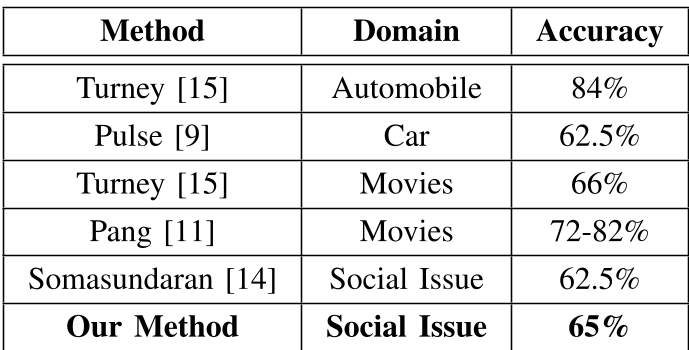
- Proposed Method Accuracy: 65%
- Standard BOW Accuracy: 55%
- Precision/Recall: 71% / 80%
The results suggest that even with a relatively small verb dictionary, focusing on the logic of the sentence (who is doing what to whom) is more effective than simply counting "good" or "bad" words.
Critical Analysis & Future Outlook
Takeaway: This paper successfully demonstrates that "domain" isn't just about vocabulary—it's about grammar. To understand social sentiment, you must understand the action.
Limitations:
- The accuracy of 65% leaves significant room for improvement, likely due to the limited size of the custom verb dictionary.
- Sarcasm and complex nesting (e.g., "I don't think he believes that...") still pose a challenge to POS-based heuristics.
Future Work: The authors plan to integrate synonyms through WordNet and explore more sophisticated disambiguation models. In an era of LLMs, this "deterministic" approach provides a fascinating look at the underlying linguistic rules that modern black-box models often internalize implicitly.